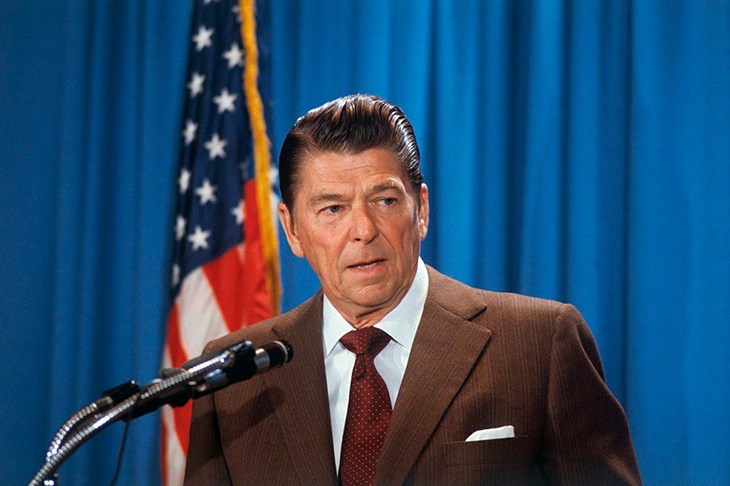
Almost fifty years ago, in his presidential debate with Jimmy Carter, Ronald Reagan said, ‘We don’t have inflation because the people are living too well. We have inflation because the government is living too well.’ Reagan could have been describing Australia today.
Late last month the Reserve Bank of Australia lifted the official cash rate to 4.6 per cent, the fourth increase this year and the sixteenth since the Albanese government was elected in 2022. Official rates are now at their highest level since 2011.
The RBA monetary policy board meets twice more before Christmas and many market economists expect another rise. Some expect two, which would take the cash rate above 5 per cent and standard home loan rates to around 7 per cent. Even one more increase would put official rates at an 18-year high, last seen in 2008.
Australia now has the second-highest official interest rate in the developed world, behind only Iceland and comfortably ahead of those paragons of fiscal ineptitude Britain, the United States and Europe. Quite an achievement given Prime Minister Anthony Albanese described Australia’s economy as ‘the envy of the world’ less than a year ago.
The day before the RBA decision, while trying to dampen expectations and deflect responsibility, Treasurer Jim Chalmers said he was ‘reluctant to blame the workers of this country for our inflation challenge’. On this he was correct. The blame lies almost entirely with the government and the RBA. Yes, oil is expensive, but the RBA governor herself said inflation was being driven by domestic pressures before the oil shock arrived.
Start with the government living too well. Commonwealth payments are running at about 27 per cent of GDP, well above the 25 per cent or so that Canberra consumed in the decades before the pandemic. This is happening with no pandemic, no recession, and commodity prices that earlier treasurers would have wept for. Add the states, territories and local councils, and government in Australia now spends close to forty cents of every dollar the nation earns.
Meanwhile, somebody has to pay for it.
The Parliamentary Budget Office expects Commonwealth receipts to keep climbing, from 25.5 per cent of GDP at the end of this decade to 27 per cent by the middle of the next. Bracket creep does much of the work quietly, lifting the income tax take every year without a vote in parliament. Inflation also conveniently swells GST receipts. And this year’s budget added broken promises on negative gearing and capital gains tax to the pile. The rest is borrowed.
Commonwealth gross debt is comfortably over $1 trillion. The Intergenerational Report projects 40 unbroken years of budget deficits, and the Parliamentary Budget Office projects that combined Commonwealth and state debt will reach $2 trillion by 2029-30.
And what has all this spending bought? Bureaucrats, and lots of them. The Australian Public Service has grown by around 23 per cent since 2022, close to 37,000 additional staff. That is an average of 28 new public servants every single day of the Albanese government. On top of this, 14 off-budget Commonwealth funny-money funds hold more than $400 billion, much of it devoted to industrial policy schemes dreamed up in Canberra.
But inflation is not only a story of too much money. It is also a story of too few goods and services, and this is where the supply side matters.
Every new regulator needs something to regulate. Every new compliance officer in Canberra creates work for many more in the private sector, people employed not to make anything but to fill in forms proving that somebody else made it in the approved manner.
Environmental approvals take years. Industrial relations laws hand building sites to the CFMEU and add a premium to every apartment, hospital, school and kilometre of road. Regulation and compliance choke supply and produce nothing.
When government pumps demand with one hand and strangles supply with the other, prices can only go one way. The Reserve Bank admitted as much when it pointed to weak productivity and pressure on domestic capacity.
The RBA’s only remedy is higher interest rates, and it is households that will bear the punishment. Australian households are among the most indebted people on earth, second only to the Swiss. Unlike Americans with their thirty-year fixed mortgages, Australian household debt is overwhelmingly tied to variable rates. More than four in five Australian mortgages move when the RBA moves.
Older readers who remember the 17 per cent mortgage rates of 1989 and 1990 may be tempted to tell the young to toughen up. Resist this temptation. Back then, household debt was a fraction of annual income. Today it is approaching double income.
Interest rates do not have to get anywhere near 17 per cent to decimate the Australian economy. A family with a $750,000 mortgage is already paying roughly $500 a month more than it did in January, and each further 0.25 per cent rise adds about $120. At the same time, the property market is suffering what might be its biggest downturn in forty years.
And while the Albanese government has much to answer for in delivering Australia’s current economic problems, the RBA also does not have clean hands. In 2021 it told borrowers that rates would stay near zero until 2024, then raised them thirteen times in eighteen months. It then devised its delusional narrow path, the notion that it could bring inflation down gently without costing anyone a job, and so kept rates lower than its peers and cut in 2025 before the job was done.
The RBA’s narrow path was never narrow. It was imaginary. Inflation was left smouldering, and now the bill has arrived with interest.
Friedrich Hayek warned that the road to serfdom is paved by planners convinced they know better than the millions of people actually doing the work. Australia’s road to serfdom has a Victorian flavour: CFMEU-priced, pothole-pitted, built at four times the budget and finished several years late.
Reagan understood that the cure for economic malaise begins when government stops living too well. Sadly, nobody in Canberra appears to have gotten the message.
Got something to add? Join the discussion and comment below.
You might disagree with half of it, but you’ll enjoy reading all of it. Try your first month for free, then just $2 a week for the remainder of your first year.