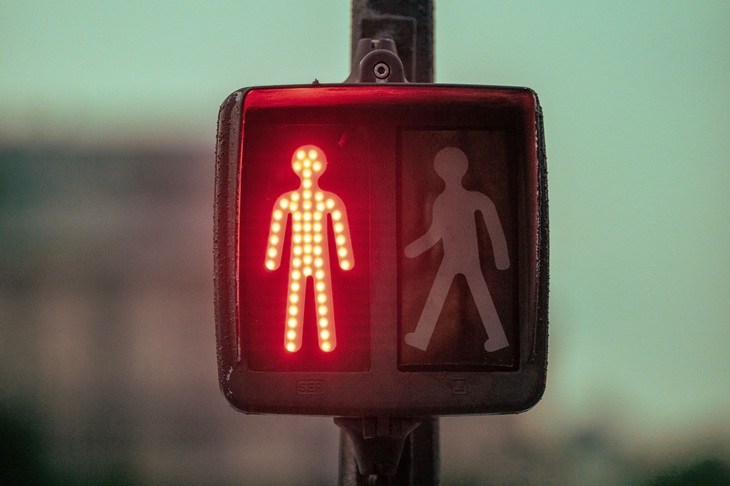
Every morning I walk through Brisbane’s red light district. Nowhere in Queensland is there such a proliferation of red lights as in the Brisbane CBD, directing both road and foot traffic through the chaos of peak hour. Amidst this chaos, at 7:30 each morning (Translink depending), I cross Elizabeth Street at the Albert Street intersection.
At peak hour, Elizabeth Street is quite busy, however, a red light at the George Street intersection can create a window of up to a minute during which no traffic flows down Elizabeth Street. Barring obscured vision from a parked bus, it is easy to see if the road is clear. On such happy occasions, I cross the street while the little man remains his ominous red. But in a crowd of thirty public servants, all anxious to reach their cubicles, very seldom will anyone join me.
Like timid sheep waiting for their neon shepherd to give a signal, they wait bleating, some staring in wistful admiration at the daring rogue who dared advance on the menacing red man, others watching in horror as a dangerous madman attacked the very foundations of the social contract. Perhaps a more apt comparison for our red-light-obsessed modern man is a dog rather than a sheep – Pavlov’s dog, to be precise. The unthinking stimulus-response to the sensory symbol of the red light makes us more akin to Pavlov’s thoroughly irrational dog than to the rational men we are meant to be.
I was once such a dog. In the folly of my youth, a decade ago, studying justice and law at uni, I was one of those unthinking, obeisant and sanctimonious slaves to the letter of the law, as my brother frequently reminds me. I was morally superior to my brother because I did not cross at the red light. To my mind, he was the anarchist who often got his morning coffee a minute before my law-abiding self. Today, however, I can humbly admit that my moral superiority now derives from unrelated sources entirely.
But with age comes wisdom (and a receding hairline), and I can agree with Socrates that the more one learns, the more one learns how much he does not know. Hence, the more we learn of the world, the more we must ask, ‘Why?’ Our generation seems incapable of asking this most fundamental question at the root of all rules, regulations and law. So, what is the point of the law of the Little Red Man? Apparently, according to our benevolent legislators, it is to ensure public safety – to disincentivise the rogue temptation to play chicken with traffic and prevent entirely unnecessary trips to emergency and intolerable back-and-forth with one’s insurer – all very reasonable goals.
Yet what happens when there is no danger to public safety; when the road is empty? Why must we conform, under threat of penalty from officious Queensland Police officers (who are frequently on scene for the local homeless resident’s morning psychotic episode), when there is no contravention of the law’s intended purpose? Perhaps the answer is that we have bred a generation so incurious, and so uninterested in the philosophical foundations of our society, that they no longer ask the most basic question underpinning all philosophy: ‘Why?’
Why does law exist? Why is this particular social convention followed? Why does society operate the way it does?
This is not to call for a revolutionary tearing down of societal norms and law. Far from it – we don’t want to recreate the streets of Delhi or Rome. There is great wisdom in Chesterton’s fence – before tearing down a fence, one ought to understand why it was put there in the first place. Yet implicit in Chesterton’s conservatism is exactly the question our unthinking man has forgotten to ask: ‘Why?’
The fool tears down the fence without knowing why it exists. Similarly, our modern pedestrian stands obediently before a Little Red Man without asking why he is doing so. Neither has bothered to understand either the fence or the Little Red Man.
The habit of asking, ‘why?’ doesn’t need to begin with lofty questions of politics or philosophy, as important as these certainly are. It might begin with something as mundane as standing on the street corner, staring at the Little Red Man while not a single car passes you by, and asking why you remain motionless. If we cannot bring ourselves to question this Little Red Man, there is little hope that we will ever question those considerably larger red men who presume to tell us what to do.
So, when confronted by the tyranny of the Little Red Man, test his authority and jaywalk, not with reckless abandon, but rather with a prudent abandon (after looking both ways, of course).