Last week, I attended the annual conference of the H.R. Nicholls Society. The society is ‘dedicated to advocating for sensible industrial relations reform to accelerate Australia’s productivity growth and enhance the prosperity of all Australians’.
Under the leadership of James Mathias, the forty-year-old society is going through a significant revival. The dinner before the conference was a sell-out.
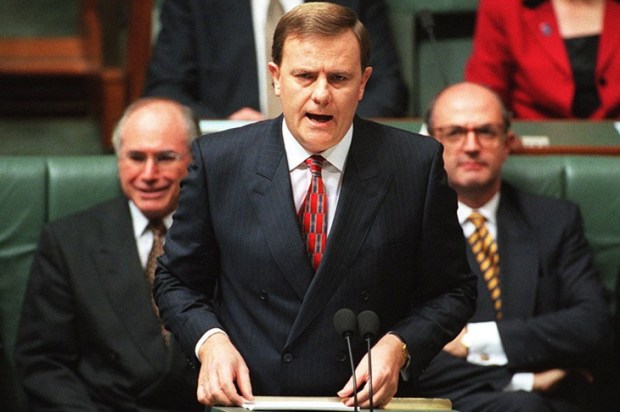
Most of the founders of the society are gone – Ray Evans and John Stone, for example – although some of the major players are still around. Peter Costello is going strong and attended the conference.
John Sharp, who was federal transport minister during the difficult days of the 1998 waterfront dispute, spoke at the dinner. A National party member from rural New South Wales, he had to endure some tough times to ensure that productivity on the waterfront could be lifted significantly.
He was helped by some other important political figures, including minister for industrial relations, Peter Reith, treasurer Peter Costello and the prime minister, John Howard. Without Howard’s support, it’s unlikely that this dispute would have been settled in the way it was.
Sharp told an extraordinary story about being in his car with some staffers in a small town in New South Wales. It just happened to be the town close to where John Coombs, national secretary of the Maritime Union of Australia (MUA), owned a vineyard. (Who ever said that being a union official couldn’t be lucrative?) When Coombs heard about Sharp’s presence, he instructed his men to upturn the vehicle. Luckily, the local constable was in the main street and saw what was going on. He bravely intervened and the henchmen quickly fled.
Both Sharp and Reith had round-the-clock protection for themselves and their families as the union officials played hardball to defend the pampered positions of stevedoring workers. It’s hard to imagine any current politician tackling an issue in such a determined way that it might involve threats to their personal safety.
A similar point can be made about some of the corporate heroes who controversially took the lead in reforming industrial relations and tackling the excessive power of the trade unions. Again, most of them are gone, but not all. Charles Copeman who headed up Peko-Wallsend in Australia led the bitter dispute at Robe River in the Pilbara. He clashed with the unions while introducing individual contracts that meant workers became even better paid.
There was Terry Palmer, who led the charge in the Weipa dispute that involved Comalco, the bauxite/alumina/aluminium operation owned by CRA which became Rio Tinto. His bravery and determination were rarely matched, even at that time. He was very ably supported by John Ralph who held various senior positions within the CRA network of companies.
Hugh Morgan and Arvi Parbo from Western Mining Corporation were also notable reforming corporate figures.
And of course there was Chris Corrigan, whose willingness to take on the might and thuggish behaviour of the MUA was quite exceptional and contrasted with the approach of the managers of his main stevedoring competitor, P&O Ports. Fearless, risk-taking and unwavering, Corrigan was not everyone’s cup of tea.
There were massive violent demonstrations at the docks. Corrigan and the federal government suffered several legal setbacks. But in the end, the dispute was settled in a way that productivity at the docks improved dramatically; for a time, the figures recorded at the main Australian ports matched those in overseas ports.
All this got me thinking about the absence of courageous corporate figures in today’s environment. Where are the Charles Copemans, Terry Palmers, Chris Corrigans? Have we moved to an era in which ingratiating yourself with the government of the day and the large superannuation funds is seen as a key guiding principle?
Are today’s corporate leaders more likely to be influenced by the nitwits in their government and investor relations departments than by a desire to pursue policy reforms in the national interest? Is this the type of corporate leader you get when the government is committed to running a system of crony capitalism in which government co-investment and favours are the main determinants of business investment? In other words, are our massively overpaid company executives just a bunch of unimpressive rent-seekers?
It is worth pointing out that the Australian economy has changed a great deal in forty years. We are now largely a service-based economy with small segments of high performing mining and agriculture. Manufacturing is a relatively insignificant sector.
The big professional service firms – think KPMG, Deloittes, PWC, EY and the like – are major players. Their leaders have very little interest in deregulation or efficient government services. High compliance costs equal bumper profits for these firms. Their leaders are unlikely to be advocates of public policy reform.
(It is widely rumoured that Labor’s idiotic idea of removing cash refunds for franking credits emanated from one of these big consulting/audit firms. Then shadow treasurer, Chris Bowen – yes, B1 has been around the fairground a great deal – fell for this highly dubious piece of advice, hook, line and sinker. It never made any sense because it failed to understand that company tax is a withholding tax. High-income earners with a pile of fully franked shares would not have been affected, only struggling self-funded retirees and others on low incomes. Good one, B1.)
We now have a group of pitiful executives joining up to the Business Council of Australia whose main role is to flatter the Albanese government and sometimes to make some helpful suggestions but very quietly. The BCA has been ensnared on multiple occasions – think here Tony Burke’s Jobs Summit and then Jimbo’s Economic Reform Summit, née Productivity Roundtable.
In the first instance, the employers were completely double-crossed, particularly in respect of the facilitation of multi-employer bargaining. In the case of Jimbo’s shindig, participants were required to sign non-disclosure agreements and promise not to mention industrial relations and energy. And they did sign them!
Instead, we have the chief executive of our largest bank regularly praising the actions of the Albanese government even when those actions – for example, the tax changes in the last budget – are at complete odds with the interest of the bank’s shareholders. He bends over backwards to be ‘helpful’, appearing as a sycophantic ‘yes’ man while many of us have a quiet chuckle.
We now have very many chief executives and company board members happy to take orders from the industry super funds which have become dominant shareholders of many large Australian companies. Given the connection of these funds to Labor, we know what sorts of advice and pressure are being meted out.
Corporate courage is clearly out. The main game is fawning and taking orders. And we wonder why the Australian economy is in such a hole?
Got something to add? Join the discussion and comment below.
You might disagree with half of it, but you’ll enjoy reading all of it. Try your first month for free, then just $2 a week for the remainder of your first year.