Recent earnings from some of the world’s largest tech companies reveal the eye-watering scale of their AI infrastructure spending.
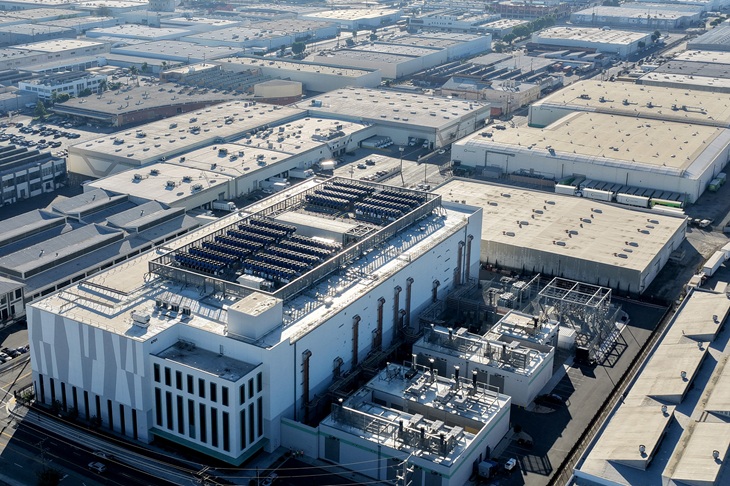
The four largest hyperscalers – Google, Microsoft, Meta, and Amazon – are set to spend $700 billion on AI capital expenditure this year alone.
By 2030, total global spending on data centres is expected to reach $5.2 trillion, dwarfing every major infrastructure build in human history.
But in the frantic competition of the AI arms race, we risk hollowing out the productive capacity of our economies and triggering a global recession.
In the first quarter of the year, three-quarters of US economic growth was attributable to AI spending. Housing investment, meanwhile, declined 8 per cent. Data centre construction spending has now surpassed that on new office buildings.
Data centres already represent seven per cent of total US power consumption, a figure both the IEA and Australia’s own energy market operator expect to double by 2030. They are already pushing up wholesale electricity prices, simultaneously stoking inflation and slowing the grid connections they depend on to operate.
The hyperscalers are deploying capital on the assumption AI monetisation will scale fast enough to justify each successive hardware generation before the previous one becomes an expensive paperweight.
The graphics processing units that power these facilities depreciate within three to four years, but the debt used to finance them does not. There is a circularity to the financing, with faint traces of Enron.
AI companies raise capital on the promise of future revenues, use it to buy infrastructure from suppliers whose valuations are inflated by AI demand, and book the activity as growth, while the debt quietly accumulates in structures that are not always transparent to the market.
Nearly half of US data centres planned for this year are already delayed or cancelled, with grid connection timelines stretching beyond five years, and the entire system rests on a supply chain concentrated near one of the most geopolitically contentious places on Earth.
The data centre sector in New South Wales is doubling every two years. Last year, it accounted for 12 per cent of the state’s non-residential building investment.
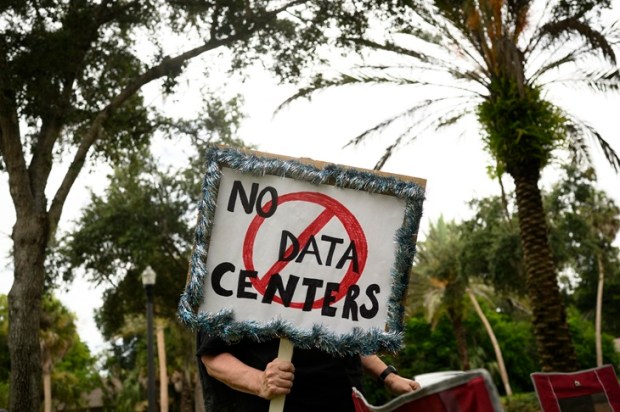
Australian councils are turning NAIMBY – No AI In My Backyard – petitioning state governments to pause approvals over fears of overwhelming water, energy and land capacity.
Australians, already competing with record immigration for housing supply, now find data centres in the same queue: vast facilities housing the AI that many fear will replace them at work, while also pricing them out of a home.
And unlike most developed economies quietly revisiting their nuclear energy positions, Australia has ruled out the one baseload power source that could underpin data centre growth at scale.
Then there is ‘Ghost GDP’ – the hollow economic growth driven by AI spending that does not flow through to the everyday economy.
No wonder consumer sentiment sits at pandemic-era lows. None of it is reaching the median worker. The gains are circling instead in the upper atmosphere of capital markets.
The revenues are real enough for now. The big four tech companies are growing theirs at over 20 per cent annually. But if AI monetisation falls short of what current valuations require, the unwind will not be orderly.
Large firms have flagged an abrupt repricing of AI stocks as a key downside risk to 2026 growth.
OpenAI has $600 billion in future spending commitments, is already missing revenue targets, and its CFO privately fears the company cannot honour its computing contracts.
One small retail company, recently rebranded as an AI business and soared 800 per cent on the announcement, reminiscent of the dot-com boom, when simply appending ‘.com’ to your name was enough to double a share price. We know how that ended.
AI is now not only a market bubble, but a core anchor propping up the entire US economy. The US government will have no choice but to backstop it once the inevitable AI bubble pops.
We have been here before, with railroads, with electricity, with the internet. The infrastructure survived. The bubble did not. The difference this time is that when this one pops, it will not just be shareholders who feel it.