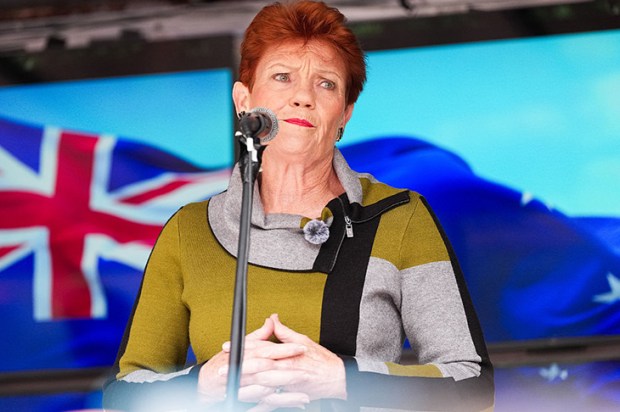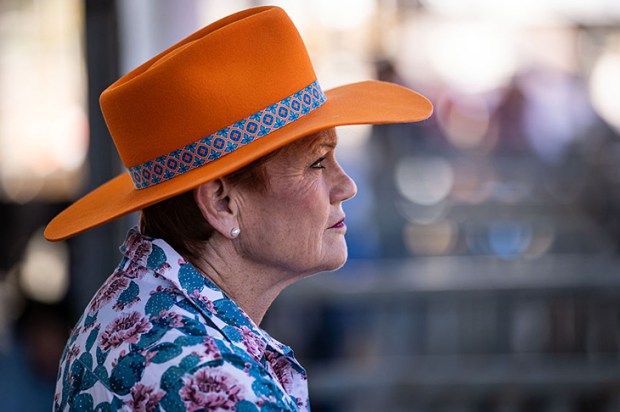
How exciting. Three weeks ago in these pages, I predicted that if Pauline Hanson sought special leave to appeal to the High Court in her case against Mehreen Faruqi, she would get it – and win.
She has now applied for special leave.
Hanson has already lost before a single Federal Court judge and then before all three judges of the Full Court. Ordinarily, four judges to nil would not be considered good odds.
The exchange between Hanson and Faruqi at the time of Queen Elizabeth’s death concerned the monarchy, colonialism, immigration, national identity and what, if anything, migrants owe their adopted country. It was political communication in its purest form. Hanson’s language was rude and coarse – but hardly un-Australian.
There are at least three routes to victory available to the High Court. The first is a narrow application of facts to the law route. It is boring. The second, concerns the constitutional foundation of section 18C of the Racial Discrimination Act. As constitutional expert Professor Anne Twomey has observed, a serious question arises as to whether a provision extending to conduct merely because it ‘offends’ or ‘insults’ is sufficiently supported by the relevant international convention on which the law relies. It’s still a bit yawny.
The third is the fun bit: the implied freedom of political communication. The Full Court accepted that section 18C imposes a significant legal burden upon political communication. Yet it found that section 18C effectively – and validly – required that politicians speak politely in ways that do not insult, offend or intimate about matters of race and immigration. But that does not really stand up to scrutiny or sit well with previous cases.
More than 20 years ago, in Coleman v. Power, the High Court considered the conviction of a Queensland protester who had publicly accused a police officer of corruption. Like Hanson, Patrick Coleman’s mode of expression was not genteel. Yet the High Court overturned his conviction for using insulting words.
Justice Kirby’s observations in the Coleman case might have been written for Hanson’s case now.
Reading another judge’s description of political interchange, Kirby said he had difficulty recognising the Australian political system as he knew it. It sounded more like an ‘intellectual salon’ in which civility usually prevailed.
‘One might wish for more rationality, less superficiality, diminished invective and increased logic and persuasion in political discourse,’ he continued. ‘But those of that view must find another homeland.’
From its earliest history, Kirby observed, Australian politics had included ‘insult and emotion, calumny and invective’ in its ‘armoury of persuasion’. These were part and parcel of the struggle of ideas. The Constitution protected representative government as it was actually practised, not merely ‘the whispered civilities of intellectual discourse’. (Whiffs of Sir Robert Menzies here, if you ask me!)
Kirby’s conclusion was a classic. It included the gem that freedom of political communication belonged ‘as much to the obsessive, the emotional and the inarticulate as it does to the logical, the cerebral and the restrained’.
It is difficult to reconcile that with the notion that Hanson’s contribution to a heated political exchange may be proscribed by parliament because it was insufficiently polite. The implied freedom must surely permit Australians – and especially Australian senators – to engage in robust political speech.
There is some irony in the fact that Pauline Hanson will be the person who takes 18C to the High Court. But it is not altogether an accident.
Constitutional conservatives have been hopeless at invoking and litigating the implied freedom and advocating for freedom of speech more generally. We have spent decades denouncing the implied freedom and put less energy into identifying and litigating laws that silence or trample our own values. If conservatives had embraced freedom of speech with half the enthusiasm of the unions, environmental campaigners and animal activists we might by now have a constitutional jurisprudence more visibly protective of our causes too.
Hanson is changing that. She is not asking the High Court to invent a US-style constitutional right to say whatever one likes, wherever one likes. She is asking it to enforce the existing constitutional limitation upon governmental power in the most obviously political circumstances imaginable about a subject at the heart of the political debate reshaping politics at this very moment across the Anglosphere.
While there are solid doctrinal and constitutional reasons supporting a Hanson win, there is another reason: the High Court is in a bind. Constitutional law is political. Not necessarily in the crude partisan sense. But it determines who may exercise public power, against whom and subject to what limitations. While High Court judges do not decide cases by consulting opinion polls, they do not live in completely soundproof chambers. They sniff the political winds.
Hanson has promised that, if One Nation takes office, she would conduct a referendum to place an express freedom of speech in the Australian Constitution. Presumably that promise will be pursued only if she loses the case.
The irony is exquisite. For more than 30 years, constitutional conservatives have denounced the implied freedom as an American-style constitutional right smuggled through the back door by activist judges. Hanson now proposes an express freedom of speech through the front door because the supposed American import has proved too limp and emasculated to protect her rude but unremarkable and quintessentially Australian political speech.
An express provision in the Constitution would move Australia appreciably closer to an American-style bill of rights. It would likely create an express personal right extending far beyond the modest structural limitation developed by the High Court since 1992. It’s an understatement to say that the consequences for the Constitution and our society would be unpredictable.
Finally, the moment has arrived for the High Court to deal with section 18C. A High Court decision leaving Hanson without constitutional protection in this case would hand One Nation a powerful populist cause to place an express freedom of speech on the referendum agenda. The High Court will understand that it is time for the implied freedom of political communication to either sink or swim.
Four judges to nil below notwithstanding, Hanson’s odds get better.
Got something to add? Join the discussion and comment below.
You might disagree with half of it, but you’ll enjoy reading all of it. Try your first month for free, then just $2 a week for the remainder of your first year.