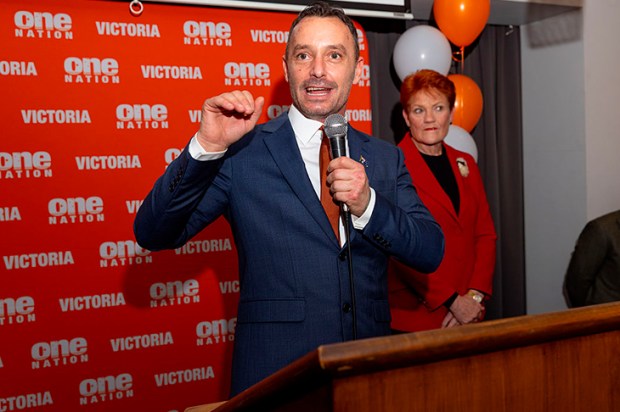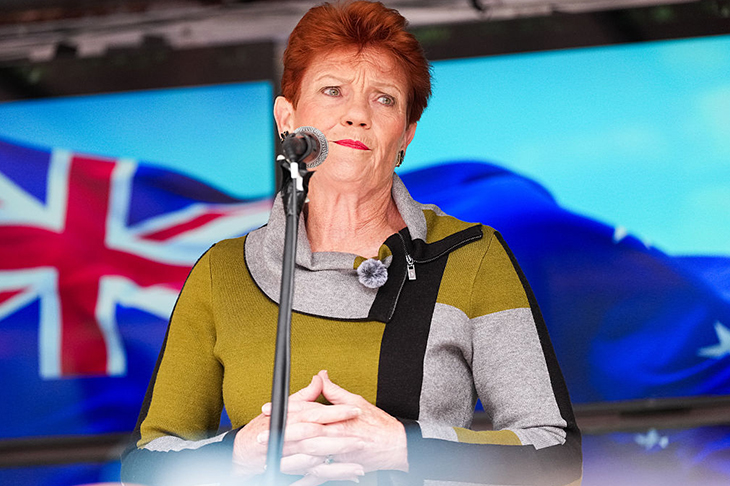
One of the small pleasures of Australian politics over recent years has been Pauline Hanson’s Please Explain videos. Usually they involve a politician, bureaucrat, activist or journalist being invited to explain themselves after wandering into territory where common sense has disappeared. They are always funny and sometimes they are devastating. I confess I have enjoyed plenty of them. I even had a giggle at the one describing my husband Angus as ‘the most boring man on the planet’. There are many worse accusations in politics.
Regular readers will know that I have spent column inches arguing that the Somewhere versus Anywheres are a thing, and many of the grievances now driving support for One Nation are real. The rise of One Nation should be no surprise. Pauline and Barnaby identified genuine problems long before much of the political class was prepared to acknowledge them, and they get big credit for that. But when an outsider movement ceases to be merely a protest and claims to be a serious contender for government, people will ask questions about whether the solutions make sense.
Which brings me to a couple of my own.
The first concerns One Nation’s most often quoted proposal to ‘abolish the Department of Climate Change’. The policy sounds terrifically punchy. Insurgent. It promises savings of $30 billion. It taps into voter frustration with a climate and energy debate that has careered seriously off its moorings into a world of mad targets, vested interests, bureaucratic empire-building and costly policy failure. The difficulty is that there is no Department of Climate Change. There is, admittedly, a Department of Climate Change, Energy, the Environment and Water. Which raises what seems to me a perfectly reasonable question. Is this a gimmick? Or will One Nation abolish the entire department?
Because if the proposal is really about abandoning climate programs and bureaucracy – which is reasonably set out in the policies – then just say so. But if the proposal is literally to abolish the department, and therefore abolish any government oversight of electricity, water administration and any and all environmental approvals in one fell swoop, some further clarification might be helpful.
The point is that someone will need to exercise ministerial oversight of a department of some kind in order to keep the lights on.
No doubt it is boring to ask these questions. But there is a big difference between abolishing a department and changing its name. Given the state of play here and globally, is it likely that by the time of the next election there will be barely a cigarette paper between the Coalition and One Nation on policy prescriptions – and Labor itself will be crab-walking so furiously away from the climate overreach it has forced upon us, the question of whether ‘Climate Change’ still belongs in the department’s title will barely be a question at all.
My next ‘Please explain’ is more serious.
In recent weeks Pauline has repeatedly said she would force the divestment – within two years – of all foreign-owned agricultural land. The policy published on One Nation’s website is more restrained, speaking instead of preventing future sales of freehold farmland to foreign investors. Yet Pauline’s repeated public statements reveal a far more radical plan.
If Pauline is seriously proposing the forced divestment of existing foreign-owned farmland it is not merely a bad policy. It is a spectacularly bad one. I confess an interest. My immediate and extended family on both sides are farmers. Many of my friends are farmers. I am struggling to understand why a politician whose support is sky high in regional Australia would advocate a policy where the burden of such a policy would fall heavily on regional Australia.
The moment we start talking about forcing the divestment of billions of dollars worth of productive agricultural land within two years, we are no longer talking simply about foreign ownership. We are talking about the functioning of the Australian rural land market itself. Foreign-owned farms sit alongside Australian-owned farms. FIRB has cracked down on Chinese ownership and much of the remainder is largely held by British, American and Canadian interests. Representing around 14 per cent of Australia’s agricultural land, these properties are valued against Australian owned properties, financed by the same banks and operate within the same regional economies.
If a government forces 53 million hectares of agricultural land quickly onto the market, the effects will not be confined to the properties being sold. A forced fire sale of this kind will affect land valuations not only across regions but, in time, across the broader sector. Reduced land values weaken borrowing capacity and reduce wealth. Reduced borrowing capacity reduces investment. Reduced investment eventually affects the contractors, machinery dealers, transport operators, stock and station agents and ultimately the life blood of the country towns that depend upon prosperous farms, no matter who owns them.
This policy would not hurt foreign investors nearly as much as it would hurt Australian farmers and farming communities. One Nation’s success has been built on persuading regional Australians that it understands their concerns better than the political class in Canberra. Yet this proposal displays either ignorance or plain ratbaggery about the entirely foreseeable consequences for the prosperity, investment and wealth creation in the very communities One Nation claims to best understand and represent.
Nor does the problem stop there. Australia’s prosperity depends in no small part on being regarded as a safe and predictable place to invest. Investors have generally assumed that if they purchase assets lawfully and comply with Australian law, a future government will not simply decide they must dispose of those assets on a whim.
It is difficult to overstate the damage such a policy would do to Australia’s reputation as an investable nation.
One thing we do know. The lawyers would be delighted by the prospect of years of litigation about property rights, compensation and constitutional limits on Commonwealth power. Farmers, farming communities and ultimately Australian taxpayers, perhaps less so.
Now look, I know these are terribly boring questions. The sort that might occur to someone married to the most boring man on the planet. But when one policy proposes abolishing a department that does not exist, and another proposes a radical forced divestment of billions of dollars of productive agricultural land, there will be questions. There will be many more.
So, Pauline, over to you.
Please explain.
Got something to add? Join the discussion and comment below.
You might disagree with half of it, but you’ll enjoy reading all of it. Try your first month for free, then just $2 a week for the remainder of your first year.