It’s all happening in Britain. If you didn’t follow Nigel Farage’s extraordinary week last week, you probably should. Debate still rages over whether he has pulled off another performative anti-establishment masterstroke or committed his first serious strategic blunder. There isn’t space here for the full rundown, except to say that he has called a by-election in his own seat in an attempt to clear the air over questions surrounding political donations.
The broader point, however, is much more interesting. Sir Charles Moore, writing in the Telegraph, began by conceding the obvious. Outsiders do get picked on. The establishment protects itself. In 2023, Farage himself had to expose the extraordinary debanking treatment he received from Coutts. None of that should be forgotten.
Nevertheless, as Moore concluded, there comes a point when permanent performance ceases to be persuasive. The closer a political movement comes to government, the less convincing it becomes to treat every awkward question as proof that shadowy forces are conspiring against you. Scrutiny is no longer evidence of persecution. It is evidence that voters are beginning to wonder how you might actually govern.
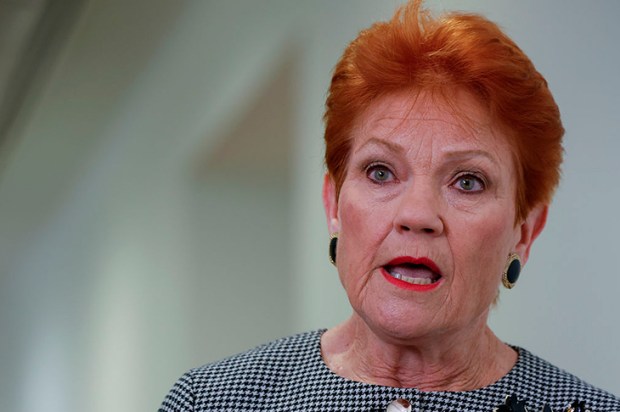
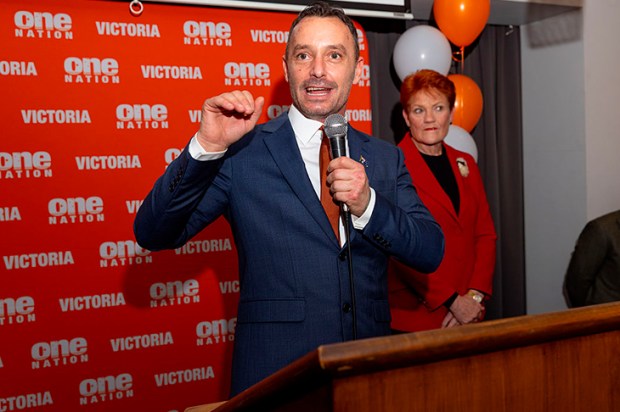
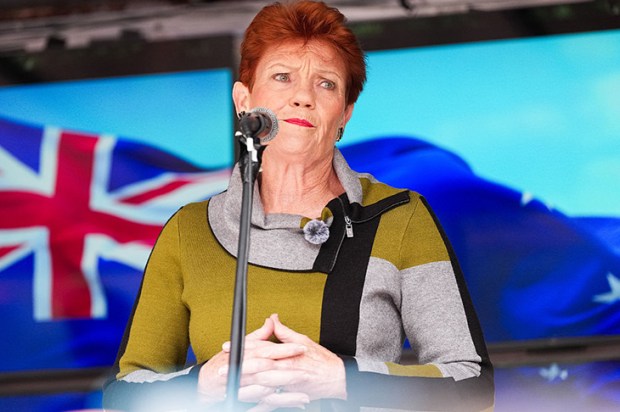
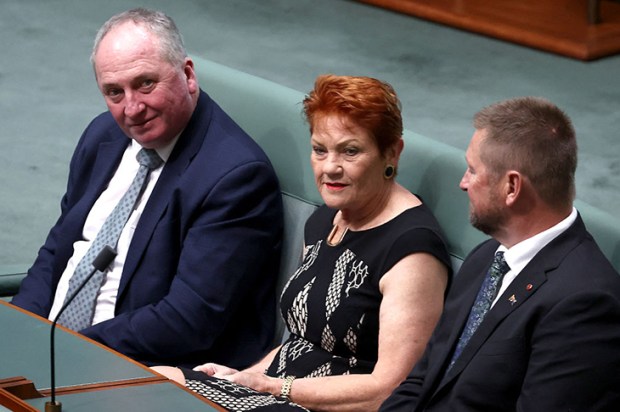
Our own performative Pauline has spent a couple of weeks immersing herself in the international populist conversation. Back home, the headlines have been dominated by her appearances alongside Tommy Robinson. There is nothing remotely wrong with speaking to controversial figures. We must all resist the lazy habit of assuming guilt by association. Politicians, journalists and broadcasters interview contentious people all the time. Our very own Karl Stefanovic has broadcast a show with Tommy Robinson.
Then again, Karl isn’t asking Australians to make him prime minister. At least, not yet.
The more interesting comparison for us is between Hanson and Farage himself – the bloke Hanson said she was going to the United Kingdom to visit.
For some time, Farage has appeared to understand that anyone serious about becoming prime minister in a Westminster democracy eventually has to stop looking like an insurgent and start looking like a prime minister. Reform has built a genuine political democratic party with an administrative structure separate from its parliamentary wing. Farage did not allow Tommy Robinson inside the Reform tent. More recently, he has recruited heavyweight Conservative defectors. He has broadened Reform’s parliamentary team and steadily tried to reassure voters that Reform was becoming a government-in-waiting rather than simply a vehicle for protest. The predictable problem with this approach is that his more radical supporters on the right started to fracture.
The more recent plunge by Farage back into another people-versus-the-establishment drama occurred just as voters were beginning to ask more mundane questions about funding, judgement, temperament, stability and governing.
Hanson, by contrast, appears determined to travel in the opposite direction. Whether by instinct or design, right now she seems far more comfortable remaining the perpetual outsider. Liberal defectors no longer seem especially welcome. The international populist circuit appears a much jollier home than the slow, painstaking business of building a parliamentary team and a grassroots political party capable of governing.
That may yet prove electorally brilliant. But maybe not.
Australian politics is not British politics. It certainly is not American politics.
In the United States, voters are asked to place extraordinary trust in a single elected president. Executive power is vested directly in the office of the president; the Constitution expressly says so. Westminster systems ask a different question.
We have always elected governments. Prime ministers remain, constitutionally and by convention, first among equals. Voters instinctively want to know who the treasurer will be, who will manage defence, who will negotiate internationally, and, above all, whether there is a serious team capable of governing.
That is the transition that Farage and Reform are at least attempting to make.
Back home, in recent weeks, the Coalition’s responses to Hanson have spanned the full spectrum. Tony Abbott, out of genuine respect, initially offered unqualified supportive character references for Hanson. We can all respect Pauline’s persistence over nearly three decades without agreeing with every position she adopts. Andrew Hastie has been less accommodating, declaring ‘there [would] be war with One Nation’. Given One Nation declared outright war on him first, that seems a fair response too.
Then the always patient Angus did something much less exciting – and very Angus.
He reached for the calculator. While thoroughly dismantling Labor’s economic management, he observed that One Nation’s policies simply did not add up. Or better put, they added up to an exorbitant amount. Interest rates, he warned, could rise by three percentage points. Debt would soar. Australia could ultimately find itself confronting a sovereign debt crisis.
The economic response is Angus’s instinct but also his profound duty. True conservatives have always understood that a lot in politics eventually comes back to economics. Conviction matters. And culture in this day and age certainly matters. But there is not much point winning the culture wars if the country is heading towards Venezuela.
Hanson’s response was revealing. Rather than answering the economic critique, she scolded Angus. She did not produce costings and did not even say she ever would. She treated scrutiny itself as the problem.
The predictable online pile-on duly followed. One Nation’s energetic digital armies again descended upon Facebook pages, intimidating politicians, journalists and editors. But outside the social media universe something else was happening. For those not checked out, or in echo chambers howling at the moon, some in middle Australia were watching and listening.
Then came the most revealing moment of all. Barnaby Joyce himself conceded that One Nation still had work to do on its economic credentials. Having acknowledged they hadn’t done the maths, he wandered into the rather extraordinary suggestion that responsibility for keeping governments economically disciplined might somehow be handed to the Reserve Bank. The details scarcely matter. The bizarre response did. The One Nation treasury spokesperson says One Nation might hand political decisions and advice about spending to the deepest part of the establishment. Sorry kids, if you need to ask the Reserve Bank how to manage the economy once you’re elected, you’re not ready to manage the economy.
A little scrutiny from a friend had gone a very long way.
Barnaby Joyce has political skills that count for a lot. He is instinctively candid, sometimes to his own detriment. And after two decades in government, he understands what makes many Australian tick.
His best contribution last week came not from a brain explosion about handing over responsibility for economic management to unelected bureaucrats, but from Tenterfield, where he posted:
‘Australian politics is not American politics, and it is not British politics, and it is certainly not totalitarian politics.’
Quite so, Barnaby. Quite so.
Louise Clegg is a former lawyer, now writer. She is married to the opposition leader.
Got something to add? Join the discussion and comment below.
You might disagree with half of it, but you’ll enjoy reading all of it. Try your first month for free, then just $2 a week for the remainder of your first year.