After the summer Pauline Hanson returned from Britain with Nigel in her handbag, even though he declined to meet her. The Reform slogans came through customs intact: the ‘uniparty’, the betrayed voter, the insurgency coming to smash a failed political establishment. But successfully transplanting Reform into Australia will not be as simple as copying and pasting the nomenclature.
The comparison is imperfect and Farage has it easier. He is an elected member of the House of Commons and in a position to become prime minister if Reform can command a majority. Hanson remains in the Senate, trolling Coalition seats but not yet willing to commit to the risk.
Hanson also faces a problem Farage does not. Australia is a federation. One Nation cannot become a serious alternative federal government without viable state-based organisations, credible candidates and parliamentary presence in the states. Knowing this, Hanson is rushing to fill every available seat in Victoria and New South Wales with her hand-picked candidates. This has produced Warren from Pakenham and Mike (not) from Cessnock – two putative premiers who have never faced a preselection, won an election, sat in parliament or led a party room. This is pretty wild stuff.
Britain at least gives the term ‘uniparty’ some factual foundation. The Conservatives governed for fourteen years and presided over all of what Reform now attacks: monstrous mass immigration, the small boats debacle, shocking rising expenditure and net zero capitulation that ran off the rails.
That is not true here. Australian Liberals have disappointed their true believers in recent years – God knows, I have been one – but disappointment does not amount to complicity in our country’s severely worsening predicament. Labor’s eye-watering non-pandemic spending, crazy immigration settings and 82-per-cent renewables target are just some Labor policies which the Liberals have always strongly opposed. In government the Liberals were smashed to pieces by Labor for refusing to spend more, for their aspiration for a gas-led recovery and net zero ‘pragmatism’ – or recalcitrance – depending on where you stand. The Liberals have always been both pragmatic and capable of being world-beating tough on immigration. Remember John Howard and Tony Abbott? The ‘uniparty’ just does not quite land here.
Reform is a more serious outfit than One Nation. It has many more elected representatives, actual local organisation and a more democratic internal structure. Farage has gathered substantive people with genuine parliamentary and deep policy experience, and is making a determined attempt to look like a prime minister. One Nation is thinner. Its leading performers are brilliant communicators, but behind the big hats and social-media juggernaut lies no emerging governing party. It has shifting positions, promises and announcements, but no evidence so far of the sustained policy work, internal discipline or institutional heft required to govern.
There is nevertheless a big similarity between the two insurgencies. Both benefit from the brand of a fearless leader saying aloud for decades what many voters think. Hanson attempts an even more Trumpian role than Farage. But Farage seems to think that voters in a Westminster system ultimately look for a credible prime minister with a serious team.
In a presidential system, a separately elected president can operate as a pressure valve for popular discontent. Responsible government generally requires the government to sit inside parliament. The idea that Hanson’s popularity and immunities can be transferred by national surrogacy to little-known prospective leaders such as Pickering or Newman is optimistic.
The British media is now awash with questions about Farage’s funding. The Clacton by-election did not end the parliamentary investigation into a £5-million gift he received before entering parliament. Now James Orr, Reform’s impressive head of policy, and Dan Jukes, one of Farage’s closest advisers, have stood down after being secretly recorded apparently discussing ways of obtaining the benefit of foreign money. It turns out their enemies were laying traps. But as Brendan O’Neill, one of Reform’s most voluble defenders, conceded on the weekend, entrapment takes two.
Reform is not finished, but its period of effortless ascendancy looks to be. Kemi Badenoch and the Conservatives are finally visible again, with strong, unapologetically conservative policies and one poll placing them narrowly ahead of Reform for the first time. Correctly, Kemi has never tried to emulate Farage, and sticks to her knitting.
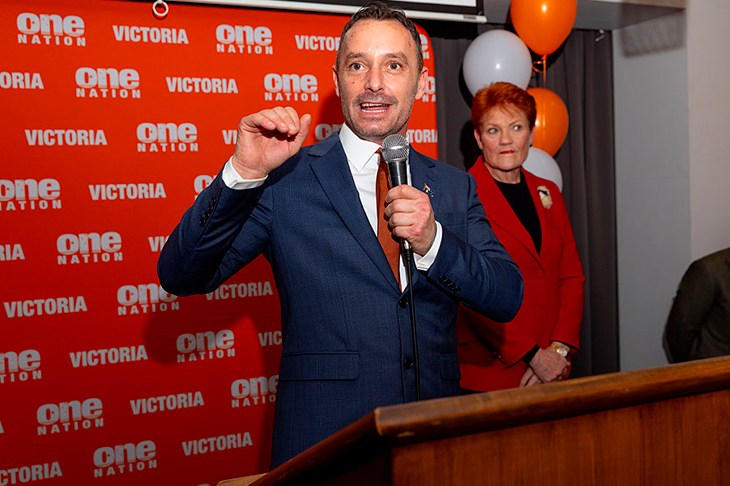
Only a month ago, Hanson personally unveiled Pickering as One Nation’s Victorian leader and prospective premier. Now the party’s lawyers have been wheeled in on account of serious historical allegations made by his former partner, which he denies. But anyone putting himself forward for high public office must contemplate what former partners, employers and associates might say when scrutiny inevitably arrives. Either Hanson’s vetting was hopeless or her judgment was worse. That’s why leaders from the majors emerge only after necessary scrutiny from colleagues, journalists and, most importantly, voters.
Pickering is the man Hanson personally presented as an alternative premier. Removing him seriously calls into question her judgment. Keeping him means his problems become a huge question hanging over One Nation in an election where law and order will be big.
So far, Australia’s conservative media ecosystem has given One Nation the gentlest ride afforded any serious contender for political power in recent memory. Its polls are trumpeted, its announcements amplified and, when Hanson stumbles over policy or language, friendly commentators explain that we all know what she means.
The problem here is not that One Nation will occasionally select a dud. All parties do. The difference will be frequency. It will make these mistakes more often and, because the entire show is a personality cult backed by a constitution which astonishingly gives Hanson full veto and presidential power, every mistake will, and frankly should, be sheeted directly back to her.
We will continue to hear that the journalist was biased, the candidate entrapped, the former partner vengeful, the defector disloyal and the policy misrepresented. Or Barnaby’s favourite: a little redemption never hurt. Perhaps not. But One Nation will need a lot of it.
Last week I posed that, in the long term, One Nation’s governance structure, just by itself, made it a house of cards. How the timing plays out is anyone guess. But almost on cue, the putative premier from Pakenham has placed its Victorian campaign in fatal jeopardy. The house that Pauline built is already beginning to buckle.
Got something to add? Join the discussion and comment below.
You might disagree with half of it, but you’ll enjoy reading all of it. Try your first month for free, then just $2 a week for the remainder of your first year.