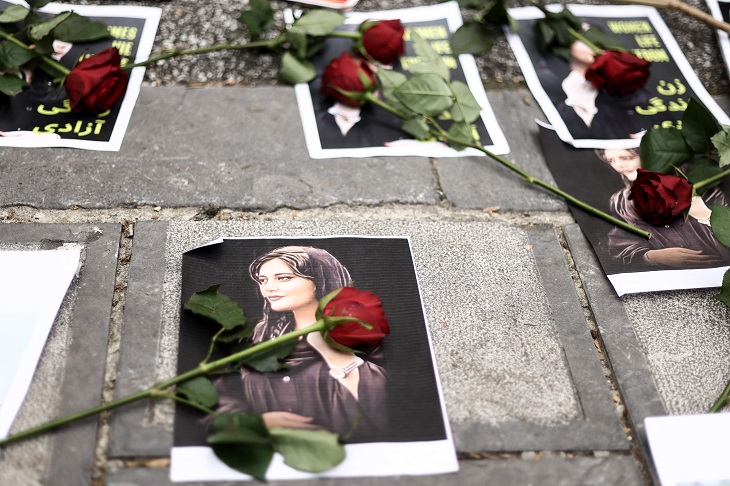
As 16 September approaches, the anniversary of Mahsa Amini’s death in the custody of the Islamic regime occupying Iran, it is worth looking again at what began in Iran in 2022 and what happened to it afterwards.
The Woman, Life, Freedom movement was not born in the diaspora or shaped by the political factions that would later seek to claim it. It emerged from inside Iran after the death of a 22-year-old Iranian woman detained by the morality police. In the days that followed, Mahsa became known to many simply as the daughter of Iran, her death coming to symbolise something far larger than the fate of one young woman. The slogan spread from her hometown, the western Iranian city of Saqqez, across the country because it captured something larger than compulsory hijab. It was a rejection of a political system that had spent more than four decades controlling the lives of Iranians. Women removed their hijabs in public. Men stood beside them. Students challenged authorities. Protesters chanted ‘Death to the dictator’. The target was clear. The target was the Islamic Republic itself. For a brief period, that clarity cut through the divisions that had weakened the Iranian opposition for decades. Monarchists, republicans, leftists, and people with no settled political affiliation could stand behind the same immediate objective; the Islamic Republic had to go.
That unity did not last. Once the movement gained international attention and widespread public sympathy, a struggle began over who was entitled to define it. Parts of the diaspora opposition increasingly presented Woman, Life, Freedom as if it carried a complete ideological agenda; republican, left-wing, suspicious of Iranian nationalism, and incompatible with support for Crown Prince Reza Pahlavi. None of that was inherent in the original movement. It was added later. This was hardly new in Iranian politics. Across modern Iranian history, political factions have repeatedly tried to appropriate popular movements, slogans and symbols, then recast them in service of their own ideology. The left, separatist movements, reformists and supporters of the Islamic Republic have all, at different times, engaged in this kind of political appropriation. Woman, Life, Freedom had become the dominant language of the uprising, and those seeking to redirect it, soon began imposing their own political agendas on the movement.
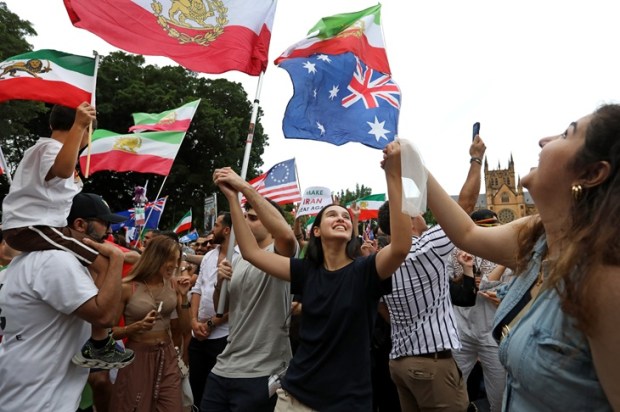
The dispute around the slogan ‘Man, Homeland, Prosperity’ was a clear example. As concerns grew that separatist and factional currents were using Woman, Life, Freedom to detach the uprising from a broader Iranian national identity, people inside Iran began adding ‘Man, Homeland, Prosperity’ alongside it. The addition was not a rejection of Woman, Life, Freedom. It was an insistence that the struggle for women’s freedom and individual liberty belonged within a struggle for Iran itself. Yet sections of the opposition portrayed it as an attack on the original slogan rather than a complementary expression of national reconstruction. From there, the argument widened. The Lion and Sun became suspect. Iranian nationalism was treated by some as inherently exclusionary. Concern for territorial integrity was recast as hostility towards minorities. Pahlavi supporters were increasingly portrayed not simply as political rivals, but as people who stood outside the movement altogether.
That was a serious distortion. Support for Crown Prince Reza Pahlavi was never at odds with the movement’s demands for freedom. On the contrary, his longstanding advocacy of secular democracy, equal rights, and an end to the Islamic Republic placed him firmly at the forefront of that struggle. Yet the reaction to the ‘I Give My Mandate’ campaign showed how far things had shifted. Through this campaign, large numbers of Iranians publicly expressed support for Crown Prince Reza Pahlavi playing a role in a transition from the Islamic regime. Opponents were fully entitled to reject him. But instead of limiting the argument to ‘I do not support Pahlavi’, they went further and suggested that supporting him was incompatible with Woman, Life, Freedom itself. The movement had begun as a revolt against the Islamic Republic. It was now increasingly being used to police the opposition and to cast some of the regime’s most determined opponents as threats.
That shift was captured in the slogan ‘Death to the oppressor, whether Shah or Leader’, a chant heavily promoted and used by the Mojahedin-e Khalq (MEK), a terrorist organisation with a long history of armed violence. People have a right to oppose monarchy. But politically, the comparison was revealing. Iran has not had a Shah since 1979. What it does have is a Supreme Leader whose regime shoots protesters at point-blank range in the streets, fires pellets into their faces and eyes, deliberately blinds and maims them, tortures detainees, rapes and sexually abuses prisoners, carries out executions, and imprisons those who dare challenge its rule. Yet enormous energy was directed towards falsely portraying the idea of a future monarchy as a threat, while the actual dictatorship responsible for Iran’s repression remained in power.
The role of the Islamic regime in exploiting these divisions should not be ignored. The regime has a long record of influence operations and manipulation of political debate. It does not need to persuade opposition supporters to love the Islamic Republic. It only needs them to distrust one another. From Tehran’s perspective, an opposition divided between monarchists and republicans, nationalists and ethnic movements, left and right, is far safer than one focused on regime change. If every discussion about removing the Islamic Republic turns into another argument about Pahlavi, the regime benefits. If the Lion and Sun causes more outrage than the flag of the Islamic Republic, the regime benefits. If reformists who spent years defending change from within the system can reinvent themselves while those calling for regime change are treated as extremists, the regime benefits.
That is how Woman, Life, Freedom was taken from the movement that created it. Its purpose was gradually distorted. What began as a national revolt against the Islamic regime became a political instrument used to separate the regime’s acceptable opponents from those it saw as a genuine threat.
Four years later, however, something had changed. Iranians had seen what could happen when the political meaning of a protest was left broad enough for others to redefine. Language intended to unite could be reinterpreted, repackaged and eventually used to advance agendas that had little to do with what the protesters themselves wanted. By the protests of late 2025 and early 2026, many appeared determined to leave far less room for that kind of ambiguity. Rather than speaking through broad slogans that others could later interpret on their behalf, protesters increasingly stated their political demands directly. They named the political figure they supported.
When mass protests swept through Iran in late 2025 to early 2026, the demand for the Islamic Republic to go was no longer difficult to discern. Millions poured into the streets chanting openly against the regime. In city after city, pro-Pahlavi slogans such as ‘Javid Shah’ and ‘Pahlavi will return’ were heard, along with chants explicitly invoking Crown Prince Reza Pahlavi by name.
‘Javid Shah’ left little room for reinterpretation. ‘Pahlavi will return’ was equally clear. After years in which others had tried to tell Iranians what their slogans supposedly meant, protesters were now stating their demands plainly. That did not mean every Iranian had become a monarchist, nor did it settle the question of Iran’s future constitutional system. That question should still be decided by Iranians in a free vote. But it did make one thing much harder to sustain; the claim that Pahlavi supporters were somehow foreign to the movement for Iran’s liberation.
The people chanting ‘Javid Shah’ were not standing against Woman, Life, Freedom. They were standing against the same regime that murdered Mahsa Amini. They were demanding the same fundamental thing; an end to the Islamic Republic and the right of Iranians to reclaim their country and decide what comes next.
The question in September 2022 was whether the Islamic Republic should stay or go. Four years later, millions of Iranians reaffirmed their answer in unmistakable terms. This time, they were no longer content to leave others to interpret what their slogans meant. They named the alternative around which they were rallying.
After four years of attempts to recast, dilute and redirect a movement born against the Islamic regime, the people in the streets stripped away the ambiguity. They risked their lives to say openly that the Islamic regime had to go, and to name the man they wanted to lead the way beyond it, Crown Prince Reza Pahlavi.
Pejman Amirnejad is a Sydney-based Australian-Iranian community advocate.