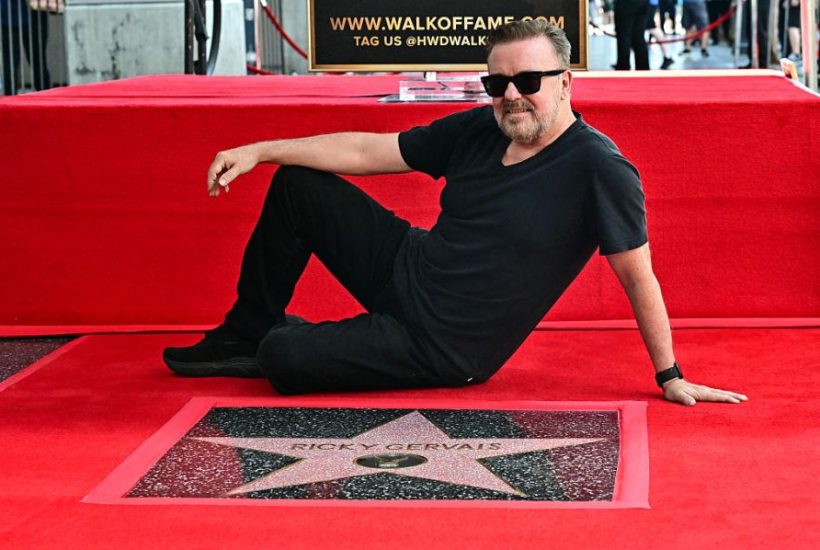
A defiant Ricky Gervais has insisted that he’s ‘never been so happy’ after his Netflix series, Alley Cats, reached the number one spot on the streaming platform over the weekend, despite a critical mauling.
And what a mauling it’s been. The Independent gave it one star, describing it as ‘abrasive, smug, and completely mirthless’. The Telegraph called it ‘staggeringly unfunny’, awarded it zero stars and dismissed it as ‘the worst thing to happen to cats since Cats‘. Metro’s critic was ‘shocked that a man I used to think was a comedy genius’ could ‘produce such lazy claptrap’. Even the Times, which gave it three stars, detected a ‘distinct whiff of tomcat pee’.
In the face of this bombardment, Gervais has remained defiant on social media. ‘Millions of you’ watched the show, he tweeted, ‘and that has annoyed a few people.’ He said he was ‘still over the moon about the viewing figures’ and insisted he was ‘the most sincere and thankful I’ve ever been’ for having ‘the best fans in the f**king world’. He’s encouraged viewers to tweet him about the show, adding that ‘a photo of your pet gives you more chance of a reply’. Many have obliged, assuring Gervais that it’s only the ‘woke’ and the ‘offended’ who dislike Alley Cats.
Perhaps it isn’t Gervais who has changed, but the world around him
These contrasting fortunes put me in mind of one of Gervais’s own sitcoms. In the brilliant Extras, he played Andy Millman, an aspiring actor who sells his sitcom to the BBC only to watch his original idea being steadily reduced to a hellish, lowest-common-denominator catchphrase comedy. Think Mrs Brown’s Boys, but without the depth.
The fictional sitcom draws a respectable six million viewers, but what Millman craves is validation from the critics for a comedy that will earn the respect of his peers and ‘stand the test of time’. In the end, he has to settle for the fan base he has, and he accelerates the catchphrases for their moronic pleasure.
In one episode, Millman is approached in a pub by a group of dim-witted fans who demand that he repeat his catchphrase. They refuse to leave him alone, but he escapes and retreats to a private members’ club, where he’s ushered into the VIP area. ‘Finally, some respect,’ he says. But the great and the good soon turn against him, with David Bowie leading them in an impromptu singalong about the ‘little fat man who sold his soul’. Millman returns to the pub, where he happily embraces the attention of the morons.
Back in the real world, Gervais has encouraged the idea that people who dislike Alley Cats are simply ‘offended’. He ploughed similar territory last year with a series of London Underground adverts, mocking everything from crime in the capital to ‘woke’ etiquette surrounding race, alcohol and suicide. Naturally, they went viral, and Gervais was embraced by the increasingly lucrative constituency of people who believe that ‘you can’t say anything these days’. Transport for London denied his claim that it had rejected any of his adverts.
Gervais’s stand-up shows have taken aim at trans issues, Aids, religion and racism. Alongside this, he’s developed the tiresome habit of reverse-intellectualising his jokes: explaining that, actually, the gag wasn’t offensive at all; you simply failed to understand it.
When I interviewed him in 2006, I wouldn’t have predicted that he would turn out this way. He was lovely company, cripplingly self-aware and unexpectedly beautiful. The only indication of what was to come was the occasional furrowed brow and wagging finger, as he delivered sub-sixth-form philosophy with the solemnity of a man who fancied himself the Plato of the 21st century.
Perhaps it isn’t Gervais who has changed, but the world around him. There is now a thriving economy of attention available to anyone who can successfully court the demographic convinced that ‘you can’t say anything these days’ and that ‘woke’ people are forever ‘cancelling’ people.
One advantage of playing to that crowd is that you no longer have to produce something as smart, funny and touching as The Office or Extras. You simply have to put something out into the world and tell your audience that the ‘woke’ can’t handle it.
Ask any fan of Gervais’s two greatest shows why they love them and they can explain in exhaustive detail. But the hardcore Gervais fans defending Alley Cats on social media seem strangely unable to say what, precisely, they like about it. I wonder if Gervais is really as happy as he’s telling us.