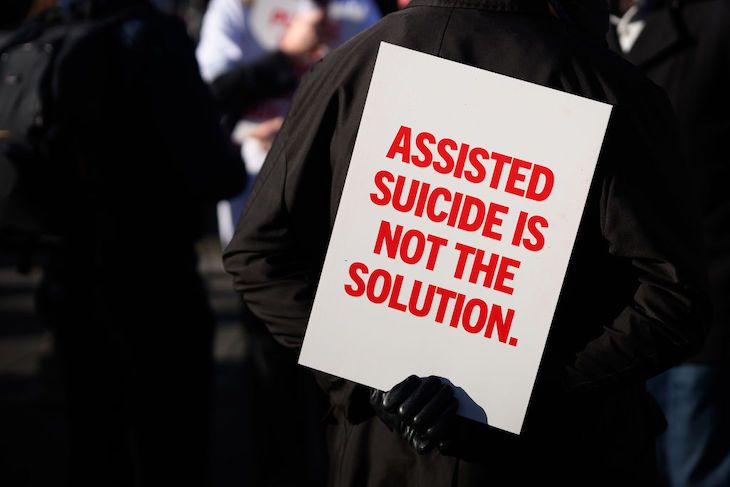
Andy Burnham has pledged to “eradicate” internal division and restore Labour’s sense of “common purpose”. The first major test of the Prime Minister’s “common purpose” is already waiting for him. Lauren Edwards’ assisted suicide bill, set for Second Reading vote on 11 September, will be a litmus test as to whether Labour MPs still adhere to their party’s traditional core value: protecting the vulnerable.
Burnham will most likely hope to see the divisive legislation voted down once and for all on 11 September
Edwards has published her bill, virtually a clause-by-clause replica of Kim Leadbeater’s attempt, which failed during the previous parliamentary session. The previous bill exposed deep divisions. After passing the Commons by only 23 votes, it entered the House of Lords, where peers subjected it to detailed scrutiny. The legislation attracted serious criticism from large swathes of civil society. These criticisms remain with Edwards’ Bill.
Several medical bodies, including the Royal College of Psychiatrists, questioned whether the legislation can adequately protect terminally ill patients experiencing depression or fears of being a burden. Disability campaigners, including actress Liz Carr, have warned about the wider cultural impact of creating a legal pathway to assisted suicide, particularly for people who already fear being viewed as dependent. Domestic abuse charities highlighted the difficulty of detecting subtle coercion behind closed doors. Palliative care specialists have consistently highlighted that Britain’s end-of-life care system is underfunded and overstretched, a view that the Prime Minister openly supports.
Ultimately, due to the time constraints of parliamentary terms, the Lords ran out of time to amend it into a form they considered safe or workable.
Yet the new bill is all but identical to the previous one. Countless significant flaws with the drafting remain, and egregious problems have been left unaddressed. That’s no accident; keeping the legislation largely unchanged preserves the possibility of using the Parliament Acts to force it onto the statute book if it once again fails to pass the Lords.
Few issues have exposed Labour’s internal fractures more sharply. The bill has become a lightning rod for divisions not only between MPs, but between different parts of the country. In Scotland, where Labour MSPs faced a similar proposal brought forward by Liam McArthur, the party overwhelmingly rejected assisted suicide: 85 per cent of Scottish Labour representatives voted against the legislation.
In Westminster, however, Labour MPs remain deeply divided. Some are pushing for the Bill’s passage. Many others have raised concerns about a serious lack of safeguards in the Leadbeater Bill; holes which have not been adequately closed in Lauren Edwards’ near-identical draft. Many are presumably caught between pressure from well-funded, loud campaign groups and concern among their own constituents. National MRP polling of more than 10,000 people across Britain found that nearly two-thirds believe Parliament should prioritise fixing the care crisis before debating such a bill.
Asked about assisted suicide over the summer, Burnham said the debate should not take place until palliative care and social care are properly funded, adding that “that’s the position I will stick to”. That claim is well substantiated. Hospice UK have repeatedly raised concerns over the last few months that a funding crisis is leading hospices across the country to cut frontline services. One in three Brits now die without the palliative support they need. How can we justify creating a system that offers only shoddy end-of-life care or a lethal injection?
The Government’s new ECHR (European Convention on Human Rights) memorandum, impact assessment, and equality impact assessment on the bill underscore these concerns in stark fashion. They warn that structural pressures involving poverty, poorer healthcare access, lower-quality care and domestic abuse could result in disproportionate numbers of people from ethnic-minority backgrounds choosing an assisted death to avoid financial hardship or escape abuse. In addition, the key year ten estimate for annual assisted suicide deaths has increased by 60 per cent and, grimly, could result in nearly ten assisted suicide deaths every day.
For Labour to opt for something that entrenches inequality to the point of increased death would be quite remarkable. To do so at the scale projected by the Government’s own figures is unthinkable. Surely the most basic “common purpose” the party shares is to prioritise care for the most marginalised groups?
A “yes” vote on Friday would swing the government’s legacy substantially away from this core value. Burnham’s decision to abstain from the vote is cold comfort for supporters of the Bill – clearly, this Bill is not supportable according to the Prime Minister. And his public concern over the bill means his position will be weakened if MPs openly back for the bill. Many backbenchers will be looking on, reading between the lines and reconsidering previous support for it.
A party leader cannot promise unity while MPs rebel against an instinctive left-leaning, equality-driven “common purpose” for the next year. The assisted suicide Bill carries too much weight to be ignored; it goes to the heart of questions about the role of the state, the value placed on disabled and elderly people, and the protections owed to those at their most vulnerable.
For Labour, already under pressure to reconnect with working-class voters on bread-and-butter issues, another year spent fighting internally over a matter that divides its own MPs could prove politically costly. Burnham will most likely hope to see the divisive legislation voted down once and for all on 11 September. Any other result could jeopardise his unifying legacy before he’s even begun. MPs on the fence would do well to follow his lead.