Last spring, a Chinese icebreaker turned up in the tropical waters of Palau. That was after Chinese research vessels arrived uninvited in the waters off Taiwan, Vietnam and the Philippines. Here in Europe, Russian research vessels and navy ships turn up uninvited too. The ships reveal nothing about the nature of their visits, but create fears of impending cable sabotage. These days, Russia and China are also building lots more submarines, and they’re impressive. Western countries, too, are building submarines, and all the while they’re trying to defend their cables and pipelines.
Just this week, the UK’s 12-metre Excalibur drone submarine used a testing range off the coast of Scotland to fire a torpedo. Defence minister Luke Pollard said: ‘This is all about making sure that the United Kingdom can be safer in these more uncertain times’, emphasising the importance of securing the North Atlantic, ‘especially against those nations that wish to do us harm, like Russia’.
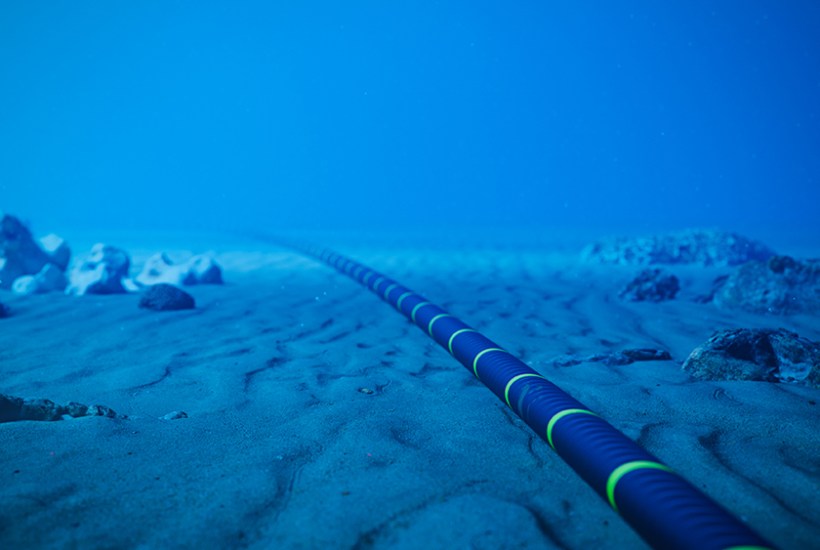
Undersea cables present a tantalising target for countries wishing to cripple adversaries and get away with it
Disorder, standoffs and skirmishes are spreading underneath the ocean – and this is where the next major conflict could erupt. It was at the end of May when the Ji Di, a state-owned Chinese research vessel built for Arctic conditions, appeared inside the exclusive economic zone (EEZ) of Palau, a small archipelagic nation in the Pacific. It spent 14 hours in the Palauan waters, departing under circumstances as mysterious as those of its arrival. ‘Its fleet of unmanned drones and underwater vehicles can map the sea floor and collect data on everything from undersea minerals, ocean currents and marine ecosystems,’ reported ABC, the Australian national broadcaster.
It was not the first time Palau had received unwanted visits by Chinese research ships. ‘Similar incidents were reported in 2018, 2024 and 2025, while in 2023 a Chinese vessel allegedly operated near Palau’s fibre-optic cable,’ ABC noted. What was the ships’ mission? They didn’t tell, nor did Beijing.
Palau’s president, Surangel Whipps Jr, was not pleased. ‘Their research vessels come into our EEZ uninvited and do whatever they want,’ he complained. But what could he do? Palau is a small and remote nation. Worry as he might that the ships could harm his nation’s two subsea cables, Whipps was not in a position to chase them away.
In Europe, too, unwelcome vessels keep turning up, and here their missions are just as nebulous. Unlike Palau, our countries have a great number of subsea cables that such unwanted visitors might want to document – or worse.
Consider the Yantar, a Russian research ship equipped with all manner of gadgets, including submarines. Every now and then over the past few years, it has suddenly appeared off the coast of one country or another. Each time, its mysterious undertakings have troubled the authorities, especially because the vessel has a habit of turning up near undersea cables. But each time, the national authorities let the Yantar finish its visit and depart. Yes, officials have their suspicions, but we’re countries of the rule of law: we can’t simply ban ships from our waters because we don’t like them.
Last November, though, the Yantar turned up in Britain’s economic zone in a manner so provocative that the then Defence Secretary John Healey had to set his foot down. The research vessel was loitering in waters north of Scotland, just outside UK territorial waters, and the RAF dispatched two planes to keep watch – whereupon the ship’s crew shone lasers at the pilots’ eyes.
‘That Russian action is deeply dangerous,’ thundered Healey. ‘And this is the second time this year that this ship has deployed to UK waters. So, my message to Russia and to Putin, is this: We see you. We know what you are doing. And if the Yantar travels south this week, we are ready.’
The mysterious Yantar – habitually labelled the ‘Russian spy ship’ – is indisputably a menace, but the real action is often elsewhere. For Russia, the Yantar may even be a diversionary tactic, deployed to steer western naval ships and public attention away from activities the Kremlin is keen to hide.
In fact, a whole new disorderly world is emerging underneath the oceans’ waves. The research vessels that Surangel Whipps Jr, John Healey and virtually every other leading politician in peace-loving countries worry about may well be a diversionary tactic, but they can also conduct activities both benign and ominous. They can document the fauna on the seabed. They can survey the undersea domain for the benefit of submarines. They can investigate, or even harm, undersea cables.
That matters, because the seabed depends on peace. Or to be precise, it depends on everyone following rules. That’s because the vast majority of the water in the world’s oceans, and the seabed beneath them, belong to no one. But today, many of the world’s mightiest countries are not all that committed to rules any longer, and the domain most exposed to the growing lawlessness is the world beneath the waves.
That’s why northern European governments were alarmed when, in 2021, the cables in the waters around them started getting damaged under suspicious circumstances. I dive into the incidents – so to speak – in my book The Undersea War. I spoke with those involved in investigating the mysterious damage to the indispensable lifelines on the seabed, and followed them as they tried to discern what is occurring and how to stop it. Imagine being coastguard officials having to decide whether a remarkable number of uber-sloppy seafarers have entered your country’s waters and incompetently dragged their anchors across your country’s cables – or whether the damage you’re seeing is sabotage. If the latter, who’s behind it? Is it part of a bigger game?
Meanwhile, China is gearing up for more submarine warfare against the West. Beijing is, in fact, expanding its silent service at a furious pace. In the past five years alone, Chinese shipyards have delivered a staggering 24 submarines, and more are in the works. Western countries, including Britain, are building more submarines too, though not at China’s speed, and so is Russia, whose boats today are far better than they used to be.
In fact, Russia considers submarines its naval trump card. A battle over Taiwan could begin in the Taiwan Strait, or rather in submarines underneath its surface.
And the growing standoff beneath the world’s oceans doesn’t end there, because now all manner of undersea robots and other technological devices are joining the submarines, cables, pipelines and animals in these dark domains. Some are defensive, some are offensive, many are both – and they’re there to help their side defeat the other. Below them all are, of course, the world’s pipelines and especially its cables. The humble strings simply have to keep functioning, but they present a tantalising target for those wishing to cripple adversaries and get away with it.
In today’s intensifying undersea cold war, a skirmish in any guise can erupt. We may – indeed we almost certainly will – see more mysterious cases of mauled cables. We may see submarines face off. We may see undersea robots attack the other side. And did I mention the suddenly real prospect of a battle over vast quantities of minerals on the seabed? The undersea war is approaching.
Got something to add? Join the discussion and comment below.
You might disagree with half of it, but you’ll enjoy reading all of it. Try your first month for free, then just $2 a week for the remainder of your first year.