When Nigel Farage announced on July 7 that he was resigning as MP for Clacton and would immediately contest the resulting by-election, he framed the move as a people versus establishment referendum on his character.
Within hours, the establishment replied by not turning up.
Labour, the Conservatives, the Liberal Democrats, the Greens, and Rupert Lowe’s Restore Britain all declined to stand.
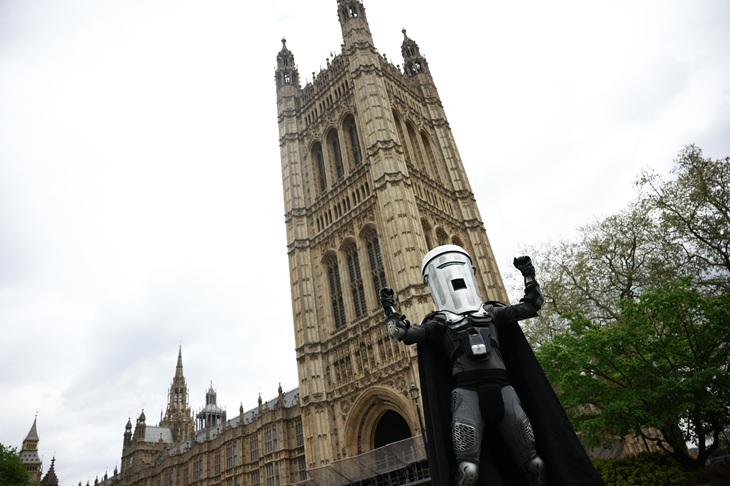
Into the vacuum stepped Count Binface, an intergalactic space warrior in a dustbin helmet, whose manifesto pledges include capping the price of a 99 Flake at 99p and building at least one affordable house.
On my way, Clacton. pic.twitter.com/R4pgCJu0T0
— Count Binface (@CountBinface) July 7, 2026
Bookmakers now price Binface at 5/1 to win the seat. That is not a joke; it is the same odds offered on England winning the World Cup.
On Polymarket, traders assign a 6 per cent probability to the outcome. Those are fat tail numbers, the kind of low frequency, high consequence event that standard political models routinely underestimate and that keeps risk managers awake.
So, what would actually happen if the bin won?
Start with the structural fragility of Reform UK. The party leads national polls at roughly 26 per cent, ahead of Labour on 21 and the Conservatives on 20. Yet it remains, in concentration terms, essentially a sole proprietorship.
Apply the Herfindahl index to its leadership brand and the reading sits close to the theoretical maximum of 10,000: one name, one face, one centre of gravity. A defeat at Clacton, in a contest Farage himself engineered, would not simply cost the party a seat. It would trigger an immediate repricing of the polling premium that has been built almost entirely on one man’s name recognition.
Reform without Farage in Parliament is a product without a patent.
The historical parallel everyone is reaching for is Tatton in 1997, when Martin Bell, a former BBC war correspondent standing in a white suit, unseated the scandal-plagued Conservative Neil Hamilton in one of the safest Tory seats in the country. The mechanics were identical: Labour and the Liberal Democrats withdrew their candidates, concentrating the anti-corruption vote on a single challenger. Bell won by over 11,000 votes in a constituency with a notional Conservative majority exceeding 22,000.
The difference, of course, is that Bell was a serious and credible figure. Count Binface is a comedian in fancy dress.
But the enabling conditions, a crowded field clearing to leave one protest candidate standing against a politician under scrutiny, are uncannily similar.
The game theory of the major parties’ boycott deserves closer attention.
On the surface it looks like cowardice, and David Lammy wasted no time contrasting the city trader and the crypto billionaire’s friend with a man in a bin. But the boycott is better understood as an option play. By not contesting now, the parties preserve their right to fight a far more consequential by-election later. If the parliamentary standards commissioner finds against Farage he could be suspended from the Commons, triggering a recall petition. If 10 per cent of registered voters sign it, Clacton goes to a real by-election, one every major party has already signalled it will contest. The parties are paying a small option premium now, the reputational cost of appearing to duck a fight, in exchange for the much more valuable option of fighting on their preferred terrain later. That is textbook asymmetric payoff analysis.
For Australian observers there is a pointed lesson.
Reform UK’s structural exposure mirrors that of One Nation: a party whose electoral capital is denominated almost entirely in one individual’s charisma. When Pauline Hanson was jailed in 2003, however briefly and however wrongly, One Nation’s already declining vote went into freefall. The party eventually rebuilt, but for nearly two decades its path back ran through the Senate’s proportional representation system, which rewards brand loyalty among a dispersed minority.
Reform has no such insurance.
Under first past the post, a populist movement that cannot survive the embarrassment of its founder is not a party in any meaningful institutional sense. It is a franchise with a single outlet.
Rachel Reeves’s quip, that if Farage wants to spend the summer arguing with a bin she will not stop him, identified the deeper trap. Whatever the result, Farage now shares a ballot paper and a debate stage with a man in a dustbin. Every news bulletin, every front page, every clip will pair them side by side. In politics, proximity is taxonomy. Stand next to a satirical candidate often enough and the satire starts to rub off. The framing writes itself, and no amount of righteous indignation about the deep state will overwrite it.
The probability remains that Farage wins comfortably. He took the seat in 2024 with 46 per cent of the vote and a majority exceeding 8,000. Even with the major parties absent, much of that base is loyal and ideologically committed. But by-elections are volatile instruments, and this one has been deliberately stripped of its conventional architecture. There is no opposition ground game, no tactical voting infrastructure, no party machine to coordinate a challenge. What there is, instead, is an open field in which a motivated protest vote need only coalesce around a single name. That name happens to belong to a self-described Recyclon from the planet Sigma IX.
The tail risk is real. And if it materialises, no amount of political forecasting will explain the moment when British democracy delivered its verdict by electing a bin.
Bin it to win it!