There are few experiences stranger than climbing into the back of a minibus and being blindfolded. Emblazoned across the front of each of our eye covers was a slogan: ‘Trust the Darkness.’ It was an appropriate motto.
For Shaun Pinner, the echoes were uncomfortable. He has driven blindfolded through Ukraine before. The last time as a prisoner of war when he was captured during the siege of Mariupol in 2022. He was driven into occupied Donetsk, uncertain whether he would ever see daylight again, and sentenced to death by a Russian-backed kangaroo court. Shaun spent months in captivity before being released in a prisoner exchange.
He was driven into occupied Donetsk, uncertain whether he would ever see daylight again, and sentenced to death by a Russian-backed kangaroo court
Most men, having survived all that, would never return to the place where they suffered so much. But Shaun is back in Ukraine.
This journey was very different. A busload of MPs and students cracked jokes, munched pastries smuggled from the breakfast buffet, and napped. While Shaun had spent a restful night in a King-size bed in the Hilton Kyiv, the students who formed part of a delegation of Brits who had travelled to Kyiv, spent the night six floors below, in the bomb shelter. Ballistic missile attacks and the shotgun thump of Patriot intercepts made for a restless night on camp beds and beanbags. Ukrainian espresso and the morning’s breaking news, the aftermath of a Ukrainian strike on a Moscow oil refinery, helped dispelled the grogginess.
When the blindfolds came off, we were astonished to find ourselves inside one of Ukraine’s most important defence technology companies: Fire Point. For obvious reasons, much of what we saw and heard must remain confidential. Operational security is not an abstract concept in Ukraine. It saves lives.
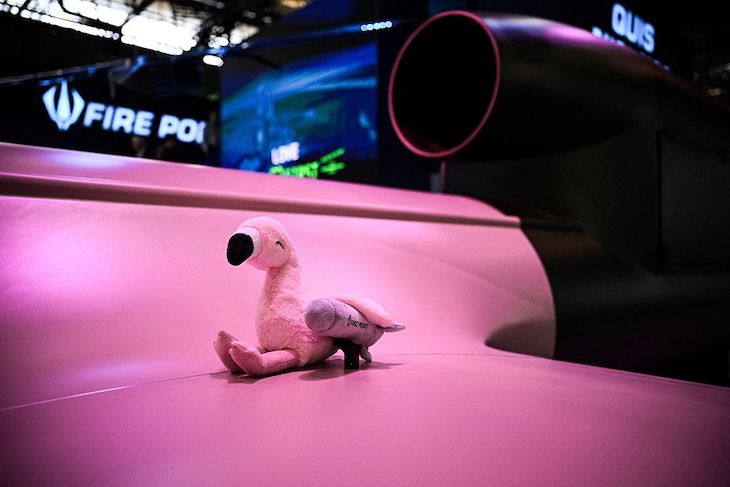
From the outside, the facility could easily have been mistaken for an industrial unit on a business park outside Milton Keynes. Inside, engineers, designers and production teams worked with astonishing urgency. The smell of resin and paint filled the air, machinery hummed, and every workstation was focused on producing the systems upon which Ukraine increasingly depends. Students wandered the corridors and looked up at an almost-ready FP-5 ‘Flamingo’ cruise missile as its wings contracted in testing. The FP-5 had been used in the last night’s attack, the famous ‘lid flip’ image of a storage tank cover sent spinning into the air already circulating on social media. We were even able to prod an FP-9 ballistic missile which, for the first time in the conflict, was reportedly used on 30 June in an intercepted strike on Moscow oblast.
Ukraine’s greatest strategic advantage was visible right in front of our eyes: necessity. Western defence procurement often measures progress in years. Committees deliberate and programmes are reviewed and reviewed again before equipment reaches the battlefield, sometimes long after the battlefield itself has changed. Ukraine does not have that luxury. Soldiers identify a problem at the front, engineers receive immediate feedback, and prototypes are built, tested, modified and returned to combat within weeks. Innovation has become inseparable from survival, and we saw it take place in real time, the morning after one unprecedented strike, and a week before another would take place.
The FP-5 is emblematic of Ukraine’s transformation, delivering strategic reach at around a third of the cost of a conventional cruise missile. The country that many expected to collapse within days of Putin’s invasion is now capable of destroying targets hundreds of kilometres inside Russia. That should command the attention of every defence planner in Europe.
At the end of the visit, the group gathered for coffee. “We are not begging for aid,” one Ukrainian MP told us. “We aren’t a hundred hungry people asking for your money. You’ve seen today what we offer.”
Ukraine still needs Western support. But there is a misconception shared by both the White House and the Kremlin. Kremlin spokesman Dmitry Peskov once claimed that Russia had effectively ‘demilitarised’ Ukraine because its armed forces had become dependent on Nato equipment. Ukraine is not merely absorbing foreign military aid. It is improving it.
Outside Ukraine, debate tends to swing between two comforting extremes: either Russia is on the verge of collapse, or Ukraine is weeks away from defeat. Neither bears much resemblance to the country we visited. The uncomfortable truth is that many Western militaries, Britain included, remain organised around procurement systems and operational assumptions designed for a different era. That is no criticism of British servicemen and women, but of institutions built for peacetime struggling to keep pace with industrial warfare. Ukraine has compressed innovation cycles into weeks. Britain still measures them in years.
Should Ukraine fail, Europe would not simply lose a courageous ally. Russia would emerge with the continent’s largest body of recent high-intensity combat experience, refined against a Nato-equipped opponent, and would move missile systems and battle-hardened forces closer to Nato’s eastern frontier, reducing warning times and raising the risk of miscalculation. Supporting Ukraine is not merely an act of solidarity. It is an investment in Britain’s own security.
Four years ago, the question was whether Ukraine would survive. Today, the more important question is whether the rest of Europe is paying sufficient attention to what Ukraine has become. Hidden behind anonymous industrial units, protected by extraordinary secrecy and built through sheer necessity, Ukraine is quietly shaping the future of warfare.
Amar Singh Bhandal is an MPhil researcher at the University of Cambridge and a recent Petraeus Fellow at the Institute for the Study of War. Shaun Pinner is a British veteran who fought with Ukrainian forces, was held as a prisoner of war, and is now a journalist based in Kyiv