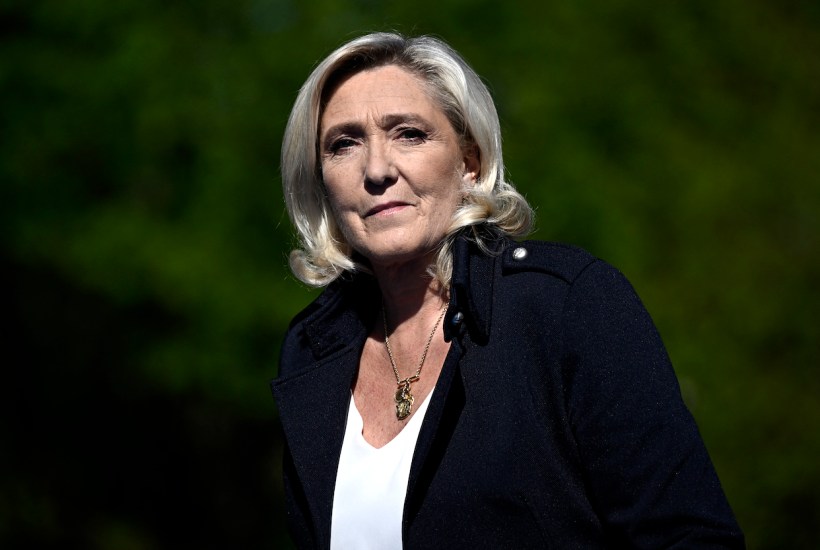
Marine Le Pen’s comeback has thrown France’s presidential election into disarray as rivals for the Élysée Palace scramble to revise their game plans.
Before yesterday’s court ruling opened the way for Le Pen to enter the presidential race, other declared candidates on the left and right were counting on her lieutenant Jordan Bardella to be the right-wing National Rally’s candidate. Bardella has definite strengths, especially his handsome looks and appeal to young voters thanks to his massive following on social media. But his youth and inexperience, at age 30, are a handicap that opponents almost certainly were planning to exploit, especially in live television debates.
Now it appears the Bardella scenario is off. Candidates for French president will likely have to face Marine Le Pen in next spring’s vote. Besides the brand appeal of her surname among right-wing voters, 57-year-old Le Pen is a seasoned politician who has worked hard to transform her father Jean-Marie Le Pen’s far-right party into an electable right-wing movement. Hardened by three presidential elections, she confronted Emmanuel Macron in the runoff vote in both 2017 and 2022. She can now hope that the 2027 election will be her vindication.
While Le Pen still has legal hurdles to overcome – including the prospect of wearing an ankle tag following her conviction for misappropriation of party funds – she is clearly determined to campaign for the French presidency over the next ten months. Polls put both Le Pen and Bardella way ahead of their opponents. Barring an unforeseen setback, there is virtually no doubt that Le Pen will be in the final run-off. The only question is who will face her in the runoff vote.
The nightmare scenario for French centrists is a runoff face-à-face between Le Pen and far-left firebrand Jean-Luc Mélenchon. In the ‘centrist bloc’ that has been ruling France since Macron took office a decade ago, no candidate has yet emerged as a clear alternative to Le Pen or Mélenchon. That paralysis is Macron’s legacy. He won the presidency in 2017 by shattering the two traditional governing parties – the Socialists and conservative Gaullists – and poaching their key figures motivated by personal ambition.
Today, the centre-left and centre-right are fraught with internal rivalries and a proliferation of presidential candidates. On the centre-right, they include former Macron prime ministers Gabriel Attal and Édouard Philippe, hard right Bruno Retailleau, and ex-prime minister Dominique de Villepin who is also making appeals to the left. The centre-left is similarly struggling to find a credible presidential candidate. Unless a single figure emerges from their ranks, they will fail to make it to the final runoff vote next spring – leaving a face-off between Le Pen and Mélenchon.
Le Pen’s sudden political renaissance is also a setback for Jordan Bardella, though he is publicly supporting her and returning to his subordinate role as her second-in-command (and likely prime minister if she wins next year). ‘I am neither relieved nor disappointed,’ said Bardella yesterday, standing next to Le Pen in a press scrum. ‘I am delighted that Marine can wear our jersey and carry our colours.’
In recent weeks, however, cracks have been appearing between Bardella and Le Pen. He made public statements suggesting that he disagreed with her policy on pension reforms. While Le Pen is committed to maintaining the retirement age at 62, Bardella hinted that he was more flexible. Emboldened by his own political celebrity as his party’s probable presidential candidate, Bardella’s statements were interpreted within the party as a public disavowal of his political mentor.
Personal betrayal is a recurring theme in the French Republic’s presidential political system, which makes it difficult for aspirants to carve out their own space under the watchful and jealous eye of the republican monarch. Nicolas Sarkozy famously betrayed his mentor Jacques Chirac to assert his own political ambitions, and once in office made disparaging allusions to his predecessor. In a drama often described as ‘tuer le père’ (kill the father), Emmanuel Macron betrayed his mentor, François Hollande, before displacing him in the 2017 presidential election and subsequently installing himself in the Élysée Palace as Hollande’s successor.
Bardella can now adjust to his secondary role
Recently, murmurs suggested that Jordan Bardella was preparing to commit matricide (‘tuer la mère’) to make his own claims on the French presidency. If so, that is now unlikely, as Marine Le Pen has reclaimed her status as her party’s presidential candidate. Bardella’s personal life, meanwhile, has been the subject of gossip and puzzlement as he throws himself into a jet-set lifestyle with his new girlfriend, Italian princess Maria Carolina de Bourbon des Deux-Siciles. He recently attended the Grand Prix de Monaco with Maria Caroline, who is described as a social media ‘influencer’. They were also spotted together at a posh Monte Carlo club called Jimmy’z. Bardella’s taste for luxury and aristocracy has been criticised as incompatible with his populist image as a boy raised in the disadvantaged Paris suburbs.
Bardella can now adjust to his secondary role as Marine Le Pen steps into the spotlight. For Le Pen, the judicial question in coming months will be whether she is obliged to wear an electronic ankle bracelet while campaigning for the French presidency. But even that irritation, if not removed, likely won’t stop her campaign.