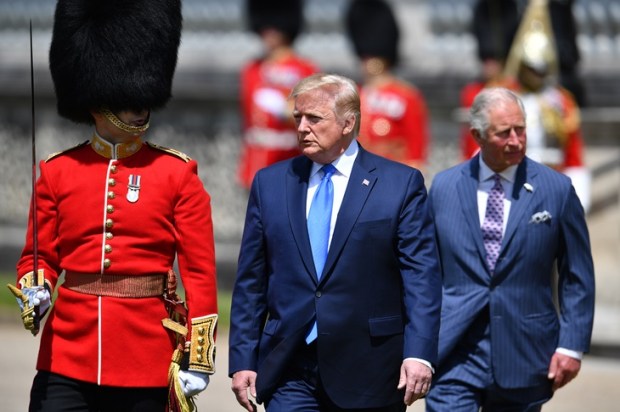
On June 17, 2026, Donald Trump signed a memorandum of understanding with Iran at the Palace of Versailles. The symbolism was not subtle. The last time a victorious power dictated terms at Versailles was 1919. That empire collapsed within a generation. This one shows no such intention.
Operation Epic Fury lasted 38 days. In that time the United States destroyed 85 per cent of Iran’s defence industrial base, sank 150 warships, eliminated every submarine, and killed the Supreme Leader. When Iran closed the Strait of Hormuz, through which 20 per cent of the world’s seaborne oil had flowed, the United States imposed a counterblockade and then forced the strait open again. Three carrier strike groups rotated through the Persian Gulf.
The estimated cost was $35 billion. That is 3.7 per cent of the annual defence budget. Pocket change for a hegemon.
The old boast about the British Empire was geographical. The sun never set because the map was painted red from Gibraltar to Hong Kong. The American version is structural. The sun never goes down because the architecture of dominance operates in every time zone simultaneously, through money, microchips, and military mass.
No colonial governor is required. The system runs itself.
Start with hard power. The United States maintains roughly 750 military installations across more than 80 countries. Britain, France, Russia, and China combined operate fewer than 50 overseas bases. The US defence budget for 2025 reached $954 billion, exceeding the next 14 countries combined. Eleven carrier strike groups patrol the world’s oceans. China, the nearest rival, fields three carriers, none yet nuclear powered and none with comparable battle group integration. Apply the Herfindahl Hirschman Index to global military spending and the result is a near monopoly. One actor holds approximately 35 per cent of a $2.9 trillion global defence market. In antitrust terms, that is a dominant position. In strategic terms, it is hegemony without a credible tender offer.
Now consider financial architecture. The dollar accounts for roughly 57 per cent of global foreign exchange reserves, 89 per cent of foreign exchange transactions, around 50 per cent of SWIFT payment flows, and approximately 80 per cent of trade finance. The yuan manages barely 2 per cent of reserves and 3 per cent of SWIFT traffic. Every attempt to displace it triggers a countervailing force that restores the status quo. BRICS summits produce communiqués. The Cross Border Payments Initiative enters pilot. The dollar absorbs the shock and carries on. A recent CEPR analysis shows that the aggregate decline in dollar reserve share from 71 per cent in 2000 to under 57 per cent today is driven disproportionately by a handful of large holders, principally China and Switzerland, whose portfolio decisions reflect idiosyncratic national strategies rather than systemic de-dollarisation. The dollar has not been abandoned. Its market share has been diluted by the expansion of total reserves into a wider basket of minor currencies. The structural position remains intact.
Reserve currency status is self-reinforcing. What Valéry Giscard d’Estaing called an ‘exorbitant privilege’ is better understood as a structural monopoly. The dollar is the unit of account, the medium of settlement, and the store of value for a global system that has no realistic alternative. The rest of the world pays the cost through transaction fees, exchange rate risk, and involuntary exposure to Federal Reserve policy. That is the real tax of empire. It is collected invisibly, continuously, and without a single customs officer.
Technology completes the triad. Eight of the ten largest companies on Earth by market capitalisation are American. Nvidia alone commands nearly $5 trillion. Alphabet, Apple, Microsoft, and Amazon follow. Cloud computing, artificial intelligence training infrastructure, and the foundational large language models are overwhelmingly American products running on American designed chips fabricated under American export controls. The concentration is a fat tailed distribution in which the dominant actor sits several standard deviations beyond the mean. The probability of reversion within any policy relevant time horizon is vanishingly small.
For Australia, the implications are inescapable. Aukus is a $368 billion bet on the perpetuation of American primacy in the Indo-Pacific. It is a wager on continued access to American technology, intelligence, and extended deterrence. The price of admission is strategic alignment. The commitment is open-ended. But Aukus is only half the exposure. When Iran closed Hormuz, Australian petrol surged past $2.50 a litre, fuel reserves fell to fewer than 40 days of supply, stations ran dry, and the government-imposed rationing. A country that imports more than 80 per cent of its refined fuel through Asian refineries dependent on Gulf crude discovered what structural dependence on an American guaranteed sea lane actually means. Canberra is not merely allied to the hegemon. It is structurally dependent on the hegemon’s willingness and capacity to keep the sea lanes open, the payments system running, and the chips flowing. That dependency is the price of shelter. It is also the price of not being the empire yourself.
The British Empire required governors, garrisons, and gunboats. The American empire requires server farms, carrier groups, and the Federal Reserve. The medium has changed. The message has not. Power projection in the 21st Century runs on silicon, settlements, and strike capability deployed continuously across every meridian on Earth.
The sun never goes down because there is no night.