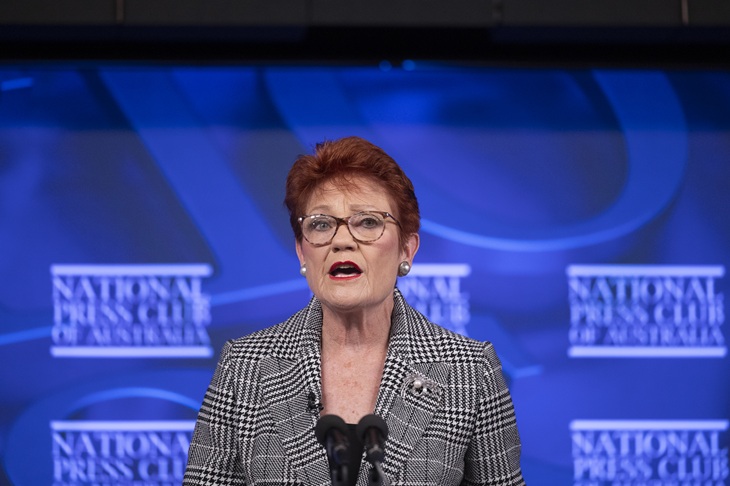
On 17 June, at the National Press Club, Pauline Hanson said the sentences that have kept the commentariat employed ever since:
‘We cannot be a multicultural society. We are a multiracial society, but we must be monocultural.’
Asked what she could possibly mean, she pointed at the Socceroos – players from every background on earth, wearing the green and gold, one nation under one flag, succeeding under the same set of rules. That, she said, is the monoculture.
The reaction was instant and it was total. Angus Taylor announced that he judges people on character and conduct, and that if Senator Hanson wants to judge them by the colour of their skin, One Nation should explain itself – a stern reply to a speech she had not given.
I am not sure which voters Taylor thinks form part of the Liberal base. However, my model, SynthPol, struggles to find any path to a majority government using such campaign tactics.
The Prime Minister diagnosed the whole phenomenon as the economy, stupid. A former Liberal adviser answered him in the Australian Financial Review that he had missed the moment entirely: it’s the culture, stupid. A former Labor candidate warned that Hanson now faces a ‘demographic cliff’ – that migrant Australians will bury the pitch. A Spectator Australia colleague defended the word’s plain meaning and documented the strawmen. For more than a fortnight, the country has conducted a full-dress seminar on one word.
And every participant, attacker and defender alike, has accepted the same premise: that the question is whether this is about culture or about economics. One side says values, identity, race. The other says wages, housing, energy. They disagree about everything except the thing that matters, which is the assumption that these are the only two alternatives.
Part of the trouble is the word ‘economy’ itself. When the Prime Minister says it, he means something singular, abstract, and tied to aggregate domestic output – the thing measured in GDP, addressed in budgets, and assumed to rise and fall for everyone at once. This gives Albanese all sorts of camouflage for actions and reactions. It also causes a lot of confusion.
I have developed a synthetic-voter engine – a simulation, not a poll – that has spent the past year testing the culture-or-economics premise against every dataset Australian politics produces. The engine’s answer is that the question is malformed. The divide reorganising the country does not run between culture and economics.
It runs between two systems of making a living that the academic word ‘economy’ hides. And we already have a map of that divide – not one that I have drawn, or any pollster, but one that the entire electorate, compulsorily, in ink, identified on a single Saturday. Almost nobody has pursued its broader implications for current politics.
The economy of things and the economy of words
Let’s call these systems what they are. Australia runs a material economy – of things – and a symbolic economy – of words – under one currency. The economy of things is focused on making, growing, digging, building, driving, and caring: its assets are physical, its skills applied, its output can be weighed or at least witnessed.
The economy of words administers, credentials, communicates, litigates, and curates: its assets are abstract, its skills discursive, its output is made of language and positions. Both are real. Both are honourable. But they are diverging – in security, in geography, in status, and above all in political voice – and that divergence, not any specific culture war or general economic drift, drives our current political realignment.
You can measure which parties represent which electorate. Build an index of each seat’s position – consider factors such as occupations and industries, the ‘applied’ against the ‘discursive’ – and correlate it. One Nation’s vote tracks the economy of things: 0.80 at the federal level, where 1.0 would be a perfect match and 0 would be none.
The Greens are the mirror opposite: their vote tracks the symbolic economy at around half a point and runs negative on the material one. Newspoll’s own quarterly demographics, published last week, describe the same creature in different terms, using a less powerful lens. It shows that One Nation’s support sits with technical qualifications or no tertiary education, over-50s, an even split of women and men, homeowners and renters alike.
But here may be a more interesting point: both major parties register flat. Labor correlates with the economy of things at −0.24, the Coalition at +0.23 – statistical shrugs. The war has combatants. However, they are not the legacy parties. The traditional parties, with their attention firmly in the rearview mirror, have so far missed the entire shift in the political landscape.
The majors are missing in action, since they have yet to understand what’s happened. The Coalition’s primary vote now sits at 17 per cent – the lowest Newspoll has ever recorded. Most leaders of our legacy parties have acted like managers in buildings that are emptying – like executives at two head offices still dictating memos to workforces that have quietly taken jobs elsewhere, like Smith-Corona and Olivetti aiming to perfect the typewriter for a previous era when the desktop computer has arrived.
The variable that fires on the wrong flank
We can test the commentariat’s premises. If the One Nation surge were a values eruption – the backlash, the bigotry, the culture war of the columns – then values variables should predict who defects to it. The Australian Election Study lets you check, voter by voter. We can take the axis of secularism versus religion, the classic culture-war variable – one that sorts American politics like a knife. And, indeed, it is the single strongest values driver in the SynthPol model – and the only significant one – but it lights for voters drifting from legacy parties to the Greens.
Among voters drifting to One Nation it does precisely nothing: the coefficient is 0.002, which is statistically indistinguishable from zero (p = 0.98). It is a flat line. The drivers of the One Nation drift are positional: work, tenure, income, life stage.
These numbers invert the whole debate. Australia does have a values-driven flank, a bloc that is genuinely organised by cultural conviction. However, it is the Greens. The flank everyone calls the culture war – Hanson’s – is the one where cultural variables find nothing to grip. The experts have the culture war on the wrong side of the map.
The day the country drew the map
If you doubt the map, the country has already drawn it once, under laboratory conditions no pollster could ever afford.
In October 2023, Australia held a referendum. Strip away, for a moment, everything contested about the question itself, because my point is not the question. My point is the instrument. A referendum removes every piece of machinery that muddies a party vote – no candidates, no incumbents, no preference deals, no brand loyalty, no local members handing out sausages, like Peter Malinauskas. One question, every adult in the country, voting compulsorily. It is the purest measurement of a national divide that our system is capable of taking.
Run the ‘No’ vote across the same seat index. It correlates with the material economy at 0.86, and with the symbolic economy at minus 0.90. Those are not numbers typical for political science; they are more like photographs.
Let me be careful here, because the entire argument deserves care. I am not relitigating – or rehashing – the Voice debate. And proponents can fairly say the referendum asked a specific constitutional question, not a class question. But the geography of the answer is a matter of public arithmetic, and the arithmetic offers two interesting conclusions. The ‘No’ coalition was not the same as ‘the political right’ – because legacy parties of the right are flat on the current axis of political debate.
Instead, the 60 per cent ‘No’ votes were the material economy voting as itself, because the vehicles were taken away and it could vote freely. Whatever else October 14, 2023, meant, it was a day when Australia’s two diverging economies were revealed and counted.
A property dispute
Read Hanson’s word against that map and it stops being mysterious. Monoculture, as she actually defined it – one flag, same rules, any background – is not a racial claim. Taylor answered a racial claim to suit the framework he applies.
What Hanson is asserting is something more interesting: a claim about where the debate should start – that there should be a single shared civic culture which is nobody’s project and everybody’s floor; that difference is welcome if it comes on top of this floor and not welcome if it destabilises it.
Seen that way, the monoculture fight is a dispute over terrain, and the focus is on the starting point itself. To the symbolic economy – which holds its assets in credentials, language and recognition – official multiculturalism is simple neutrality: the state declining to privilege one culture. However, to the material economy, the same policy is intervention: accommodation, subsidy, curriculum, mandated deference – a default being continuously edited by people whose job is editing.
The idea of government interference, it turns out, depends on who’s observing. Each side feels the other’s default, the other’s starting point, as unwarranted intervention. That is why the two sides cannot even agree on who began the fight: from inside each economy, the other one did.
There is a scholarly irony here worth one paragraph or two. The academic left’s favourite book on nationhood – which I suspect from the debate Hanson’s team has read but Labor and Greens haven’t – argues that nations are imagined communities. The vulgar reading, the one that Australia’s media is highlighting against Hanson, runs: ‘imagined’, therefore ‘invented’, and so mythology.
But the book’s own point was the opposite: imagined does not mean imaginary. Imagining – so that millions of strangers can hold one identity – is the most durable solidarity modernity has produced. A team of every background wearing one jersey under one flag is not a refutation of that thesis. It is the thesis.
There is an older name for her position, too, and it is not the sinister one the outrage reaches for, intending to shut down debate. A shared civic floor, membership by participation, national solidarity expressed through material works, common ambition – that is the tradition of Joseph Chamberlain, who built it out of Birmingham gas mains, its sewers, its housing. One flag, one community, and a common set of rules all designed to help the average citizen’s life is a manifesto closer to Birmingham municipalism than to anything so far mentioned.
Chamberlain proved entirely prescient about the voters and the outcomes, if not about the politics and the parties.
The cliff, measured
Which leaves the one objection in the fortnight’s commentary that is actually an empirical claim, and therefore data-dependent: the demographic cliff. Hanson cannot win, the argument runs, because migrant Australians will read monoculture as aimed at them and vote accordingly. This is checkable, so I checked it.
At a glance the cliff is there: seats with more overseas-born voters give One Nation less – a correlation of about minus 0.5. But first glances can be deceiving.
For example, the Australian Financial Review recently reported that in South Australia the Greens were One Nation’s second-largest source of preferences – ‘about a third’ in some seats. However, if you pool the seats where Labor was still standing to absorb the flow, it is closer to 9 per cent: real – and telling – yet a fraction of the headline number. The raw number and the controlled outcome can reveal different stories, and the ‘cliff’ does.
Migrants in Australia are not randomly distributed across the two economies – the material and symbolic eco-systems – I have identified. They are concentrated in the symbolic-economy metro areas – the overseas-born share of a seat there correlates negatively with the material index at minus 0.56.
Once we control for a seat’s economic position, the migrant effect collapses: from −0.51 overall to −0.13. For recent arrivals, it vanishes entirely. At −0.03, it is indistinguishable from nothing. And the collapse is symmetrical: the apparent migrant lean toward the Greens (+0.29) dissolves to +0.02 under the same control. Of course, seat patterns are not individual voters – which is why I pair seat maps for geography with AES data for individuals.
The point is that migrant Australians are not a substantially separate values bloc. In the same way that a debate about ‘somewhere’ vs ‘anywhere’ is misplaced since these attitudes just reflect other variables, migrants split according to their situation in Australia’s two economies. They live in the same country as everyone else.
The commentariat has arrived at its conclusion about migrants for an obvious reason. The seats where migrants concentrate are the seats where the commentariat lives. From inside the symbolic economy, migrants genuinely do look like natural allies of its politics – because the ones pundits meet are their neighbours. The tradesman from Tetovo or Tirana in the outer suburbs, paying material-economy prices for material-economy housing, is not at their dinner parties. The cliff is real in Grayndler. However, the country is mostly not Grayndler.
The pile-on
The last few weeks have been an enlightening spectacle. The Prime Minister mirrored Hanson’s analogy using the Socceroos, but tellingly he labelled it something different. Albanese pointed at the same team and declared ‘we are a multicultural nation’.
This event neatly encapsulates this article’s point: what is seen as basic and what is seen as interference depends on the observer. The identical emblem is read as ‘unity through shared rules and ambitions’ within the material economy but highlighted as a ‘celebration of diversity’ in the symbolic economy.
Albanese’s own side can see the hazard even if he cannot: one Labor MP warned against chasing One Nation ‘down a rabbit hole like Keir Starmer did’ with Reform in the UK. The warning is apt. Starmer’s pile-on did not shrink Reform; it certified Reform as the thing worth piling on.
Other leaders and premiers are joining the queue to attack Hanson – the NSW Premier Chris Minns pivoted his state-conference speech away from the Liberal opposition to denounce Hanson’s word instead – each creating a strawman with their own self-serving definition rather than acknowledging that the owner defined it with care based on solid, and indeed leftwing, intellectual ground.
If voters believed Albanese sincerely held a vision which combined shared national identity and common ambition as part of a committed programme, then One Nation would not be competing at the top of Australia’s polls.
But a government cannot spend years teaching the country that its national default is something that needs to be continuously manipulated – in one way or another conceded, regretted, discounted, contextualised, deprioritised, or differentiated without a clear endpoint – and then borrow the flag for a press conference.
Will it work?
So, will planting a flag on monoculture help One Nation win? My engine’s typology says that someone who plants a flag gains not just by persuading but by forcing every other vehicle to locate itself against her axis. This past fortnight or so has been a live demonstration, with Taylor outmanoeuvred into speaking race when Hanson talked common ambition, and the Prime Minister cornered into his usual, Starmer-like, vacillation between outright denial and bargaining.
The loadings say Hanson’s recruitment pool sits where her vote already lives, at 0.80 on the material index, which includes the material economy’s migrants. The voters her word, ‘monoculture’, repels are concentrated in seats she is never going to hold. The direction of the bet is not close.
But an engine that respects its readers stakes its claims where they can die. So, formally: the SynthPol holds at 70 per cent confidence that Hanson’s monoculture flag underpins or raises One Nation’s primary vote. It includes a falsifier in public – if two consecutive Newspolls before March 31, 2027, put One Nation at or below 28 per cent, or a published breakdown shows her vote falling disproportionately in high-migrant, material-economy seats, the claim dies and the register records the death.
The wager is live, not safe: the primary touched a record 31 last month and has already edged back to 29, one point above the tripwire. The ‘cliff’ hypothesis is registered alongside at 30 per cent, with its own falsifier, so that exactly one of them will be wrong on the record. That is more than anyone predicting her ruin has offered.
However, I don’t even need the model to reach a practical conclusion. A country that has spent more than two weeks fighting about a word, has already answered the issues which that word raises – 151 electorates, ink on paper, one Saturday, no parties or preference. The answer had nothing to do with ethnicity or colour, and everything to do with which of two economies a voter lived in.
Hanson did not suddenly divide the country at the Press Club. She read out a division the country had already revealed. The word is just one way to encapsulate this split. The referendum about the Voice generated a map. And one of the strangest facts about Australian politics right now is that the people paid to read maps are the ones who haven’t looked sufficiently hard.
I will lay it out here in a half-mathematical fashion so that Hanson’s opportunity to win outright at some point is clear. Imagined Communities → Monoculturalism → Hanson → One Nation → Material Economy (0.8 correlation) → No Vote (0.86 correlation) → Australia (60 per cent referendum outcome). I believe that Hanson has noted the one link in this chain that needs strengthening and is now trying to weld it tight: the section which goes One Nation = Material Economy. Both Albanese and Taylor seem to be doing their best to help Hanson succeed.