A little under two years ago, almost three months following the UK’s general election, the dean of British psephology noted on radio that ‘2024 may be the election in which the two-party system effectively died a death’.
The idea has generated a lot of debate since.
Two of the most incisive commentators in England, both of whom grace this magazine, have written interesting articles in the context of Farage and Reform’s rise, offering divergent portraits of the British voter.
Charles Moore, focused on Burnham in the Telegraph, offers the flattering portrait. The British voter, on his account, is at heart a prudent, discerning creature – fond of legitimacy and security, wary of ‘those who over-claim and shout the loudest’ – who will, as the noise subsides, decline the raucous insurgent and return to the thoughtful, respectable option. They have a lot to lose otherwise.
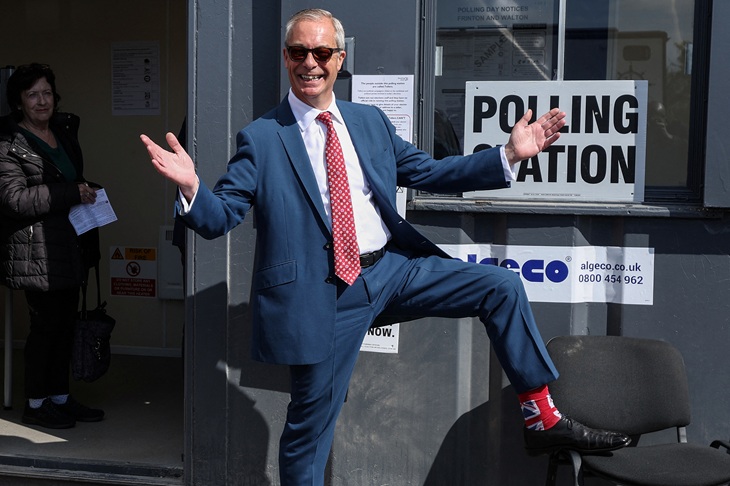
Matthew Parris offers the more unflattering one in a piece whose title plays off a popular paraphrase of Mark Twain: ‘Reports of my death have been greatly exaggerated.’ Parris implies, at least to me, that the voter is part of a flock, mesmerised when a showman arrives but certain to scatter when the showman tires: ‘Reform,’ he suggests, ‘is nothing without Farage’; and Farage, ageing and self-knowing, will step aside before the next election. That, argues Parris, will be the end of it. One writer credits the electorate with wisdom. The other credits it with little.
So both arrive at the same conclusion. The insurgent fades; the system settles back to two; the old map, redrawn at the margins or not, is still the map. And their quarrel about the voter’s character is cosmetic. The agreed result is their shared claim – and their common desire. It rests on a particular sleight of hand.
Both argue as if what is happening revolves around something immediately visible: a man, a party, a paint job. The impression I get from their articles is that the electorate is irrelevant – as if Farage were the bit of dirt around which a crystal forms.
If we switch the analogy to public transport, what both writers talk about is the driver and the livery. They argue over the quality of the wheelman and his bus, but neither gives much agency to who’s inside. In the process, they risk caricaturing the passengers – a displaced class which has emptied from one vehicle and is looking for another that better suits.
They assume the bus routes are fixed; they imply the valid drivers are those union-certified professionals tasked with operating such transport; and the passengers must decide if they want to go somewhere and, if so, which bus to take. Voters are simply choosing to ride or not – within a pre-authorised network.
The voter is either enlightened or a sheep: one boards wisely, the other is almost herded inside, but each is judged solely by the bus boarded. Neither writer asks whether the voter might be looking at the overall network and deciding that he or she no longer wants to go where any of the usual buses are headed, looking instead for an alternative.
Here is the difficulty with their approach: Britain has been here before, and we know the outcome. Go back to 1900. A marginal new party – leader-thin, improbable, written off by the grandees of the day as a rabble that could not last – sets up on the edge of the Liberal coalition. The working substrate behind it is real, and durable, and homeless. It takes the better part of a quarter-century for this marginal party to put together a machine.
In January 1924 the party forms its first government: a brief, minority one – relying on Liberal sufferance. No one can yet say the Liberals are finished; the Liberals themselves, in the serene expectation of a later recovery that doesn’t arrive, hand the insurgent party its first taste of responsible power.
1924 never appears as a coronation. It is, in fact, an audition – for a new era the finalisation of which does not happen until the landslide of 1945. The point is: neither in 1900 nor in 1924 can you see where things are heading. Labour looks as fragile, as personality-thin, as incapable to the establishment as, I believe, Reform seems to Parris or others now. And so none of these commentators are forecasting the process of 1900 – but rather are in danger of repeating its misjudgement.
Moisei Ostrogorski, writing in 1902, saw that a party machine develops interests of its own and comes, in time, to exist chiefly for its own reproduction, whether or not it still fits a living soul. The consequence is the one our commentators miss. A vehicle that has lost its substrate does not just topple over. It tries to persist – the Liberal rump grinding on through the 1920s, then – decades later – reborn as the Liberal Democrats: a machine still turning long after most passengers had stepped off except for the occasional bout of nostalgia.
To some observers, the machine’s survival looks like loyalty. It may not be. And this is Moore’s error distilled: legitimacy and prudence do not summon a departed substrate to a natural home; they merely dignify the empty vehicle as it pushes on. The most sophisticated electorate in the Westminster world proved as much, because for all the prudence – despite Gladstone and his worthy successors – the Liberals were not saved.
There is a small cruelty in watching people mourn the inability of the Liberal Democrats to step into today’s breach, as if there were a middle-ground there to conquer. Hopeful onlookers fail to recognise what they are witnessing: a dissolving axis that negates the very idea of solid terrain and the remnants of a zombie party wandering this shadowland – still soldiering on more than a hundred years after the twilight began – a party that seems more a corpse than a convalescent.
Reading Parris, my mind wanders to the valiant efforts of teals in Australia. Are they chasing a centre that is dissolving – a middle ground that isn’t there – not because voters are becoming more extreme but because the political landscape is being reconstituted?
Which brings us to the word the entire reversion thesis – that things will return to normal – relies upon: ‘transitional’. Multipartism, Parris assures us, is only the gap between one party dying and another being born – a season, soon over. But let’s consider how long Britain’s previous gaps actually ran.
From the Liberal split of 1886 the country operated a genuinely multi-party system for two or three generations depending on how you count it. The Irish party held the balance of power until Sinn Féin annihilated it in 1918. The Liberal Unionists endured as a distinct force until they folded into the Tories in 1912. The Liberals themselves split into factions – Asquith and Lloyd George – from 1916 and ran candidates against one another. Labour climbed throughout. Coalitions and National governments recurred from 1915 until the end of the second war and the 1945 general election.
The clean Labour-versus-Conservative duopoly that Moore or Parris treats as the natural resting state of British politics did not actually set until after 1945 – fifty-nine years after Gladstone himself triggered the instability with his move on Home Rule, something his son had earlier heralded with the Hawarden Kite in 1885. And this ‘transition’ period lasted longer than a single working life – longer than most people’s careers. Which is the natural state?
I’m not claiming academic exactitude. However, a quick calculation suggests great stability in the British party system featured in a minority – about 150 – of the more than 360 years of recognisable politics from 1660. If someone genuinely wanted more stability, then – perhaps surprisingly – the pre-1660 era showed more regime stability.
The settlement Moore and Parris mourn was never a law of nature. The post-war two-party order was downstream of one particularly good fit: a large industrial working class with a fixed material home, a vehicle purpose-built to house it. That fit has come apart. Moore and Parris remember the settlement so completely, and so warmly, that they have mistaken it for nature.
The very thing that makes their articles valuable and truly worth reading – a combination of long memory and earned authority – is, in this case, the wellspring for errors. They are not reading the present. They are defending the sky they were raised under.
In fairness, Parris highlights one mechanism that is entirely real, and it deserves to be granted in full rather than brushed off. First-past-the-post (FPTP) does punish the smaller groups: a vote for C is a wasted vote, and that pressure does shove the system back toward two main parties. However, even if we grant this point completely, it still does not deliver his conclusion. Last time, the return to equilibrium took the better part of 60 years to resolve.
And in Australia – where I write, and where a similar realignment is now underway – the FPTP mechanism does not exist at all. Under compulsory preferential voting no vote is wasted; the displaced hand their first preference to the insurgent and watch it flow. The wasted-vote barrier, the single strongest defence the two-party system has ever owned, is simply not there.
Whether or not a system reverts to some two-party equilibrium, nothing in history demands that it happens within a year or two or that the result lasts for most of the time. Our present situation cannot be labelled, a priori, a momentary spasm.
So, back to the starting question. Is the voter a sheep or enlightened? The reason Moore and Parris go for one answer or another is that they are mourning a lost world – the one in which they grew up. It is the same way I feel about Canberra when it is no longer outside my front door.
Their view implies that the voter’s entire purpose is to choose, foolishly or wisely, between two parties that nature has established. If instead we consider the voter as part of a substrate in search of a vehicle that fits – giving the voter agency – then this dichotomy between sheep and enlightenment turns out to be misleading.
It is not merely a specific two-party system now under question in Britain or Australia. It is an outdated, almost Victorian, model of the voter. The electorate is not simply an assembly of individuals adjudicating merits of two pre-established options marked off for their respectability. It is a mix of people looking for a political home – and when it is no longer fit-for-purpose, they aim to move house.