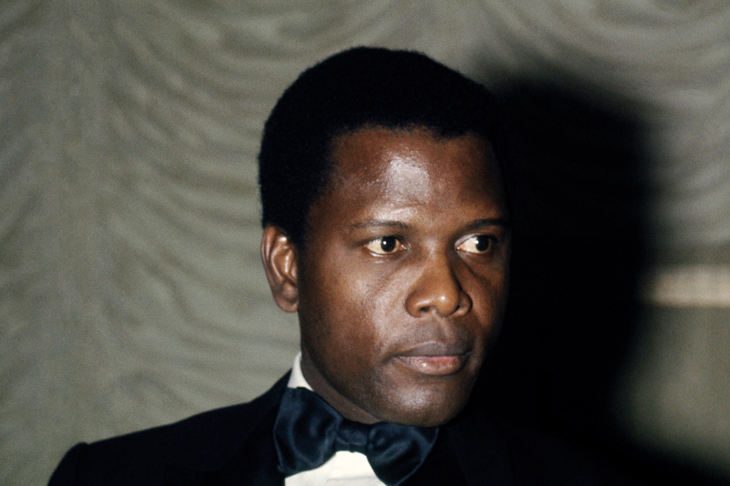
Anyone who knows the Sixties can easily be reminded of the beauty and the authority of Sidney Poitier. The MTC production of Retrograde – a very sleek and attractive play by Ryan Calais Cameron – sees Alan Dale (the old Australian actor from The O.C.) play a studio lawyer who wants to ensure – no matter what skulduggery it involves – that Poitier remains the creature of Hollywood and not be a lefty pest in the manner of that great singer-actor Paul Robeson. In that respect McCarthyism and its hysterical anti-communism is more central to the play than the subsequent triumphs. But Retrograde is directed with a glitter and sure-footedness by Bert LaBonté so that the overall effect is dazzling even if touches of the acting look a bit improvised and momentarily uncertain. It doesn’t matter because we have the illusion that we are staring in the eyes and being mesmerised by the intimately familiar voice of one of the most powerful actors ever to occupy a screen. A German friend says the effect is ‘phantastisch’ which is stronger in German because it means not just fantastic but enchanting.
And by some mesmeric if not magical feat of arms, Donné Ngabo convinces us that we are in the presence of the great actor. Word has it that Matthew Rhys did this with Richard Burton in his one-man show Playing Burton. But Retrograde not only captures the equally distinctive voice but Ngabo is miraculously handsome to boot.
The voice was always a thing of wonder. Someone described it as having a Bahamian undertow to the surface American. Remember the moment in that marvellous film In the Heat of the Night when that very grand actor Rod Steiger says, as the police chief in the immemorial tones of Southern prejudice, ‘What they call you, boy?’ And Poitier replies with thundering anger, ‘They call me Mr Tibbs.’ It remains the case that Americans of West Indian background – such as the former head of the Pentagon and secretary of state, Colin Powell – have an inbuilt advantage when it comes to the command of histrionic rhetoric (perhaps like New Zealanders such as Sam Neill and Russell Crowe apropos of Australia and the Celts apropos of England). In any case, Sidney Poitier became a kind of pin-up boy for the civil rights movement. He went from being an escaped convict on the run and tied up with Tony Curtis in The Defiant Ones (1958) to winning an Oscar for Lilies of the Field (1963) and later made the wildly successful To Sir With Love (1967)
In the midst of all of this Katharine Hepburn – who thought Sidney Poitier’s Oscar should have gone to Albert Finney for Tony Richardson’s Tom Jones – made Guess Who’s Coming to Dinner with Poitier and her lover and partner Spencer Tracy.
Retrograde in Bert LaBonté’s expert hands – and with a Poitier to die for in Donné Ngabo – is everything sleek and sumptuous theatre according to an urbane set of tricks could possibly ask for. Alan Dale plays a plausible devil in the wilderness tempting the guy to whom he waves a contract (which might as well signify the perdition of his soul) and if you’re feeling critical of foregone moral conclusions you might sigh – but in fact it’s pretty exhilarating watching the instinctively good young man confront the allotted temptation and spit it out of his mouth.
It helps that Retrograde is very easy on the eye and that the whole plot line is both foreordained – a joyous play on the old story of outwitting the forces of evil. The Black Angel soars and the White Angel collapses after much bluffing and convincing.
It helps too that Josh McConville as the decent liberal-minded but bamboozled good guy puts in an attractive performance that testifies to his own bewilderment in a way that is plausible and warms the heart. But Retrograde is a hopeful play as well as a winner in the entertainment stakes because it dramatises the elements in play, pushing for a bad if not horrific outcome and the upshot is not just positive but an open invitation to buoyancy and hope.
Is it surprising that a play which could be accused of being old fashioned should burn with such fire and illumination? It suggests how much of the theatre’s lustre and its ability to show how the spectacle of the good can be wielded in ways which are traditional. In that respect, it’s fascinating to see such a sumptuous production – full of ideas that are not easily refuted just because they are familiar – sweep into elegance and intrigue in the smallish and seductive space of the Fairfax Theatre and make us feel that Donné Ngabo’s acting and Bert LaBonté’s whirlwind and eloquent production and the steadiness of Alan Dale – perfectly cast never mind the bit of needful improv – are seeing a good American play done with the sense of excitement it deserves.
Long ago in The Sublime, Josh McConville showed he was an actor of the first rank and he is impeccable here. But we need to see more of Donné Ngabo. Anyone with the skills to recycle the majesty of Sidney Poitier could do anything and we should let him do it – in Shakespeare, in Sam Shepard, in whatever.
We sometimes forget how the different fields of drama are interconnected. We’ve just finished watching Mobland on Paramount. It is produced by Guy Ritchie (who also directs the first three episodes) and one of the scriptwriters is Jez Butterworth who wrote the staggeringly well received Jerusalem and which starred – famously – Mark Rylance. Later there was The Ferryman with Paddy Considine. There are unspeakable horrors in Mobland which has a cast that includes Considine and Tom Hardy and showcases two extraordinary performances – as the overlords of iniquity and horror – from Pierce Brosnan and Helen Mirren. Never was the melodious brogue heard to such hair-raising effect.
Got something to add? Join the discussion and comment below.
You might disagree with half of it, but you’ll enjoy reading all of it. Try your first month for free, then just $2 a week for the remainder of your first year.