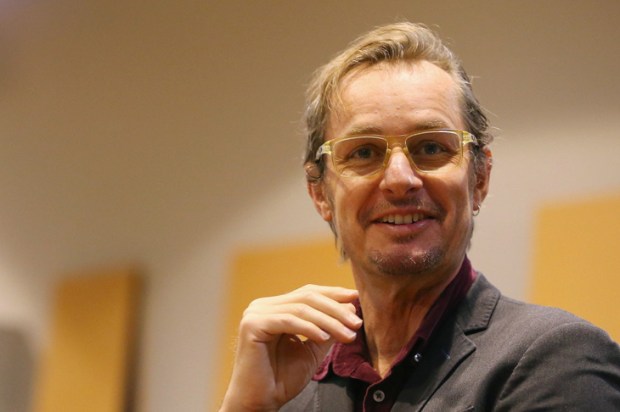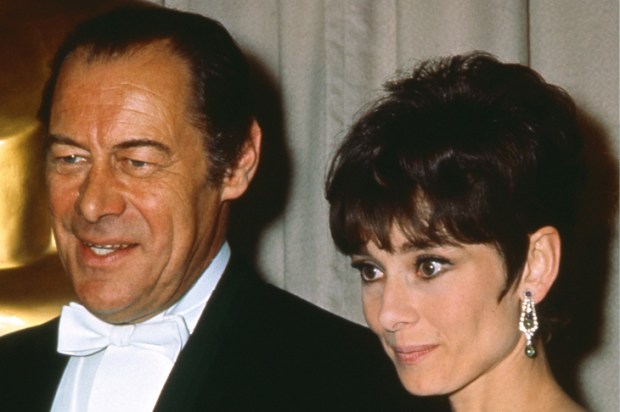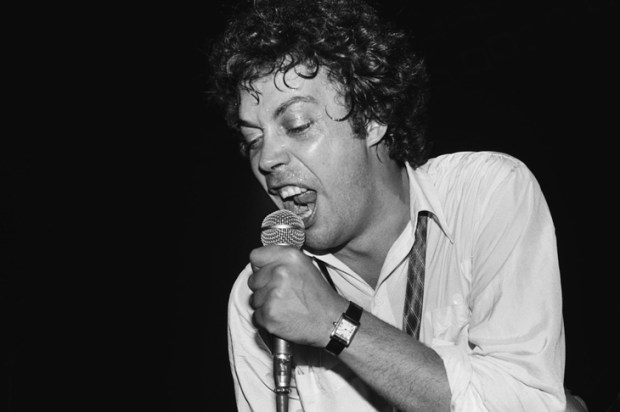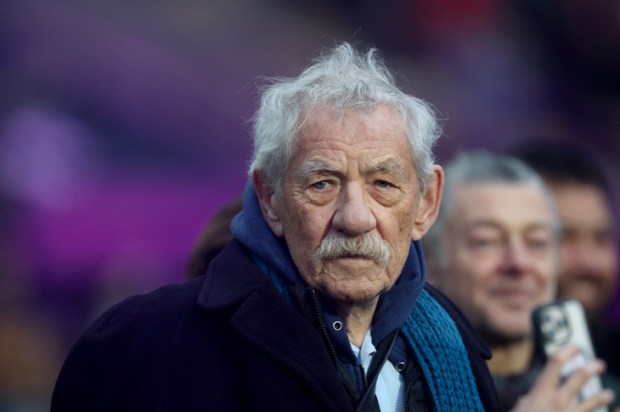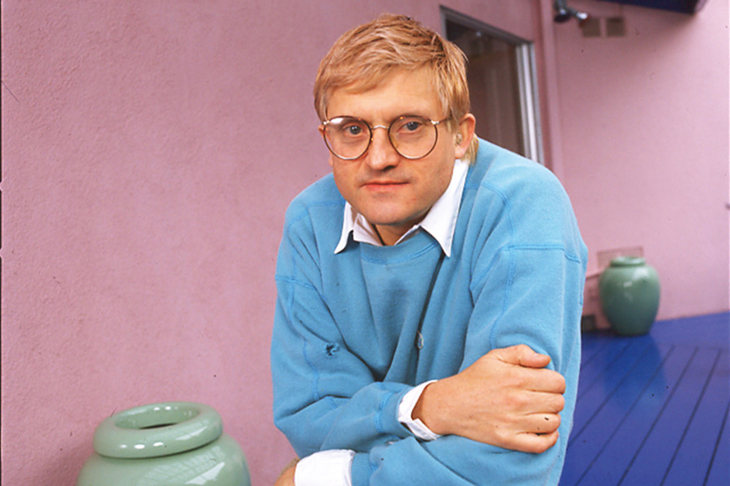
June 11 saw the death of the Yorkshire-born English painter David Hockney who was arguably the most celebrated painter of his day and took what might have been the idiom of pop and made it profoundly witty and constantly evolving. King Charles spoke in his praise the other day, highlighting the bright yellow Crocs he wore to events at the Palace. David Hockney refused a Knighthood though he eventually accepted the Order of Merit and the French Légion d’honneur.
America made him. Although he grew up in Bradford, Yorkshire it was Los Angeles where he first felt totally at home. He painted Christopher Isherwood and Don Bachardy and their collection of Hockney’s work is said to be the richest collection of any paintings in private hands. He was compared to Picasso, he was compared a bit more tellingly to Matisse. He dyed his fairish hair to a strident blond vaunting the motto, ‘Blondes have more fun’.
The enigma of David Hockney is exemplified by his 1967 painting ‘A Bigger Splash’ where there’s an extraordinary interplay of the flat planes of everything that is residually comfortable and somehow suburban about the different structures pointing upwards and the splash of whoever has left that mysterious unidentifiable aftereffect. Hollywood entranced him and he would play tricks with his dual portraits where a couple seem to have wandered from a different wonderland.
David Hockney was both an advocate for what he wanted to do with painting and a terrific explicator of how his art – and everyone else’s – had come about. Some people see van Dyck and Caravaggio and company in Hockney’s cavalcades of boys and Hockney used to argue with great passion that these masters had used camera obscura (or whatever crypto photographic aid) to get their effects. His popularity as a painter is not separate from his awareness of what cameras can do and the musing about what can be done mimetically with photography or in spite of photography.
He was originally as a bright young thing promiscuous but then he fell in love with a boy and changed his tune. He was also extraordinarily sensitive to the needs of those he knew who were beset with Aids, rushing to pay hospital bills.
He used to say that because he was a painter he was bound to be rich because he just liked what he was doing so much. But the break-ups of serious relationships sometimes made Hockney jump from the indolent ease of California back to the dour iciness of Yorkshire where he was sometimes mistaken for Alan Bennett.
In some ways he came across as a deeply histrionic figure with his striped caps and striking shoes but he could not have been more serious about his art.
He also jumped with unpredictable relish to theatre commissions: he designed a production of Stravinsky’s The Rake’s Progress but he went on to Wagner and certainly made love to this employment. In 1992 it brought him to the Melbourne Festival with his design of Richard Strauss’s Die Frau ohne Schatten. The Hockney design was intricate and irresistible.
For the right kind of ballet-lover that will be true of the Australian Ballet’s revival of John Cranko’s Romeo and Juliet. It is certainly very grand in its massively staged ensembles such as the Capulet ball. It’s arguable that the production is less strong in the psychological delicacy of the actual love match with Grace Carroll as Juliet and Joseph Caley as Romeo. The Australian Ballet under David Hallberg is a massive fortress of competing scintillations. Given Cranko’s sense of the spectacular it does favour robust physical mastery rather than the psychological subtlety of the actor-dancer of the Helpmann variety.
You can’t object though with the psychological intimations of Shakespeare’s ‘It is the lark’ so heartbreakingly paralleled by Prokofiev’s score.
There’s been a general fuss about accents recently in relation to Christopher Nolan’s film of The Odyssey and it’s interesting to think of Mel Gibson’s endeavour in this respect. First he played Hamlet in Zeffirelli’s film of the most wide-open of Shakespeare roles and then he made his Jesus film The Passion of the Christ and his Mayan one Apocalypto in hypothetical re-constructions of the original languages.
Mel Gibson’s Hamlet – with a cast of some splendour (Glenn Close, Paul Scofield, Alan Bates) – is in what can be classified as high Australian. It’s an accent we tend not to hear – think of Sam Neill in Reilly: Ace of Spies – but the British can spot it as not the King’s English. There are things wrong with Mel Gibson’s Hamlet. He doesn’t for a start sound introspectively confounded. The actual accent however and the control of it is all you could want – the mastery of the verse, the quality of the vowels: he’s everything you could wish for an accomplished actor, generically Australian, who is simply stuck in a role that doesn’t suit him, despite his lustrous Nida equipment. However, Mel Gibson’s penchant for lost or long-ago languages might well have worked with The Odyssey. Imagine if Christopher Nolan’s version was in a suitably abridged version of Homer’s hexameters. This lunatic idea might in practice be fascinating. At Cambridge people who act in the campus’s Greek play undertake to at least start learning Greek.
And think of the verbal music of the actual words the Bard – or succession of bards – put together and enthralled their listeners with. No one wants the wrong accents for Shakespeare: think of the horrors of Mickey Rooney in Max Reinhardt’s A Misdummer Night’s Dream. You’re much better off with high Australian or high whatever.
But The Odyssey in the original might have been extraordinary in some revamp of that ancient music. It certainly wouldn’t sound suburban and you could banish fears of Boston. It’s interesting too that Mel Gibson’s crazy reconfigurations of ancient languages do actually sell. He did tell the podcaster Joe Rogan that he had another biblical epic in mind but this time in English. He should stick to high Australian. And given his archaeological pull, why didn’t he think of Homer?
Got something to add? Join the discussion and comment below.
You might disagree with half of it, but you’ll enjoy reading all of it. Try your first month for free, then just $2 a week for the remainder of your first year.