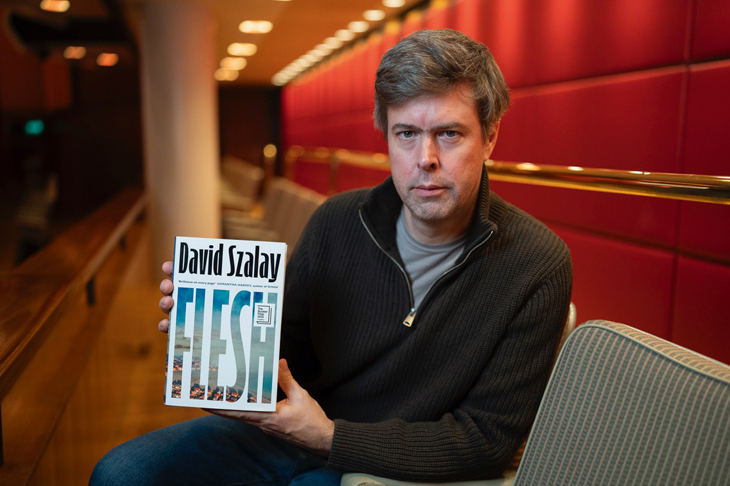
There’s something very odd about the fuss that’s been made about David Szalay who won the Booker a few months ago to the delight of readers who realised that this was a Booker of the Bookers, that Flesh was an exceptional work even among novels of the first rank. Auden said any play of Shakespeare could be longer or shorter, no play of Sophocles could. And yes – amazing though it is to say it – Szalay was a Sophocles of a writer. All of which made it bizarre to have Flesh compared to Kubrick’s Barry Lyndon as if Szalay was not only influenced by Kubrick but at some level was hiding this patent influence. And things were made even more bizarre by the fact – not of much interest to the inquisitors – that Kubrick’s Barry Lyndon is in fact based on the book by Thackeray, the author of Vanity Fair.
Some people might have recollected that in Vanity Fair Thackeray made a point of emphasising that his greatest work had no hero. And everyone was so obsessed by the fact that both Barry Lyndon and Szalay’s hero István remarked on a painting because of the shade of blue it used that they neglected to notice that the protagonist of Flesh is in his passive witnessing way a good guy whereas the Thackeray/Kubrick Barry Lyndon is pretty much a scoundrel. None of which stops the Kubrick film from being an extraordinarily lyrical evocation of late-eighteenth-century Europe.
If you look at it again you are aware of the wilfulness and wiliness of the way Kubrick’s Barry Lyndon achieves aristocratic wealth and status. Whereas in Flesh we get István in mere proximity to the action.
Yes, he throws the husband of his middle-aged mistress down the stairs. Yes, he is tempted to let the son of the family die but he doesn’t even though the young man is his sworn enemy. In the Kubrick and the Thackeray we get him beating the boy but there’s nothing like the catastrophe represented in Flesh. And the way the protagonist, however reduced his circumstances, makes the best of things.
And Flesh is a masterpiece of economy. Often István is presented as the bystander of his own predicament but the remarkable aspect of him is that – with minimal notation – he makes the best of it. It would be wrong to illustrate this in a set of (further) spoilers but it functions in this highly credible way so that there is a sigh of relief from the reader who knows that the action is as tersely articulated as it could be. The effect of this is to invest what happens with the richness of the place that is left for human survival.
A large number of people with a commitment to a new and ravishing technique are awed by Flesh not in the first instance because of the excess of its action but more particularly the minimal way it creates worlds and shatters them without making a song and dance.
Of course this whole mini-controversy underlines in a somewhat absurd way the fact that there are a finite number of plots in the world. Paradoxically what the comparison with Barry Lyndon highlights is the potentially infinite number of plotlines a coherent narrative line can trace.
It should be pretty clear that Flesh works in a way that contrasts with Barry Lyndon. The extraordinary and exorbitantly pictorial aspect of the Kubrick could not be more different from the Szalay. The Kubrick works with an elaborate florid magnificence which co-exists with and derives from the Thackeray but the only thing it has in common with the Szalay are the coincidental empathies and points of emphasis.
This is not to deny that Thackeray is a master of the rise and fall and Kubrick treats this with a lavishness which is opulent in design and operatic in its articulation but there is no hint of the tacit quality which is the most striking feature of Szalay’s innovative quality.
This Hungarian-Englishman has performed surgery on the amplitude of novelistic technique and that’s why he has created such an effect of awe in the literary world.
None of which is to deny the very different merits of Kubrick and Thackeray. The latter is a master of the anti-heroic and he’s brilliant at emulating with great space and drama the rise and fall of the inexorably ambitious schemer.
The impression created by Barry Lyndon as a book is different to the besotted and berserk beauty of Kubrick (who is always the literary rival of whoever he adapts: think of Lolita).
But this whole somewhat piddling pointing to an affinity – and the subsequent turn to Thackeray – is a reminder of how he was thought of as the equal of Dickens if not the superior. D.J. Taylor used to give the impression that Thackeray was, without qualification, the best writer in English.
Some of us – a surprising number in fact – think that of Szalay in Flesh. The whole controversy is weird because it takes Kubrick’s transfiguration of Thackeray’s Barry Lyndon as central. This flatters David Szalay but reconfigures him in a glass darkly. In Flesh, István is so tacitly inserted into the narrative that the primary relationship between the two is the radicalism of their difference. Kubrick’s Barry Lyndon is a magnificent inflation of the Thackeray character and Kubrick’s conception of him is grand as well as Mozartean in its deliberate use of beauty as a fundamental and iconic glory that puts its idiom on the whole dramatisation.
But Kubrick’s hero – who is also an anti-hero – is fabulously assertive where Szalay’s is the dislocated victim of wherever he finds himself.
Szalay’s István acts – morally, instinctively, however – without undue emphasis. The upshot is extraordinary. And it’s also a magnificent denial of Thackeray’s anti-heroism. In that sense the comparison of David Szalay’s Flesh and Kubrick’s Barry Lyndon is fine: they’re both consummate works of art.
Got something to add? Join the discussion and comment below.
You might disagree with half of it, but you’ll enjoy reading all of it. Try your first month for free, then just $2 a week for the remainder of your first year.