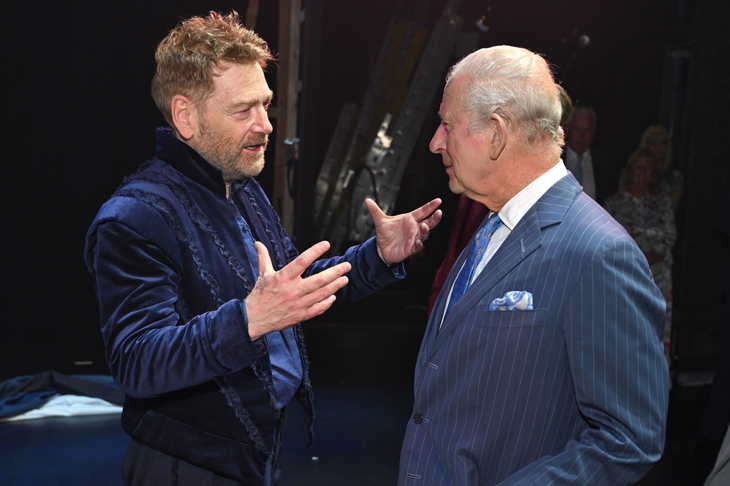
When Ken Branagh took the stage of the Royal Shakespeare Theatre at Stratford for the first time in thirty years – as Prospero in Richard Eyre’s new production of The Tempest – King Charles made a surprise appearance. He’s a man who loves the theatre and he and Branagh go way back to the days of filming Henry V, the Branagh film so lavishly cast that it had a fourteen-year-old Christian Bale as a singing pageboy. The King also wept when an old Soldier of the Empire – was he a Gurkha? – read in Urdu his translation of the Bard. He also showed the American Congress that the monarchy was compatible with a sense of irony beneath the sparkle.
He would certainly have seen Antony Sher as Falstaff in Henry IV and you wonder if Alex Hassell as Prince Hal seemed as insipid to him as he did to us watching the National Theatre Live recording. Well, Alex Hassell has come into his own as the dashing Rupert Campbell-Black in the magnificent version of Jilly Cooper’s Rivals (the second season is now on Disney+) which has aroused the enthusiasm of Queen Camilla. What a Higgins in My Fair Lady Hassell would be.
Remember Gus the Theatre Cat, in Cats? Both Alec Guinness and John Gielgud recorded the verse monologue in which Gus proclaims his great role was Firefrorefiddle, the Fiend of the Fell. Along the way he says, ‘I have acted with Irving, I have acted with Tree.’ Well, Tree was Sir Herbert Beerbohm Tree (the original Higgins in Pygmalion). Irving was Sir Henry Irving, the greatest actor of the Victorian stage and he is the subject of a play by David Hare, Grace Pervades, with Ralph Fiennes as the actor manager and Miranda Raison as his much younger leading lady.
You may recall that Miranda Raison (late of Spooks) played Hermione in Branagh’s production of another of the last plays, The Winter’s Tale, back in 2015 with Judi Dench almost incomparable in the Peggy Ashcroft role of Paulina, the wonder worker. Like everyone who works with Branagh, Raison demonstrates an absolute mastery of Shakespeare’s verse.
Michael Frayn, the playwright and novelist, has had an extraordinary career. Noises Off, his comedy which highlights the horrors of backstage if you put them in reverse, must have high claims as one of the most successful – and funny – plays ever written. Michael Frayn also wrote some very fine translations of Chekhov including Wild Honey (his comic version of Platonov). Frayn once said he had no advantages as a Chekhov translator over Stoppard or whoever except for the fact that he could speak Russian. Frayn has battled ill-health recently – a fall that proved toxic – so it’s cheering that Copenhagen – the play featuring the Danish physicist Niels Bohr and the German formulator of the indeterminacy principle Werner Heisenberg – is enjoying a revival at the moment. Alas, the other two ravishing plays that comprise his ‘German’ sequence – one about Willy Brandt and the other Max Reinhardt – were not successful despite direction from the great Australian-born director Michael Blakemore and that magnificent actor Roger Allam.
David Hare has had a very different career. One of the best introductions to his work is Anthony Hopkins in Pravda, the play Hare wrote with Howard Brenton which is about a devastating and glittering newspaper magnate with a commonwealth (in this case South African) background.
It was interesting to see Rosamund Pike win the Olivier for Suzie Miller’s Inter Alia. The Sydney Theatre Company is about to revive Miller’s Prima Facie with the Australian lead Sheridan Harbridge who some people think is better in the role than the original, Jodie Comer.
I hadn’t realised quite how embedded in the Australian law it all was. A progressive High Court judge made the news the other day when he was critical of a group of conservative judges (see James Allan in this issue). But the surprise was the revelation that Robert Beech-Jones, the progressive critic, is in fact the husband of Suzie Miller, the thespian dramatiser of the law and all its heart-rending complexities which have not only garnered awards but also led to the one-woman show about Ruth Bader Ginsberg RBG: Of Many, One which has been such a success with Heather Mitchell.
But anyone who happens to be in Britain should see Ralph Fiennes and Miranda Raison in David Hare’s Grace Pervades and Kenneth Branagh as Prospero in The Tempest. There is a particular high which we remember for the rest of our lives in seeing a great actor in a great role.
The Tempest is a great example of Shakespeare’s work. Harold Bloom can be seen on YouTube with Charlie Rose saying that the late plays are not romances they are tragicomedies. It would be a thrilling thing to see Branagh return to what we think of as the last thing Shakespeare wrote unassisted for the stage: ‘We are such stuff / As dreams are made on, and our little life / Is rounded with a sleep…’
Branagh is a man with an unusual command of technique. He speaks the verse – trippingly, as Hamlet says – as if he were the natural heir of Shakespeare, encompassing all the sorrow and majesty in the world. It’s as if with a blink we are back in the early-seventeenth century. Ralph Fiennes also has this quality.
You feel with each of them that they are associates of Burbage, the actor for whom Shakespeare wrote Hamlet and King Lear. What do we make of Prospero’s words to the monster Caliban? ‘This thing of darkness I / Acknowledge mine.’
It’s not pretty or meant to be but no one else in the whole of Shakespeare is like him. And here is Caliban himself:
‘The isle is full of noises / Sounds and sweet airs, that give delight and hurt not…
Got something to add? Join the discussion and comment below.
You might disagree with half of it, but you’ll enjoy reading all of it. Try your first month for free, then just $2 a week for the remainder of your first year.