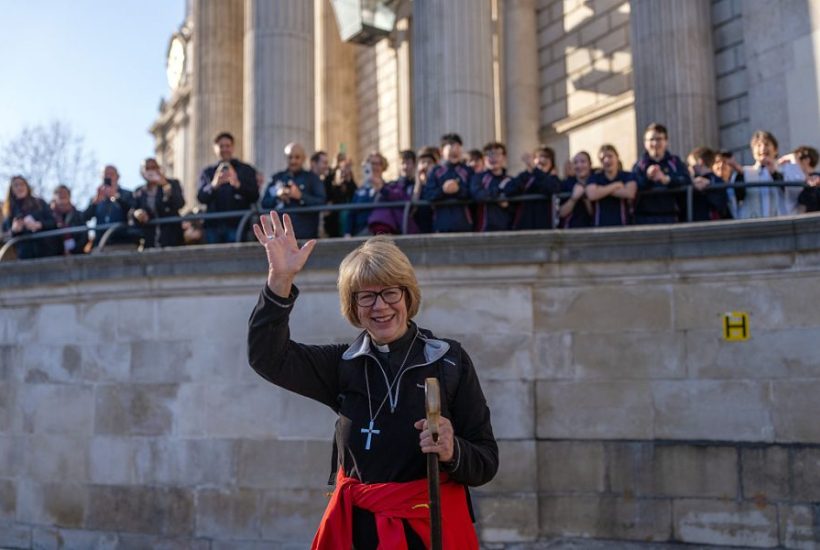
When Sarah Mullally started her pilgrimage this week, travelling from London to Canterbury, she wasn’t just embracing a tradition in England that once stretched back thousands of years, but speaking to a wider trend: the resurgent popularity of pilgrimage. The Archbishop of Canterbury, due to be enthroned next week, joins an estimated 250,000 Britons who will take part in a pilgrimage this year.
British experiences with pilgrimage have tended to focus on trips abroad: to holy sites like Lourdes or on treks such as the Camino de Santiago – which stretches from southern France to Santiago de Compostela in Spain. Trips aren’t confined to Christians either – until the Covid pandemic, 25,000 British Muslims took part in the annual Hajj to Mecca. Yet many Britons are unaware that the country once had thriving domestic pilgrimage routes. The most famous example is the pilgrimage to Canterbury, exemplified in Chaucer’s The Canterbury Tales, which began following the canonisation of the murdered Archbishop Thomas Becket. Known as the ‘Pilgrim’s Way’, most take the route travelling eastwards from Winchester in Hampshire.
Mullally’s 87-mile route has taken an alternate route, from Southwark, which is believed to be the same route Becket took to travel between London and Canterbury. Thousands were estimated to take part in the pilgrimage each year in medieval times. This changed with Henry VIII, with pilgrimage banned in 1538 by Thomas Cromwell as part of Britain’s reformation. Pilgrimage was associated with themes of purgatory – those embarking on trips often did so as penance or for religious favours – and also idolatry, as pilgrims would often be travelling to sites with religious relics. Plus, pilgrimage often raised large sums for the monasteries and churches that helped organise, or lay along the route of, the journeys. All ran counter to the themes behind the reformation and Henry VIII’s ire against the organised Church.
Pilgrimage is thriving in part because of the secular age, not in spite of it
With the demise of British pilgrimage, the country lost many of the shrines and infrastructure associated with the practice. The British Pilgrimage Trust, founded just over a decade ago, has sought to change that. Guy Hayward and his team have compiled over 250 routes and 400 sacred places, which can be accessed through their website. The trust points to a range of reasons why pilgrimage should be experiencing a resurgence in popularity: ‘As a tool for spiritual ecology, mental well-being, and even urban design’.
For Britons interested, the Trust lists the three most popular routes in England as the St James’s Way – the English start to the Camino de Santiago, the Pilgrim’s Way and St Michael’s Way in Cornwall. Archbishop Mullally’s pilgrimage has taken her six days. She has previously walked part of the Via Francigena, but if she fancies another challenge, she could walk the full route – that from Canterbury to Rome.
It is perhaps unsurprising that pilgrimage should experience a resurgence in this increasingly secular age. Much has been made of the supposed ‘recovering of the sacred’ – the thousands of young people returning to Church. It is less clear, though, that young people are seeking institutional religion or expressing faith in a god; in the absence of faith and during a period of constant geopolitical crisis, young people seem to be pursuing meaning. Pilgrimage is thriving in part because of the secular age, not in spite of it. King Charles highlighted as much in his Christmas address when he said that pilgrimage is ‘of particular significance for our modern world’. Secular readers seeking a less religiously significant route might be interested to note that Mullally’s trip comes the same week that the King opened the world’s longest coastal walk, round the whole of the English coastline.
Mullally’s journey has proven a uniquely modern take on pilgrimage, as it began with her crossing the Millennium bridge and saw tourists stopping for selfies. Initially there was some criticism over its timing, which clashed with a vote in the House of Lords on decriminalising abortion. Some critics have labelled her trip a ‘gimmick’. The Rev’d Marcus Walker, Rector of St Bartholomew’s, has defended it though, declaring himself a ‘fan’ of the Archbishop’s decision and saying, ‘it’s quite good… to prepare for office by prayer and pilgrimage’. Andrew Atherstone, Mullally’s biographer, points to her personal connection to the practice, her love of long walks on ancient routes with her husband:
Beginning her Canterbury ministry in this manner is symbolically significant. Walking slowly by foot, in the spring sunshine, brings the chance to talk, think, observe and pray.
When does a long walk become a pilgrimage? Reflection when walking is perhaps reactive, whereas taking the step to take part in pilgrimage is an active attempt at contemplation. Historically pilgrimage was as much about the destination as the journey, yet nowadays most think of pilgrimage as being solely about the journey, the period of reflection.
For the Church of England, the decision to take part in a pilgrimage speaks volumes about the handover of power. Perhaps Archbishop Mullally’s pilgrimage is calculated to demonstrate a link with the Church’s past traditions, as well as a break from her predecessor’s leadership, while also showing she is prepared to take the time to reflect. As Atherstone says, Mullally’s predecessor, Justin Welby ‘was an archiepiscopal tornado, always moving at top speed – but Mullally’s chosen brand is quietness and calm’.