St Peter’s Basilica is located near the Vatican Hill (in Latin Mons Vaticanus), across the River Tiber from the location of the seven hills upon which, according to Cicero and Plutarch, the city of Rome was founded. The area surrounding Mons Vaticanus was used by the Emperor Nero for Christian executions following the fire of 64 AD, including that of Saint Peter, who was crucified and buried there. It thus became a site of significance for early Christianity, leading to the construction, originally by the Emperor Constantine, of St Peter’s Basilica above the place where the first pope was buried.
It was during the papacy of Leo IV (circa 850 AD) that Mons Vaticanus and the surrounding areas became part of the city of Rome. Since the signing of the Lateran Pacts of 1929, it has been the Vatican City State.
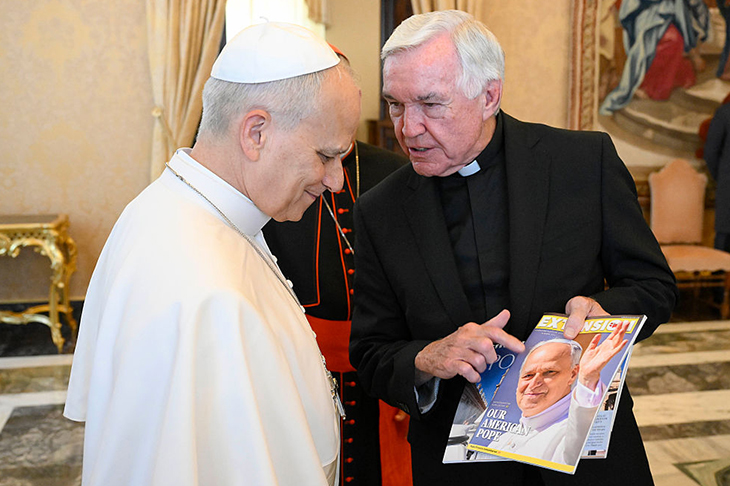
The current head of the Vatican City State, Pope Leo XIV, recently commemorated one year since his election. Some of his actions have restored some sense of normality to the papacy. These include returning to reside in the Apostolic Palace next door to St Peter’s Basilica, which was shunned by his predecessor, Francis, as too luxurious. However, this operation of performative piety, as I wrote in these pages last year, ended up costing around €29 million over Francis’12-year pontificate, equivalent to around $A55 million, thus contributing to the already dire state of the Vatican’s finances.
However, since the turn of the year in particular, Papa Prevost has engaged in affairs which, rather than give Catholics much-needed reassurance, have the same sense of performative piety as his predecessor. Indeed, some episodes have made him appear quite foolish.
On 13 April, Pope Leo began an apostolic journey in Africa, with the first stop in Algeria, the first papal visit in the country’s history. During his stopover at the Mosque of Algiers, the third largest in the world, the pope took off his shoes as required by protocol and paused in silent prayer together with Imam Mohamed Mamoun al Qasimi, showing a change of attitude compared to what he had done at the Blue Mosque in Istanbul during a prior apostolic voyage, when he remained outside.
It was reported that the pope then withdrew for a private moment of dialogue with the imam, expressing ‘gratitude for being in a place that represents the space proper to God’.
This contrasts with his silence on the continued destruction of Catholic churches around the world – and the persecution of Christians generally – at the hands of Islamists. This includes the destruction of the historic St Louis de Montfort Catholic Church in Mozambique last month, which is the culmination of two years of continuous attacks on Catholic communities in the country, including burning of 18 churches in the Chiúre district in 2024 and the beheading of six Christians in Meza.
In Nigeria, the persecution of Christians continues with alacrity, with Islamists killing at least 26 people in three separate attacks over Easter. Again, this prompted no reaction from the pope, which drew a lament from Monty Python’s John Cleese.
Yet, on 12 May, in an address to an interfaith meeting between Catholic and Muslim representatives at the Vatican, the pope called on both groups to embrace their ‘rich’ traditions to ‘revive humanity’ by helping the marginalised.
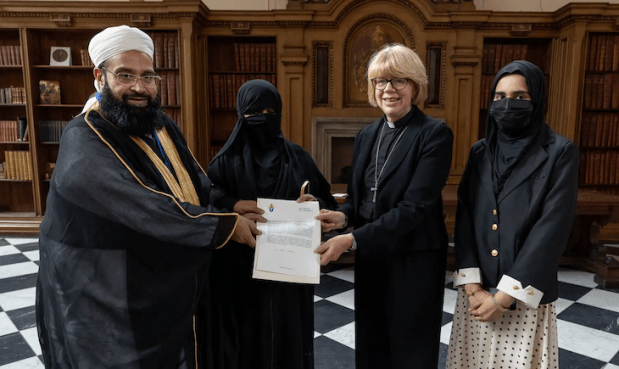
This follows on from Pope Leo’s meeting on 28 April with the new female spiritual head of the Church of England, Sarah Mullally, receiving her in the Vatican and it seems, allowing her to give a blessing at the tomb of St Peter. ‘[T]he divisions among Christians weakens our capacity to be effective bearers of that peace,’ the pontiff stated. ‘If the world is to take our preaching to heart, we must, therefore, be constant in our prayers and efforts to remove any stumbling blocks that hinder the proclamation of the Gospel.’
Those ‘stumbling blocks’ include, among other things, that the Catholic Church forbids the ordination of women and that Anglican orders are ‘absolutely null and utterly void’ (as declared by Pope Leo XIII in the document Apostolicae Curae in 1896). Of course, neither Papa Prevost nor Mullally made any prayer for the persecution of Christians, preferring to hold a pointless afternoon tea party.
The pope’s recent statements on the war in Iran have led to tensions between him, US President Donald Trump and the President’s administration more broadly. Vice President J.D. Vance, himself a Catholic, declared that while there will always be differences of opinion on topics, the pope would be advised to stick to matters of morality.
Indeed, the pope had to clarify his comments, made during his tour in Africa, that the ‘world is being ravaged by a handful of tyrants’, declaring that they were not directed at President Trump. All the while on 13 May, Pope Leo presented Iran’s Ambassador to the Vatican, Ayatollah Hossein Mokhtari, with the highest diplomatic honour of the Vatican, the ‘Order of Pius’.
The medal was awarded for Iran’s extraordinary contributions to peace and interfaith cooperation between Christians and Muslims.
So, Iran has nothing to do with financing and arming terrorists who persecute and kill Christians in Africa? The Foundation for the Defence of Democracies, among others, has reported on this nefarious activity several times.
While Pope Leo seems to be going out of his way to meet with imams and heads of other churches, calling for unity and peace, at the same time he is taking actions which will cause further disunity in the Catholic Church.
The Society of St Pius X, a fraternity which celebrates the Traditional Latin Mass, is preparing to consecrate four new bishops in July, prompting a warning of excommunication from the Vatican should the consecrations proceed. This has prompted appeals from prelates in the Church, pointing out the inconsistency of this threat while the Church accedes to the nomination of bishops by the Chinese Communist party.
The occupant of the Vatican Hill must have gravitas, otherwise his role as the Vicar of Christ on Earth will be pointless. The motto of Pope John Paul II’s pontificate was Nolite Timere (Do not be afraid). Pope Benedict XVI taught us that Deus Caritas Est (God is Love) and upon his election, exhorted us to join him as ‘a humble servant in the vineyard of the Lord’. Pope Leo last week greeted an audience to the tune of Abba’s ‘Dancing Queen’.
He seems to be the fool on the Vatican Hill.
Got something to add? Join the discussion and comment below.
You might disagree with half of it, but you’ll enjoy reading all of it. Try your first month for free, then just $2 a week for the remainder of your first year.