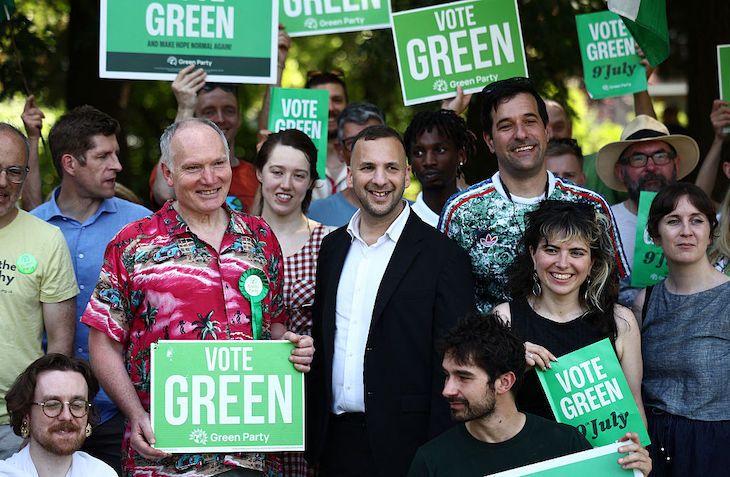
As members of the Green Party gather in Brighton for their annual conference later this week, they’re likely to be feeling pretty pleased with themselves. They’ve had a good year by anyone’s standards, polling as the country’s fourth most popular party, and with membership tripling to over 200,000.
While the Greens may be pleased with the rise in their political fortunes, we need not worry there’s going to be a green coup any time soon
The party’s successes during his first year of leadership was the main theme of Zack Polanski’s speech at the Green Gathering this summer in Chepstow in Wales. The speakers’ tent at the long-established off-grid festival was overflowing and the atmosphere buzzing with anticipation. But, unlike most of those present, I was listening as a former supporter of the Green Party and my expectations were low.
Some context: I had voted Green a few times in the previous decade, part as a protest against the main options and part as an expression of concern for the planet. Then came Covid and I watched in alarm as veteran Green Caroline Lucas led calls for longer, harder lockdowns. Subsequently, the growing authoritarianism of the party expressed itself in calls for climate-based restrictions that would de-develop Britain and end the freedoms on which our liberal democracy depends.
I also noticed that when they actually got into power, the Greens seemed to lose the plot – or rather their humanity. As a would-be Bristol resident, I was horrified by the way the Green Council disregarded locals’ concerns and used the police to impose roadblocks under the cover of darkness. The recent hassling by police officers of the photographer Alistair Hilton at a Chiswick pub after he dared to criticise a Green councillor struck me as further evidence of the censorious, heavy-handed culture at the political core of the party.
But by interests and temperament – I love nature and worry about plastic and pollution – I remain ecologically-minded. Climate change drama aside, I understand the concerns of most grassroots Greens and still hang out with them, politically homeless as I am.
Back to that tent. Polanksi was personableness personified, rotating to bestow a gentle smile on every section of his audience. ‘It’s kind of cool to be Green right now’, he said, clearly enjoying his tribe’s new-found popularity. His speech was wide-ranging and, apart from the claim that ‘excessive heat’ had caused 3,000 deaths, pretty anodyne. He talked repeatedly about the importance of healthy disagreement and the need for nuance in public debate.
This assertion prompted a question from the floor about why a group of former members were taking legal action against the party. The speaker was Zoe Hatch, co chair of Green Women’s Declaration, a breakaway group set up to ‘combat the chilling atmosphere of censure within the Green Party of England and Wales’ and suing it for discrimination following the expulsion of Hatch and others after they made gender-critical comments. Polanski responded that such views were an expression of transphobia which crossed a red line, saying: ‘for me respecting someone’s pronouns is a basic human dignity’.
His promise that the party would do all it could to promote the use of citizen assemblies to enhance democracy made my ears prick up. Citizen assemblies have been used to promote public support for dramatic measures, such as a population-wide reduction in meat consumption of up to 40 per cent by 2050. But when the workings of such assemblies are examined properly, with small numbers of people steered towards pre-determined conclusions, it is hard to see such claims as constituting anything that could reasonably considered a democratic mandate.
A question from someone active in the green movement since the 1970s effectively asked why the party was abandoning its roots as an ecology party and entering mainstream left/right politics. Polanski replied that the media were starting to understand that the party was about more than the environment, claiming as ‘a movement of system change that are linking all these things together’, it was effectively fulfilling the vision of its ecological founders.
It’s a moot point as to whether the Green Party’s forays into economic and social policy is the expression of a real shift or the fulfilment of long-established intentions only now coming to light. The policy to ‘seek the effective abolition of private landlordism‘ passed at last year’s party conference is a case in point. Since the mechanism of making private rentals economically unviable via tax changes and increased regulation is already underway through higher taxation and the Renters’ Rights Act, we have an opportunity to see this policy in action. The results are the opposite of what the Greens, as a party opposed to corporate wealth and vested interests, would want. The past year has seen an exodus of small private landlords from the rental sector, with large investors such as Lloyds Banking Group buying up many of the properties.
This illustrates a wider irony in which many of the policies advocated by the Green Party run counter to the interests of its supporters. Some live off-grid, in vans or caravans on land rented from a friendly farmer. Levying inheritance tax on farmers jeopardises such a way of life, along with the small-scale, regenerative agriculture beloved of many environmentalists. And the raft of anti-vehicle policies being implemented at national and local level make both van life and rural living more difficult.
I know from firsthand experience that Green supporters are overwhelmingly good, well-meaning people. But the movement suffers from huge naivety, with a tendency to believe in quick fixes and the infallibility of the state, combined with a reluctance to examine the real-world implications of policies.
History shows that parties which lack clarity and rootedness in reality tend not to sustain support. So while the Greens may be pleased with the rise in their political fortunes, we need not worry there’s going to be a green coup any time soon. The party is much more likely to collapse under the weight, to apply an old political metaphor, of its own internal contradictions.
In the meantime, those of us who are both freedom and nature loving will just have to carry on worrying.