Media followers learned that Scotland Yard had spent four months investigating a journalist. His offence was, it appears, emailing questions to a celebrated Cambridge professor about alleged plagiarism and improbable claims regarding events and charity.
Officers told the reporter, a man who says he was simply doing his job, to stop contacting the professor because the professor’s mental health had been affected by the questions. A law firm’s letter suggested the inquiry ‘may be racially motivated’.
The rest, as they say, is history.
It would be comforting to file this as British eccentricity. However, this seems both unlikely and unkind to the great British eccentric. Instead, it is the end-stage of a disease whose various symptoms run through many an Australian press conference, and the disease has a name: our governing elite has become a class of word, if not word-class, bankers.
The vocabulary portfolio
If we look at what major parties actually fight over, it is not delivery of goods and services – it is words.
‘Aspiration’ is held by one side like a vacant lot; ‘fairness’ by the other; ‘the fair go’ is contested title, litigated every campaign.
The words are fought over like so much terrain during The Great War, turned into mud from the combat, almost impossible to build upon, and once seized vigorously defended against trespass.
This is precisely the business model of the land-banker, and it is not an accident. It is what the establishment politician is able to do – what so much of their effort predetermines. The personnel choices reflect a professional pipeline whose entire trade is discourse. The party is governed by message-testing: the only feedback is reactions to words. The outcomes are reinforced whether through a voter panel, which cannot hear the road built or the ward staffed, but only the phrase moving a dial; or through a media economy, which pays for the gotcha by the clip.
The phrase becomes the product. Establishment forces are converging on the same degradation.
And the gotcha deserves its true name. While a party with a creed can prosecute something concrete, a party with no creed can only prosecute misspeaking – the fumbled number, the sub-optimal turn of phrase. ‘Gotcha’ politics is a blasphemy law for elite institutions that no longer believe in anything, that have no theology.
The incumbent’s version is grander: he borrows the whole country. ‘Talking down Australia’ – reached for again last month – is the word-banker’s masterstroke. On the one hand it is the leader collateralising the nation itself, so that criticism of a government becomes disloyalty to the flag. On the other, it is an attempt to capture the rival’s symbolic territory. It is like a brand advertising its margarine as tasting the same as real butter.
The exercise never quite works, because voters can tell the difference between the country and the Cabinet, but the attempt exposes the worldview: words are everything, and the key fight is over their ownership rather than the content. If leaders had the latter, there would be little need to prosecute the former.
One of the most valuable words in the entire portfolio is a four-letter one associated with economics, which somehow implies objectivity. The term is ‘cost’. Say that proposed tax cuts are a ‘cost’ to the budget and you have smuggled a baseline past the reader – the assumption that the voter’s revenue was the state’s to begin with, so that letting a worker keep his or her own earnings scores identically to spending them.
The dialect’s asymmetry is almost beautiful. We can see it happening in Britain. The threshold freeze that has dragged five million earners into higher tax bands, on its way to making three-quarters of all adults income-tax payers, is never headlined as imposing anything on workers; but unfreezing it – this will incur a ‘£100 billion cost’. In this view, only the country’s money, which people hold at the government’s whim, can ever be spent.
The same language has arrived here in matching luggage: One Nation’s package ‘could cost the budget $90 billion’ with the Opposition Leader prophesying a sovereign debt crisis. How similar to ‘neutral’ economists pronouncing Restore Britain’s cuts unjustifiable. The argument assumes both that the money is inherently the country’s and that revenue benefits do not enter the equation.
The point is not whose worldview is justified – after all, countries such as Russia and China are built on the idea of state ownership – nor is it the equation’s result. Any party can make bad choices pursuing their favourite programs. Rather, it is the focus of establishment behaviour: semantics. The fiscal scare campaign is the elite fighting about language – its home turf – against electorates who long ago noticed that the word ‘cost’ only ever points in one direction; the target result is near always the same. Elite parties search for the most powerful rhetoric which gives them what they want: in this case voters’ money. And the electorate is increasingly tired of the ploy. If ‘cost’ is the word, use it both ways: what the cut costs the budget, and what the freeze costs the worker or economic dynamism, side by side, every time.
The constabulary of words
Which brings us back to Scotland Yard, because state agencies now seem to adopt the same business model, and for the same reason. Policing a phrase is cheap: the complainant supplies the evidence, the harm is whatever the complainant reports feeling, and no detective need leave the office. Policing a burglary is expensive. It appears that enforcement, just like party competition, is migrating down the cost gradient – verbal crime is to law and order what word-banking is to policy, the burdenless substitute that lets an institution without the resources for real work keep looking busy.
It is enlightening to consider what some of these behaviours actually protect. Not something tangible – because there isn’t anything – but credentials. When the creed is gone, blasphemy law ends up defending status. It is troubling to see the machinery deployed not against simply assertions but against questions, the one thing a journalist exists to ask – the symbolic economy prepared to criminalise the audit of itself.
In Britain, the pattern has breadth: a pastor arrested over a sermon, parents arrested over comments in a school WhatsApp group, a commentator investigated over an interview – each closed, eventually, without charge, the process itself the punishment. And the cases that reach the news run conspicuously along one side of politics. Australia sits earlier on the same slope, with an eSafety apparatus and freshly expanded speech laws, and no reason to assume the gradient stops.
But the electorate is keeping the ledger even if nobody else is. Many voters have concluded, not unreasonably, that the established institutions are interested only in words: owning them, using them, and prosecuting them.
Nor is the disease confined to politics or policing; it has been running through boardrooms. Corporate cases matter because they are the control group. Budweiser went for words and lost America’s best-selling beer inside a season. John Lewis went for words; perhaps Jaguar did too, advertising everything except a car. The later Star Wars instalments through to Snow White went for words; the vegan ranges of established food companies went for words. BP, yet again, seemed to forget its business.
I fear it is the same infection – the head office trained in symbolism, the phrases sent for PR testing, the product an assumption, if not an afterthought. However, the immune system is different: consumers and shareholders deliver their verdict in a quarter, while voters, locked into a duopoly by preference and habit, need a decade.
The old economics has a word for the difference: exit. Where exit is cheap, the disease meets antibodies. Where exit is dear – a safe seat, a police force, a national broadcaster – the disease might become chronic. Which is what the insurgent burst today actually is: the electorate’s verdict, delivered late, arriving all at once.
The whole disease is one instrument-migration seen at multiple altitudes. Elite parties fight over vocabulary because their career streams are fed by the symbolic economy, their voter panels offer nothing else, and their media exposure correlates with clicks based around gotcha moments. Economists fight over costs because everything is parsed from the government ledger as though spending were divorced from voter livelihood. And increasingly our overtaxed forces seem to police phrases because, as a target, these are now valid and cheaper than either material or physical crimes.
The cure is the same at every altitude, and it is not better words or more panels. Institutions with a genuine doctrine and real belief give words a meaning; institutions without an anchored conviction give words instead a price. Listed companies are quickly judged for straying from content. The political establishment has no such restraint.
Here is my stake – it is a relatively safe one. Follow campaigning for the next national election, whether in Britain or in Australia, and count the days each party spends contesting words rather than deeds.
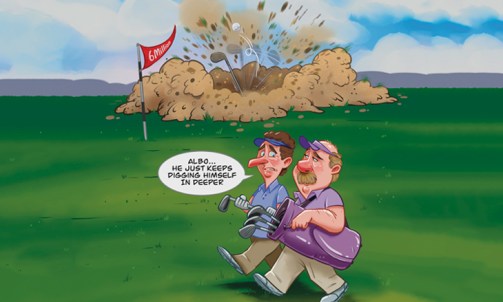
Albanese keeps trying to repurpose old conservative rhetoric as if not just his content bank but even his ideas bank were empty. Taylor argues about policy costs or program comprehensiveness. None of it is directly an argument geared in material terms towards delivering better lives.