To help explain Pauline Hanson and One Nation’s rise, it is instructive to reference David Goodhart’s seminal work, The Road to Somewhere, which is an attempt to explain the reasons for Brexit and the way the political landscape would be shaped into the future.
Goodhart famously divided people into two broad categories, the ‘anywheres’ and the ‘somewheres’.
The anywhere can be defined as someone who is university educated, is employed in a highly paid profession (either private or public sector), and is upwardly mobile, both economically and socially. In short, they would be comfortable living and working anywhere in the world and they see mass migration and multiculturalism as positive, from which they are largely inoculated from any downsides.
The somewhere is not university educated, they may not even have vocational qualifications, often performing low-to-middle income jobs, with little prospect of improving their earnings capacity. They are very much rooted in the community in which they have likely been born into and raised their own family in. In short, this person is not going anywhere, and they look upon globalisation and open borders with suspicion and growing resentment.
At the risk of stating the obvious, these same categories of people exist in Australia, the anywheres dominate our politics and institutions, including the universities and media, they live in urban areas with ready access to public transport, their income is of a level at which they don’t really feel the impacts of the higher cost of living, and they pride themselves on what can be called their conspicuous compassion. This includes being pro Voice and starting every meeting with an acknowledgement of country, pro LGBTQI, and welcoming of the come one, come all approach to mass migration. They are more likely than not to embrace the mantra of ‘diversity is our strength’.
Perhaps most importantly these people have benefited greatly from globalisation and free trade including the promotion of free markets through deregulation and privatisation. These people work in the professional services/financial sectors and have skills that are transferable around the world. The world is indeed their oyster.
None of this is meant as a criticism of the anywheres, rather it is merely an attempt at laying out some obvious facts. The anywheres have pretty much monopolised our public discourse for the last 40 or so years, and it has not mattered who was in government, starting under Hawke (granted Whitlam’s 25 per cent across the board reduction in tariffs could be seen as a precursor), gathering pace under Howard and continuing to this day.
The somewheres do also live in urban areas, but they can be found en masse in outer, peri-urban suburbs, and especially in the regions. If they own property, it has been purchased with what has become a crippling mortgage, due to high interest rates. Being able to earn overtime in a given week can be the difference between affording a takeaway pizza on the weekend for the family, and not. Both partners work, often not by choice, but out of economic necessity, meaning corporatised childcare is a necessary evil, unless they are fortunate enough to have supportive grandparents or other close family and friends.
If not practising Christians, they live their lives based on Christian beliefs, family and hard work matters, they want a better life for their children, which means more equality of opportunities, as opposed to equality of outcomes. They are for free enterprise, but no unfettered free markets. With this sense of fairness in mind, they are sick and tired of the Woke agenda being forced down their throats. When they spend their hard-earned money on attending a major AFL or NRL game, they are always respectful of the obligatory Welcome to Country but have likewise grown tired of its monotony and question what it actually achieves in practical terms.
They are rooted to their local community, often involved in local organisations, especially sport but also religion, and they have no intention of moving. If they do see the opportunity for any mobility, it is either considered unattainable or just not for them. Unlike the anywheres, they don’t see the world as their oyster, and don’t especially see any benefits from mass migration and multiculturalism, either economically or socially.
It is the somewheres who have been sacrificed at the altar of globalisation and free trade, and although it is nice to be able to buy cheap shoes, clothing, cars and electrical goods, it has been at the expense of local, well-paid jobs, and what were meaningful, and respected careers.
Goodhart makes many points that resonate, but it is this one that in my view above all nails the problem and helps to explain why One Nation has become so popular with the somewheres:
‘Both the centre left and centre right critiques of the modern capitalist economy take too little account of human psychology. Work is not just about receiving a decent income and realising one’s individual talents. There is intrinsic satisfaction from a job well done and from the teamwork that usually goes with it. But it is also about feeling valued and respected through working on behalf of others, particularly one’s family, and through making a public contribution’.
In Australia, Labor and the Liberals are both guilty of this, because they are populated by anywheres who are all about realising one’s talents. After all, they are the political class, and the living embodiment of such a worldview. Once again, this is not intended as a criticism, rather it is a simple fact.
That then leaves Hanson and One Nation, who speak the language of the somewheres. They view Hanson in particular as having the courage of her convictions, having been consistent in her beliefs for the last 30 years. This includes doing something to restore the worth and dignity that they feel has been stripped away from them under unfettered free markets and decades of economic rationalist policies.
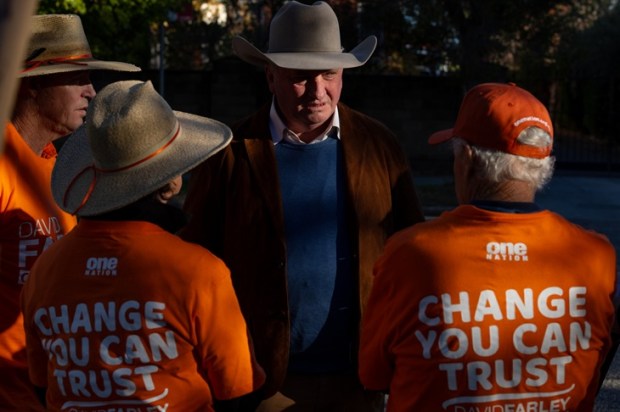
Hanson is, however, reaching an inflection point, because One Nation lacks a firm ideological basis, let alone a coherent set of principles which those in the party fundamentally agree with and are disciplined enough to not deviate from. Immigration being a recent case in point, where One Nation’s Farrer MP, David Farley thought is acceptable to contradict party policy. It is also highlighted by the recent appointment of Mike Newman to the role of NSW party leader. Newman, the son of investment banker Maurice Newman, has spent the last 25 years living in Japan and speaks multiple languages. He is the very definition of an anywhere, and to prove the point, at his inaugural press conference, he answered a question from a Japanese journalist in Japanese, receiving a swift rebuke from Hanson, who told Newman to speak in English.
Newman said he also believed the ‘market should decide’ economic matters, and to cap it all off, approvingly quoted the libertarian American economist, Thomas Sowell. Hanson is clearly no free marketeer, and at times she looked uncomfortable with Newman’s comments, which would likely not resonate with the somewheres.
Hanson should be careful, because she needs to attract and accommodate talented and capable people to the party, even those who are anywheres. But she also must not forget those who ‘brung her to the dance’ in the first place, that being the somewheres. On economics in particular, a conservative believes in the importance of free enterprise but not in unfettered and just as importantly, unfair free markets.
The distinction is an important one, because the somewheres perceive Labor and the Liberals to believe in the latter and One Nation the former. This is helping to fuel One Nation’s popularity, and that means Hanson needs to be careful not to betray the somewheres for the sake of accommodating the fashionable ideology of the anywheres. That also equally goes for social and cultural issues.