Watching re-runs of Landline the other night, I saw a business backed by Gina Rinehart get to air without the ABC’s usual moralising. At the end, some archival Australiana showed an old professor and his wife studying Lake Eyre. They looked like people who had gone to the country to find something out. I thought the presenters a little too polished for a program about the bush.
Then came the cane.
One episode treated cane farmers and cane workers as migrants who did the hardest labour. That much is true. In 20th Century North Queensland, they worked the cane fields, bought farms, and raised large families, often a dozen children, under difficult conditions. It is a genuine migrant success story.
What it is not is the story of how Australia was built.
To say those later arrivals ‘built Australia’ draws a long bow. It does not deny their labour. It objects to a narrative that treats the people who came before them as a blank, or a disgrace – as if a bunch of useless convicts sat on their hands until the immigrants arrived and, to channel Monty Python, there was much rejoicing.
One segment followed a man who slept rough until he appeared in a cane-farm’s books and later went on to great things. The story can be true and still leave out the pioneering families already on the land.
In the 1850s my great-great-great-grandfather suddenly appeared on the ration books at Ollera Station, near Guyra. He worked as a shepherd with a mate. Fenced paddocks followed. Shepherds became graziers and shearers. The family bought land at Tingha and Tenterden, then moved to ‘Ivanhoe’ via Gunnedah. A road still bears the family name. Like the later Mediterranean migrants, they had large families – often twelve children. After the Great War those families thinned out.
Those households, and many like them, carved a working country out of land that had offered the First and Second Fleets almost nothing. Twentieth-century migrants did not inherit a wilderness. They inherited a prosperity someone else had already sweated into being. That is why they came.
A proper narrative is the story a country tells itself. The West has been doing it since Homer with The Iliad and The Odyssey. Tales a people kept because they were worth keeping.
Harold Bloom spent a career defending that habit. In The Western Canon: The Books and School of the Ages, he went after the academic and cultural critics who judged literature by political, historical, or ideological tests instead of aesthetic merit. I once wrote to him. He replied with thanks. He was ahead of his time.
The habit of scoring the past by the politics of the present is what the cane-farm story was doing. A true episode of migrant hard yakka is enlisted to imply that the country before them was empty, shameful, or waiting to be invented. The work is not in doubt. The rewrite of who came first is.
Professor James Allan wrote in these pages recently that his mainstream views were now regarded as far-right. So would John F. Kennedy’s record.
It’s nuts, and people are no longer falling for it.
When Menzies spoke of the ‘forgotten people’, he meant the middle class – the engine room of the economy, neither rich enough to live off capital nor poor enough to live off the state.
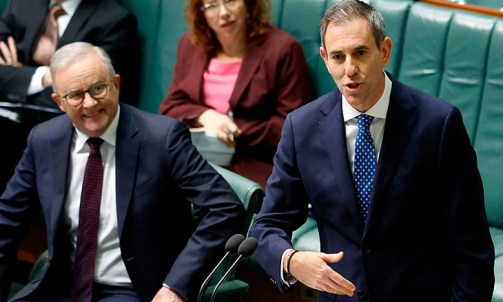
Under Albanese, that class has been crowded out by a client class of grant recipients, public-sector dependants, and subsidised NGOs for whom government is not a last resort but a business model. To Menzies’ forgotten people that idea was sacrilege. To Labor’s clients it is an entitlement.
Somebody always has to pay.
The people paying, in money and in culture, are ordinary Australians.
When I read Barnaby Joyce’s statements, I cringe a little at the language and the repetition. His message is right, but the delivery is rough. Polish it and you would only sound like the Coalition. And people have stopped trusting the polish.
This morning on my bread run through Central NSW I pulled into the truck-stop toilets at Springdale. They are the cleanest in the region, and there is always a bar of soap on the sink – a rarity in such places. The cleaner was there.
‘Do you put the soap out?’
‘Yes,’ she said. ‘I clean these twice a day. If I fill the liquid soap, it runs all over the sink before anyone uses it.’
I told her I had always wanted to thank whoever did that. She was chuffed, then admitted the reputation meant she now had to work twice as hard. Everybody stops there.
Later, I arrived at a dock early, but a big semi was sitting there waiting for it to open (they can take up to an hour to unload). As I sat there, my mate Phil the Milko arrived in his truck. He usually lets me go in front of him because he knows what I have to deal with if I am late elsewhere. He parked behind the semi, got out and spoke with the dock staff, and a few minutes later the dock opened and he waved me in. He’s quite the charmer, it seems.
Phil wears a pink beanie when it’s cold and he has a pink travel mug for his coffee. The colour is in support of breast cancer charities. Another multi-generational Aussie.
Back on the road, I put on Slim Dusty. The song that came up was ‘Three Rivers Hotel’. I later learnt Stan Coster wrote it – a grader driver on the Townsville-Greenvale line (my father was a grader driver), putting a construction camp’s mess hut into verse. Slim sang other men’s lives as often as his own. His wife, Joy McKean, wrote ‘Lights on the Hill’. I was in a truck. After some of the things you see on the road, I left that one alone.
The stories you learn by living them are not simply political narratives. They are the country. (As Slim Dusty sang in ‘Where Country Is’.)
National identity is not a dirty word. It is a fact.
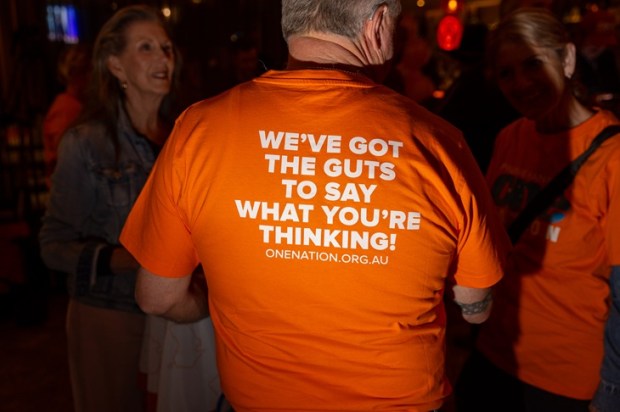
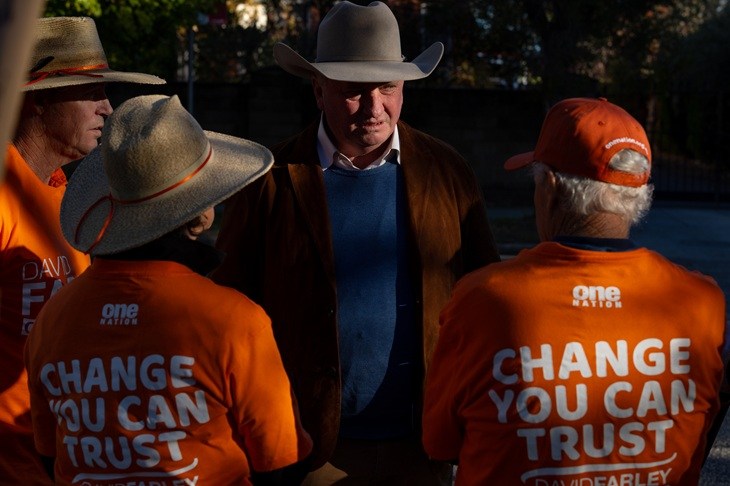
Labor can keep spinning the alternative. The people still moving to One Nation, through all the noise from the majors, are not Menzies’ forgotten people. They are the fed-up people. Fed up with narratives that write their families out of two centuries, fed up with the idea that government has all the answers, and fed up with Labor taking a bow over a one per cent undershoot on a near-trillion-dollar debt, achieved not by restraint, but by collecting more tax, especially from their super. The majors talk as if these people were a problem to be managed. Yet for all their talk, the majors lack the philosophical capital to see these people as anything else.
Dr Michael de Percy @FlaneurPolitiq is the Spectator Australia’s Canberra Press Gallery Correspondent. If you’d like to support his writing, please shout him a drink over at Donorbox.