Earlier this month, Defence Industry Minister Pat Conroy stirred controversy during a speech at the National Press Club. In pitching Labor as being the better choice for national security, Conroy said this:
‘I’m very interested in disclosing what really happened before the second world war and during the second world war, when it was a choice between John Curtin and Nazi appeaser Robert Gordon Menzies.’
The reaction was predictable. Labor supporters cheered it as a sharp political hit. The Liberals were furious. Coalition figures dismissed the claim as baseless and demanded an apology.
None came.
It would be easy to wave this away as ordinary partisan hackery and move on. But there has been little serious effort to examine the underlying claims. Let’s dive into it.
Did Menzies Support Appeasement?
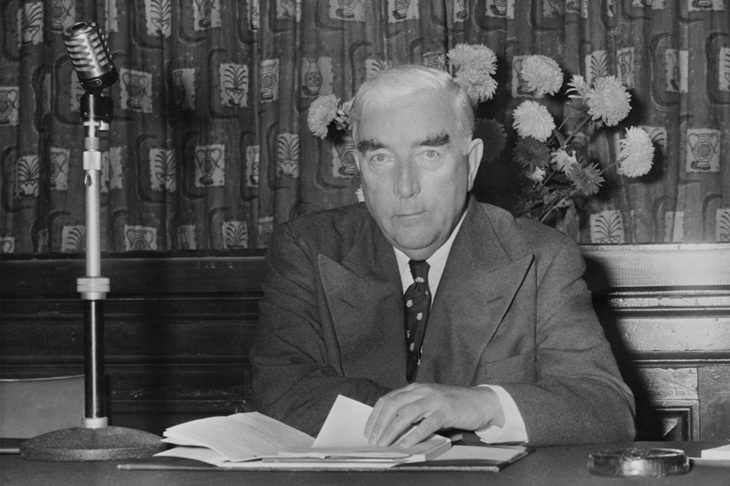
As Attorney-General (and then Prime Minister from 1939) Menzies strongly supported Neville Chamberlain’s policy of appeasement. There’s no way around this.
Throughout the interwar years he backed approaches he believed could avoid another catastrophic war. In 1938, he made an official visit to Nazi Germany, and supported the Munich Agreement.
There was also the now-infamous incident in 1938, in which waterside workers refused to load pig iron bound for Imperial Japan, knowing it would be used for weapons during the Second Sino-Japanese War. The Nanjing Massacre was public knowledge by this point. As Attorney-General, Menzies supported the shipment and threatened legal action to end the strike. Japan would later attack Australia.
It was not his finest hour.
But here’s the million-dollar question: Was Menzies unique in this regard?
The answer is a clear no.
Appeasement was the default policy of the British Empire in the lead-up to the second world war. The first world war had been an unparalleled trauma that most of the democratic world was desperate to avoid repeating. It was the official policy of the Lyons government in which Menzies served as Attorney-General. It was not a personal eccentricity of his.
On September 3, 1939, Menzies immediately declared Australia at war with Germany following Britain’s declaration and delivered a radio broadcast condemning Hitler’s actions. He had earlier described Nazi anti-Semitism as ‘barbaric and medieval’.
It’s also important to note that the Labor Party itself in the 1930s was not a pure anti-appeasement force. The party carried the anti-conscription legacy of the first world war and displayed some isolationist tendencies. Labor frequently criticised or voted against practical defence preparedness measures under the Lyons government, while at the same time rhetorically advocating greater self-reliance. Both the UAP and Labor largely followed Britain’s lead until war became inevitable.
Selective History
This is a can of worms Labor has no interest in opening. Let’s apply the same selective, context-free, morally-loaded standard that Conroy used on Menzies to another Australian political figure. In the aftermath of the Vietnam War, large numbers of South Vietnamese fled their country to escape persecution under the new communist regime. Australia under the Whitlam government was far from welcoming. Whitlam’s administration was deeply reluctant to accept significant numbers of these refugees.
Just how hostile was he to the idea of welcoming these refugees?
Clyde Cameron (a Minister in the Whitlam government) gives us some insight. Here is a statement straight from Whitlam (from Cameron’s memoirs):
‘I’m not having hundreds of f***** Vietnamese Balts coming into this country with their religious and political hatreds against us.’ -Gough Whitlam
Talk about welcoming.
Whitlam thought that because many of the South Vietnamese refugees were anti communist, they would also be anti-Labor.
He also wanted to prioritise diplomatic relations with the new Hanoi government and was concerned that taking in South Vietnamese refugees would complicate that.
He prioritised establishing good relations with the new communist government over helping out the people who had fought and bled alongside Australian forces.
Unlike Menzies, Whitlam cannot claim he was simply following the mainstream practice of the Western democracies. The United States and Canada accepted thousands of Indochinese refugees in the immediate aftermath of the war. Under Whitlam, Australia accepted only a few hundred. By contrast, the Fraser government later admitted nearly 70,000 refugees from Indochina.
This is a chapter of history Labor would prefer remained quiet.
None of this makes Whitlam a communist sympathiser in any serious historical sense. He had domestic political calculations and was operating in a complex strategic environment. It does not prove personal affinity for communist ideology. But under the exact standards Conroy applied to Menzies, the smear would be straightforward to construct.
Partisanship is a Disease
We all make mistakes and none of us are perfect. People we admire have done things we would now strongly reject. This is something that we should all keep in mind, especially when evaluating the politicians of today. Never assume that someone is incapable of making mistakes or bad decisions just because you happen to agree with their political views, or because they may be charismatic.
The deeper problem is the distortion of history.
Calling Robert Menzies a ‘Nazi appeaser’ is not neutral description. The wording may imply personal affinity for National Socialism and therefore moral failure. The reality is that Menzies followed the mainstream policy of the British Empire and most Western democracies at the time.
We must be careful not to turn history into a partisan game. It reduces the nuances of history into a crude us-versus-them morality play in which one side is pure and the other is tainted. Once history is treated as a weapon rather than a record to be understood, every side’s heroes become fair game.
That is not serious engagement with the past.
It trains people to treat the past as a tool for scoring points in the present rather than a body of evidence to be examined on its own terms.
When politicians and their supporters start mining history selectively for ammunition, the goal is no longer understanding what happened or why. It becomes winning the next news cycle. Nuance disappears. Context is discarded. Figures are reduced to moustache-twirling cartoon villains or angelic saints depending on which team needs the story. Over time, this weakens public discourse and the capacity for honest discussion.
Fortunately, there is an alternative.
We can choose to treat history as something to be understood rather than weaponised. Doing so does not require pretending past leaders were flawless. It simply requires refusing to reduce them to props in today’s fights. A country that can look at its own record with honesty, including the uncomfortable parts, is better placed to make better judgements in the present. That is a more useful inheritance than another round of selective smears.
John Ogilvie is a writer, and the policy advisor for Mannwest Group.