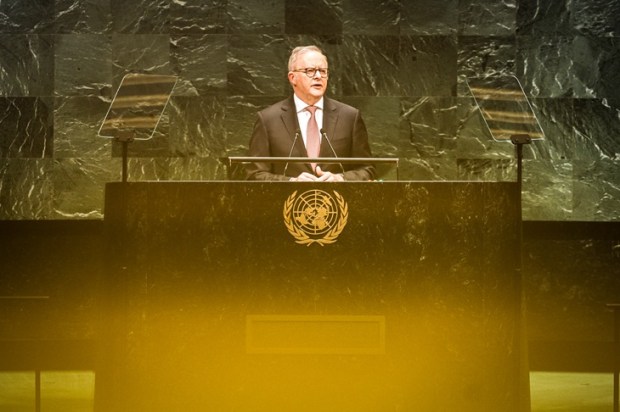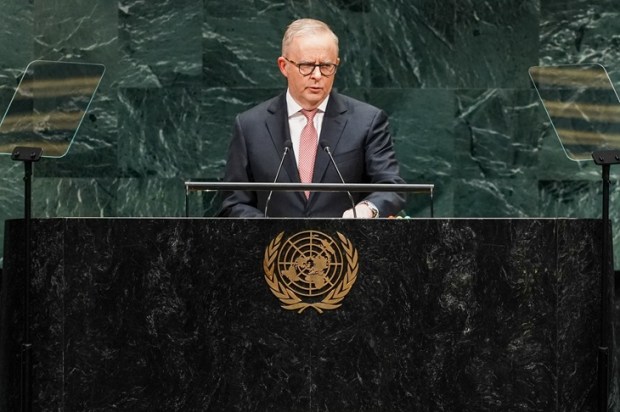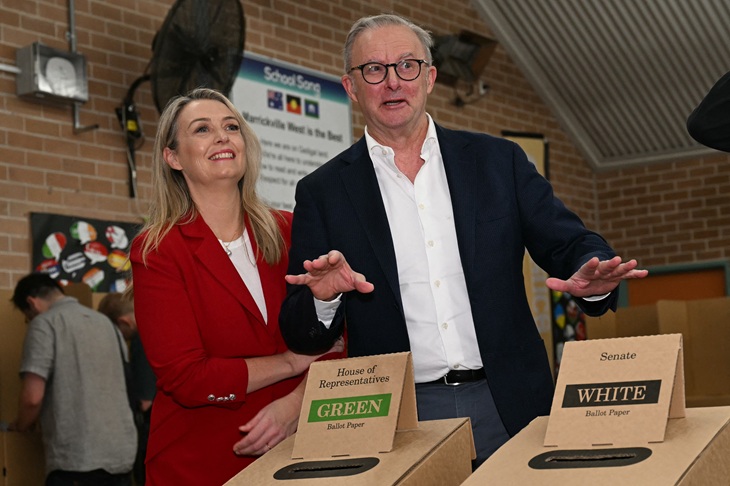
When comedian Nikki Osborne asked Prime Minister Anthony Albanese to play a game of ‘shag, marry, date’ with Kylie Minogue, Nicole Kidman, and Rhonda Burchmore, he initially hesitated.
‘I’ve just got married,’ he joked.
But after being pressed to answer hypothetically, he replied: ‘Oh, Kylie, clearly.’
Osborne then laughed, ‘You’d marry Kylie, shag her and date her?’
Albanese responded: ‘All of the above.’
Now imagine those words coming from a Coalition Prime Minister.
Imagine if Angus Taylor, Peter Dutton, or Scott Morrison had publicly said they wanted to ‘shag’ one of Australia’s best-known female entertainers.
Would there have been calls for resignation?
Would there have been accusations of misogyny?
Would there have been lectures about respect, objectification, and the responsibility of leaders to model appropriate behaviour?
Of course there would. Even the public broadcaster, the ABC would be in overdrive.
Instead, the response to Anthony Albanese has been remarkably restrained. While some criticism has emerged, the chorus that Australians have come to expect whenever a conservative politician is accused of sexism has been conspicuously absent.
The Prime Minister has since released a statement apologising ‘unequivocally’ for the comments.
However, the continued media silence is revealing.
This is not about whether Anthony Albanese should resign over an off-colour joke. It is about whether the standards we claim to uphold actually mean anything.
Either sexually objectifying comments about women are inappropriate for a Prime Minister, or they are not.
There cannot be one standard for Labor and another for the Coalition.
Deputy Prime Minister Richard Marles defended the Prime Minister by pointing to Labor being the first government to achieve gender parity in Cabinet.
With respect, Richard, that makes the episode more disappointing, not less.
A government that rightly prides itself on promoting women should surely understand why many Australians found these remarks beneath the dignity of the office. One wonders how many female ministers privately cringed while publicly defending comments they would almost certainly have condemned had they been uttered by a conservative leader.
This selective outrage is becoming a defining feature of modern politics.
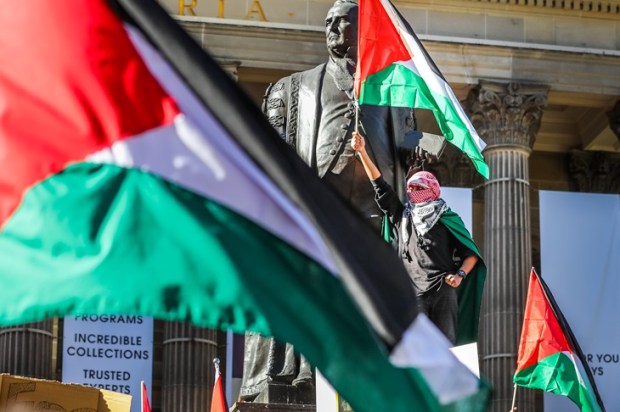
I experienced it personally when my former MP branded me a misogynist simply for questioning their support for bringing Gazans into the electorate. It was a disagreement over public policy, nothing to do with gender. Instead of debating the issue, I was given a label.
Yet when a Prime Minister makes remarks about Kylie Minogue, many of the same voices suddenly discover nuance, context and forgiveness.
The inconsistency is even harder to ignore because it is so recent. During Victoria’s ‘Ditch the Witch’ campaign directed at Premier Jacinta Allan, Prime Minister Anthony Albanese was quick to characterise the slogan as misogynistic. Regardless of what one thinks of the campaign itself, he had no hesitation in condemning language directed at a female political leader. Yet when confronted with his own ‘all of the above’ remarks about Kylie Minogue, the standard suddenly seemed rather different.
That is the point. The issue is not whether one incident is more serious than the other. It is whether the same principles are applied consistently. If ‘words matter’ when spoken by your opponents, they should matter just as much when they are your own.
Ah, the double standard. It has become one of the great jokes of modern politics, except it is no laughing matter. Public confidence is eroded when Australians see one set of rules applied to political allies and another to political opponents. Principles cease to be principles when they are enforced selectively.
Perhaps none of this should surprise us.
It reflects a broader trend in Australian politics, where virtue signalling too often appears to have replaced moral clarity.
Whether it is the decision to repatriate Australian women who travelled to join the so-called Islamic State, or immigration decisions relating to people fleeing the conflict in Gaza, critics argue this government too often asks, ‘How does this win votes?’ before asking, ‘Is this the right decision for Australia?’
We no longer judge conduct by asking whether it is right or wrong.
Instead, we increasingly judge it according to the identity of the person involved. Critical race theory at its finest:
Politics.
Skin colour.
Sexual orientation.
Activist credentials.
The same behaviour attracts outrage or forgiveness depending entirely on who commits it.
That is not equality.
It is not justice.
It is tribalism.
A liberal democracy depends on universal standards. Any wonder social cohesion is falling apart in this country.
We should judge people by the same measure regardless of whether they are progressive or conservative, male or female, gay or straight, black or white.
We should judge actions on their merits – not on the identity of the person performing them.
Right and wrong should not have a political party.
Respect for women should not depend on opinion polls.
Equality should not be selective.
If misogynistic language is unacceptable, then it is unacceptable regardless of who utters it.
If respect for women is a genuine principle, then it should never become optional because the offender belongs to the ‘correct’ political tribe.
Australians are growing weary of selective outrage.
They are tired of watching ordinary citizens labelled sexist, racist, or intolerant for expressing legitimate policy views, while political leaders receive understanding and forgiveness for conduct that would have destroyed an opponent.
If principles only apply when they are politically convenient, they are not principles at all.
They are merely partisan weapons.
The Albanese-Kylie Minogue episode will soon fade from headlines.
The double standard it exposed should not.
Because once a society abandons one standard for everyone, it no longer has standards.
It has tribes and no moral clarity.