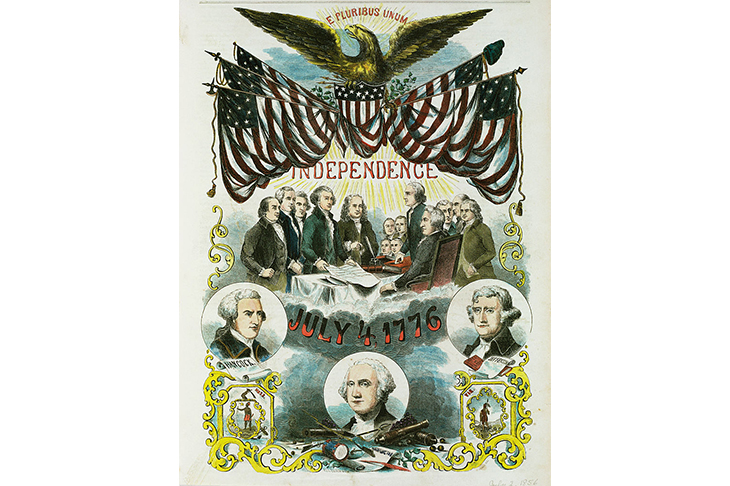
Two hundred and fifty years ago today, on 4 July 1776, fifty-six men adopted the Declaration of Independence. It is called a declaration of independence, but that is the polite version. In practical terms, it was a declaration of war. And in signing it, these men committed an act of treason against the most powerful empire on earth.
The document most of these men signed was not ready until 2 August, but either way the charge was the same. To endorse that document was to invite the gallows. Benjamin Franklin is said to have caught the mood noting that ‘We must all hang together, or we shall most assuredly all hang separately.’
They did not hang. The war was won. And the world has never been quite the same since.
What made the Declaration extraordinary was not the revolution it triggered but the argument it made. Thomas Jefferson, drawing, with some irony on a tradition of political philosophy that ran largely through Britain, produced a document that smuggled universal principles inside a list of colonial complaints.
There were twenty-seven grievances in all including the obstruction of justice, the dissolution of elected assemblies, the strangling of trade, taxation without consent, and the waging of war against the very people the Crown was meant to govern.
The list was meticulous and lawyerly for good reason. The revolutionaries were building a case, showing a watching world that their rebellion was justified, proportionate and measured rather than a fit of colonial temper.
It is the document’s second paragraph, though, that has echoed down the centuries: ‘We hold these truths to be self-evident, that all men are created equal, that they are endowed by their Creator with certain unalienable rights, that among these are life, liberty and the pursuit of happiness.’
None of this was self-evident in 1776. It was revolutionary. Almost every human being who had ever lived had done so under arrangements that assumed the precise opposite. That birth determined destiny, that station was fixed by God, and that government existed to serve those at the top rather than to protect the dignity of those at the bottom.
Jefferson did not merely reject that order but pronounced it self-evidently wrong.
The intellectual inheritance was thoroughly British. John Locke was the starting point. His Second Treatise of Government, published in 1689 in the wake of the Glorious Revolution, set out the claims Jefferson would build upon: that government draws its legitimacy from the consent of the governed, that men possess natural rights, and that a ruler who systematically violates those rights forfeits his right to govern.
The colonists, in other words, invoked Britain’s own tradition of liberty to justify breaking from Britain itself. They claimed the rights of Englishmen by refusing to remain subjects of the English king.
The Scottish Enlightenment pushed the argument further. Adam Smith subjected inherited authority to the test of reason, locating human dignity in agency rather than in rank or blood.
Where Locke had written of property, Jefferson wrote of the pursuit of happiness, a quiet substitution that shifted the purpose of government from protecting what people owned to enabling what they might become.
The experiment that followed was anything but a sure thing. The founders were not building on settled precedent. Republics had existed before and had collapsed. Democracies had been tried and abandoned.
What the Americans proved, imperfectly and at significant cost, and only after a civil war fought to begin correcting the contradiction of slavery written into their founding, was that self-government could endure. That rights could be set down, defended and renewed across generations. That a nation built around an idea rather than around blood and soil could last.
America’s Constitution, in force since 1789, is the oldest written national charter still governing a country anywhere on earth. That is no small achievement for an experiment so many expected to fail.
But the Declaration’s deepest legacy was never just American. The ideas escaped.
The French borrowed its language in 1789. Britain itself edged, haltingly but irreversibly, towards full parliamentary democracy. The great independence movements of the twentieth century framed their demands in terms Jefferson had pioneered, copying not only its spirit but often its very form. The proposition that governments derive their just powers from the consent of the governed is now so widely assumed that even dictators feel obliged to stage elections, however fraudulent, because the idea has travelled too far to ignore.
Australia is no exception. When the Australian constitutional framers gathered through the 1890s to design a federal commonwealth, they raided the American model for what was useful and politely declined the rest. From Washington they took federalism, a Senate granting the states equal weight regardless of population, a written constitution as supreme law, and judicial review. From Westminster they kept responsible government and the Crown.
The result, an odd but durable hybrid sometimes called the Washminster system, came into force on 1 January 1901.
The instinct that runs through it traces straight back to the Declaration. The Australian framers borrowed the institutions but trusted parliament and common law where the Americans trusted entrenched rights, declining to write a bill of rights into the document at all. What crossed the Pacific was the architecture of self-government.
None of this was inevitable. It required men willing to pledge, in the American Declaration’s own closing words, their lives, their fortunes and their sacred honour to a proposition that looked, by any sober assessment in 1776, unlikely to prevail. Plenty of clever men in London expected the whole enterprise to collapse. It required an argument precise enough to justify a revolution and universal enough to outlive one.
Two and a half centuries on, the Declaration of Independence stands as something rarer than a founding document. It stands as proof that ideas matter, and that a well-made argument can change the world.
The men who signed it did not know they were rewriting human history. They thought they were saving their colonies. They managed, as it turned out, to do rather more than that.
Happy birthday, Uncle Sam. The world is better for your arrival.
Got something to add? Join the discussion and comment below.
Dimitri Burshtein is at Eminence Advisory. Peter Swan AO is at the UNSW-Sydney Business School.
You might disagree with half of it, but you’ll enjoy reading all of it. Try your first month for free, then just $2 a week for the remainder of your first year.