For someone arriving in London for the Alliance for Responsible Citizenship conference, the weather forecast looked positively Mediterranean. Early morning walks through Hyde Park and Kensington Gardens with #3 – who now lives nearby – beckoned.
As it turned out, it was hot. Bloody hot. Proper Australian hot. Hot enough that I found myself ducking into Marks & Spencer for a couple of emergency T-shirts. By the end of the week Hyde Park was beginning to look almost Australian, the grass just starting to brown. Looking across it, I could almost have been back in Centennial Park in mid-January.
But the weather wasn’t the only thing that had changed.
The political conversation had changed too.
The Alliance for Responsible Citizenship (ARC) is still caricatured by parts of the progressive media as a gathering of the ‘far right’. Having now attended twice, I an assure you that that description bears almost no resemblance to reality. If anything, it is a modern concilium: economists, historians, politicians, child psychologists, journalists, technologists, business people, academics – even headmistresses – many with a Christian faith, some without. They are united less by ideology than by a shared conviction that something fundamental in Western society has drifted off course.
The first conference in London in 2023 felt like an awakening, a diagnosis of sorts. This year’s gathering felt different. The mood was calmer, more confident and the conversation much richer. Increasingly, Britain feels less like a country searching for another insurgent than one looking for an adult.
I bumped into our venerable editor Rowan Dean in Kensington High Street while shopping for those emergency T-shirts. I suggested, only half joking, that he might soon have to rename Outsiders, his weekly Sky News program. What he and others have been arguing for years is no longer quite so outside. Debates about immigration, national identity, freedom of speech, bureaucratic overreach, DEI, the large-scale renewables scam and the extraordinary costs of ideological policymaking are no longer fringe questions. They are rapidly becoming the central political questions of the Anglosphere.
That doesn’t mean the argument is over. Reform remains the formidable force in Britain, just as One Nation has become the insurgent force in Australia. But something has shifted. As Nigel Farage has become part of Britain’s political furniture, voters may be beginning to ask a different question.
Who governs? And what does a new kind of government look like?
Which is why the most interesting political figure in London last week wasn’t Nigel Farage.
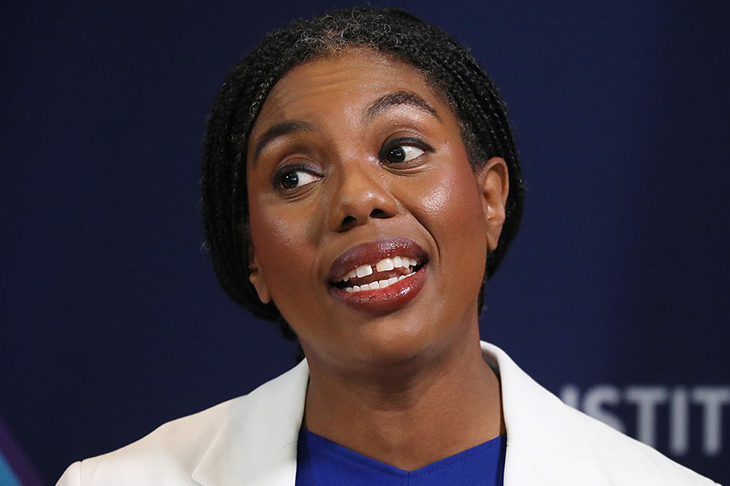
It was Kemi Badenoch.
Only a year ago Badenoch was widely dismissed as a stop-gap leader presiding over a Conservative party stranded in the mid-teens in the polls. She was written off as wooden, invisible and politically tone-deaf. While Reform surged, Farage dominated the headlines and Badenoch struggled to find traction, even oxygen. The Conservatives were gone for all money. Or so they said.
Yet something interesting has begun to happen.
The conversation around Badenoch has changed.
She has become Britain’s governess.
Rather than fighting the tactical battle of the day, she increasingly returns to first principles. Why merit matters. Why equality before the law matters. Why freedom of speech deserves protection. Why citizenship carries obligations as well as rights. Why governments cannot indefinitely spend money that they have not first earned through a productive economy. Why welfare states cannot flourish without productive economies. Why defence once again deserves priority, even over welfare. These are the elemental lessons of governing that scarcely required explanation a generation ago.
It is an oddly old-fashioned style of politics. Less performance than instruction. Less outrage than explanation. Although she now lands the occasional skewer in the Commons and sometimes even looks as though she is enjoying herself, her persona is overwhelmingly polite, grounded and reassuring. Measured.
The approach is gaining traction because many voters had almost forgotten those first principles. The muscle memory was always there. Now someone is reminding them.
For much of the past decade, the populist right’s task has been diagnosis. Brexit. Trump. Identity politics. Immigration. Net zero. National sovereignty. The politics has been about identifying what has gone wrong.
Increasingly, however, politics looks to be entering a different phase.
Through Badenoch, at least, diagnosis is beginning to give way to government.
That shift was reflected throughout the ARC conference itself. Three years ago the focus was on explaining the West’s cultural and institutional drift. This year the organisers spoke instead about reconstruction. Their closing communiqué captured the mood perfectly:
‘Reconstruction is not nostalgia. It is not longing for a world that has gone. It is the patient, unglamorous work of laying foundations again. The institutions to renew, the families to strengthen, the enterprise to unleash, the faith to recover.’
That presents both an opportunity and a challenge for parties like Reform and One Nation. Once voters believe they have finally been heard, they inevitably begin asking something else entirely.
Who can run the economy? Who can rebuild institutions? Who can keep the country safe? Who can govern?
Protest politics will remain with us. Grievance about cultural and economic failures is real. Repentance by former incumbents is necessary. But once voters believe they have finally been heard, they may begin asking different questions – not what is wrong, but who can put it right.
Britain may well be ahead of Australia in beginning to ask those questions. My instinct is that the next decade on the centre-right will belong not to the loudest insurgent – the insurgents have already won this moment – but to the strongest, most principled and most competent conservative.
For the first time in years, Britain may be discovering that what it needs – and what it may ultimately come to prefer – is not another revolutionary, but an old-fashioned governess: sensible, steady, competent. The kind of person you can trust with your children’s futures.
Got something to add? Join the discussion and comment below.
You might disagree with half of it, but you’ll enjoy reading all of it. Try your first month for free, then just $2 a week for the remainder of your first year.