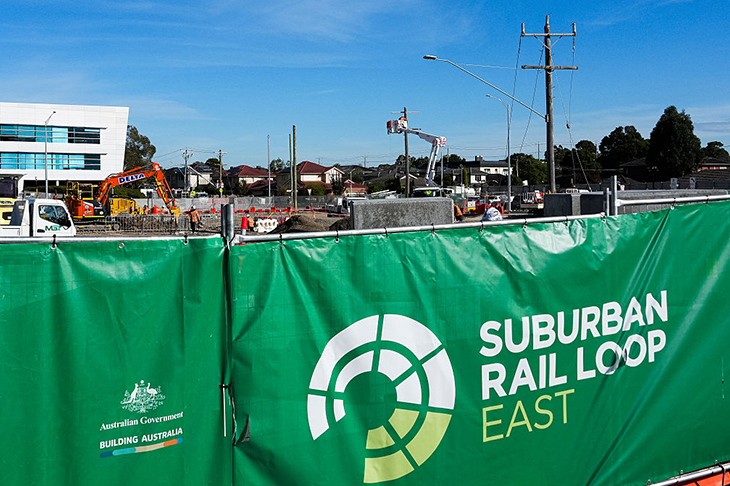
I’m always up for a bit of an adventure. So, when I was in Melbourne recently, I thought I would check out one of the recently completed Big Build projects undertaken at massive expense and after years of delay. The Metro Tunnel rail project links the south-eastern suburbs with a paddock in North Melbourne.
The final cost came in over twice the original estimate; we’re talking a total of $13 billion. It’s only nine kilometres in total, so that’s a staggering $1.45 billion per kilometre, although there are five new stations.
The argument was, which was largely correct, that the original underground rail loop was full and there was a need for another one to accommodate a rapidly rising population.
But sound justification and cost-effectiveness are different things. Of course, the government has tried to hide the compromises that were made during the construction of the Metro Tunnel as well as the near catastrophes. We were promised a train every three minutes, a pledge that has been quietly forgotten.
My adventure was perfectly satisfactory although it was hard to see how so much money was spent. It had all the look and feel of just another rail loop.
I mention this because I have just ended my state budget reporting season. I’m not sure how I got involved in the first place, but it’s a bit like the Hotel California as far as media bosses are concerned. Gosh, I even used to attend some of the lock-ups, but Covid gave me an excuse to quit that habit.
(I would always plot how I could take an early mark at these excruciating events – life-threatening illness coming on, grandmother died – but the insouciant public servants at the desk would generally let me escape whatever I said.)
Reading state – and I should add territory – budget papers is like reading fairy stories, something I do a lot these days. Can I tell you that the imaginary tales I read with my grandchildren have more credibility and meaning than the budget papers?
Let me be clear: past budget figures carry some weight, although beware subsequent revisions; there is some credibility in the figures for the coming financial year; the figures for the outyears are completely fictitious.
There are two principal tricks to watch for. The first is to make ridiculous assumptions about future spending growth. Sure, real state government spending might increase by 6 or 7 per cent per year in the coming financial year, but in years 3 and 4 in the forward estimates, the figure will be less than 2 per cent. Give me a break.
The reality is state government spending must grow in line with inflation plus population growth. This is because state governments spend a great deal of their money on the provision of health, education and social services. Absent any remarkable improvement to the productiveness of those sectors – pause here so we can all gasp – this rule will always prevail over time.
The second trick is to assume very strong growth in the state’s output – referred to as gross state product – in the outyears of the forward estimates. It’s always a stretch to think that state output growth will look very different from national output growth – apart from Western Australia. But further into the future, almost anything goes.
In this way, the Victorian Treasurer, the frighteningly underqualified Jaclyn Symes, maintains that burgeoning state government debt is not a problem because, as a percentage of gross state product (GSP), it is lower in Year 4 than in Year 3. This is truly hilarious stuff.
After all, the interest payable on the debt is based on the absolute size of the debt; it has nothing to do with the percentage of GSP. But heroic assumptions don’t hide the underlying problem – an excessive accumulation of government debt for which there is not really much to show.
But let me go out on the limb here and talk about the budget of the Australian Capital Territory. This was handed down in the middle of the budget season, but because of the relatively small scale of the spend, it doesn’t really attract the media attention – OK condemnation – it deserves.
After all, the ACT is the size of a handkerchief, and its population is less than the population of Brisbane, a city that is controlled by one council. By right, the ACT should never have been granted government status; it was always going to pump up the self-opinions of the elected politicians.
There is also a wrinkle in the ACT – and the Northern Territory – and that is the legal backing of the Commonwealth for any financial catastrophe that emerges in these territories. There is no need to assume that the feds would bail them out; the feds would have to bail them out.
To give you a flavour for what I have had to endure to write about the ACT budget, let me quote from the document. ‘Canberra is an inclusive and progressive city. As a community, we value fairness, opportunity and equality. Wellbeing is at the heart of our Budget …our first responsibility is to deliver policy, service delivery, investment and decision-making that is focused on supporting all Canberrans.’
Here’s the thing: doing all that great stuff doesn’t deliver budget surpluses. In 2025-26, the net operating deficit will come in at around half a billion dollars, and this includes a ‘superannuation return adjustment’. This latter term is just a fancy accounting way of making the deficit look smaller by taking some dough from the government’s superannuation fund. The adjustment for that year was over $300 million!
There will be another substantial deficit in the 2026-27, followed by a small one in 2027-28 and – abracadabra – surpluses in Years 3 and 4. Well, that’s the assumption. In the meantime, net government debt goes from $11.1 billion in 2025-26 to $14.1 billion in 2029-30.
As a percentage of GSP – yes, I can play that game – the ACT debt position is the third highest, behind Victoria and the Northern Territory. That’s really saying something given that gross household income per capita is highest in the ACT by a country mile. In 2024, it was over $100,000 in the ACT compared with $59,000 nationwide.
Why wealthy Canberrans can’t look after themselves is anyone’s guess. But evidently what Canberrans really need is an underused, wildly expensive light rail network and more money on public hospitals.
Did I mention the environmental destruction that the construction of the light rail network has involved? But who cares about a lost swath of trees when Canberrans are saving the planet, all on their lonesome.
Talking about the environment, the ACT government continues to boast that it’s 100-per-cent renewable even though there is not a single large-scale renewable installation located within the ACT. Its electricity is simply sourced from the grid.
But to give this charade some substance the ACT taxpayer over the years has invested in Large Scale Certificates that are a means of subsidising renewable energy operators. That’s right, Canberrans have been handing money to all those overseas spivs who have destroyed the rural landscape in so many parts of the country, just not in the ACT.
It’s nearly a full year before the budget season rolls around again. I’ll need all that time to recover.
Got something to add? Join the discussion and comment below.
You might disagree with half of it, but you’ll enjoy reading all of it. Try your first month for free, then just $2 a week for the remainder of your first year.