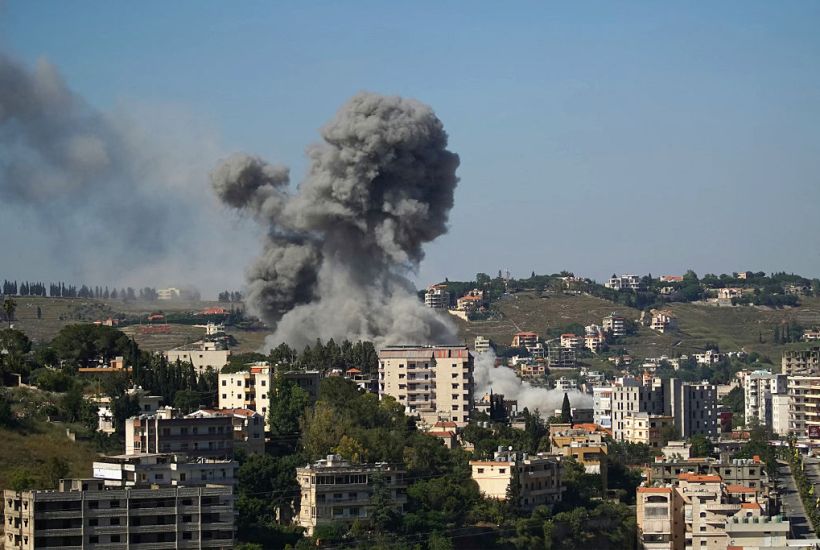
Even before the ink on the agreement between Israel and Lebanon was dry, its opponents began trying to destroy it. Reports emerged of exchanges of fire between the IDF and Hezbollah in southern Lebanon. In Beirut, newly erected ‘Lebanon First!’ signs replacing pro-Iranian messages on the airport road were set alight by Hezbollah supporters. Hezbollah Secretary-General Naim Qassem denounced the agreement as ‘humiliating, disgraceful, and constitut[ing] a surrender of sovereignty,’ insisting instead that ‘the provisions of the Iranian-American memorandum of understanding must be implemented.’ Good. These were the first indications that this agreement’s importance lies far from where much of the early commentary has chosen to look.
For the first time in many years, Washington, Jerusalem and Beirut have jointly established a diplomatic framework that explicitly treats Lebanon as a sovereign state responsible for its own territory
For decades, any serious attempt to understand conflict on Israel’s northern border has eventually led to Tehran. Hezbollah’s military power, its role within Lebanon’s political system, and Iran’s use of the organisation as the cornerstone of its regional deterrence strategy have become so deeply intertwined that Lebanon itself has come to be viewed less as a sovereign actor than as a puppet in a much wider confrontation. The framework signed last night between Israel and Lebanon, brokered by the United States, fundamentally challenges that assumption in clear terms agreed by both states.
There is a temptation to focus on its ceasefire arrangements, phased deployments and technical security mechanisms. Those provisions will determine whether the agreement survives but they do not explain why it matters.
Its deeper significance is political. For the first time in many years, Washington, Jerusalem and Beirut have jointly established a diplomatic framework that explicitly treats Lebanon as a sovereign state responsible for its own territory, its own security and its own decisions of war and peace. Lebanon is no longer Iran’s to negotiate.
Prime Minister Benjamin Netanyahu summarised that objective: ‘The agreement with Lebanon is a very serious blow to Iran and Hezbollah. Lebanon, Israel and the United States are essentially telling Iran that it is none of your business and that you have no involvement and no role.’
That observation deserves more attention than the western media might give it. The agreement matters beyond southern Lebanon, because it redraws the strategic map of the Levant by separating the Lebanese theatre from the Islamic Republic’s wider regional project.
Whether that ambition ultimately succeeds remains to be seen. The agreement will be judged by implementation rather than aspiration, and there are already signs that Hezbollah will resist it at every opportunity. Judged on its own terms, this is a remarkably significant achievement. It advances Israeli security without requiring meaningful strategic concessions, strengthens the principle of Lebanese sovereignty, places the United States firmly at the centre of its implementation, and offers the first credible framework in many years through which Lebanon might eventually emerge from the shadow of Hezbollah and Iranian influence. Read as a whole, it reveals a much more sophisticated strategic logic than much of the early commentary has acknowledged.
This also explains why much of the criticism directed at it misses its central design. Israel is not being asked to surrender its principal military achievements in exchange for promises. On the contrary, it retains almost all of the territory it captured and, according to defence minister Israel Katz, there will be ‘no redeployment by Israel in southern Lebanon, no withdrawal, as long as the terrorist organisation Hezbollah is not disarmed throughout Lebanon.’ Everything else flows from that condition: the phased pilot areas allow the Lebanese armed forces to assume responsibility only after verified disarmament, meaning the framework is designed to expand if it succeeds, and pause if it fails. Israel therefore loses very little while creating the possibility of a fundamentally different security environment.
But military arrangements are only part of the story. The legal consequences may prove every bit as significant. Israel’s continued presence in southern Lebanon would no longer rest solely on military necessity but on terms accepted by the sovereign Lebanese state itself. That makes it considerably harder for external actors to characterise Israel’s presence simply as occupation – or to demand unconditional withdrawal while the agreed security conditions remain unmet. The framework also commits Lebanon to ending hostile political and legal campaigns against Israel, establishes direct dialogue between the two governments under American auspices, rather than through hostile intermediaries, and opens the door to a comprehensive peace and security agreement. It is notable that the United States is the sole broker rather than regional actors frequently viewed in Israel with suspicion, reinforcing Washington’s central role as guarantor of the process.
One feature of the framework deserves particular attention. It is structured to produce gains even if its most ambitious objectives are never realised. In the most optimistic scenario, Hezbollah is progressively disarmed, Lebanon re-establishes sovereign authority throughout its territory, and Israel secures both its northern border and the prospect of genuine peace with a neighbouring state. In the more pessimistic scenario, where Hezbollah obstructs implementation, Israel largely retains the security position it has already achieved while exposing Hezbollah, rather than Israel, as the principal obstacle to peace. That asymmetry is, in my assessment, the agreement’s greatest strength.
There is another assumption it quietly challenges. Israel is once again pursuing a negotiated path where a credible opportunity exists to exchange conflict for enforceable security arrangements. The text states that Israel has no territorial aspirations in Lebanon and provides a pathway towards full withdrawal once its security conditions have been met. Whether lasting peace proves achievable is another question entirely, but the willingness to pursue it is undeniable even by Israel’s most obstinate critics. For those of us who have long argued that Israel seeks security rather than perpetual conflict, this is powerful evidence of that claim. That reality has too often been obscured by ideological opposition to the Jewish state and an unwillingness to acknowledge initiatives that do not fit established anti-Israel narratives.
That shift is already beginning to register internationally. The agreement has been welcomed in Europe and has the potential to strengthen Israel’s standing by demonstrating a proactive commitment to negotiated security and regional stability. Reports also suggest that support within Lebanon extends well beyond one political or religious community, including significant backing among Christian and Sunni constituencies: this cannot simply be dismissed as an externally imposed arrangement.
It also informs a wider debate surrounding the Trump administration’s Middle East strategy. Recent commentary has portrayed Washington’s handling of Iran’s nuclear programme and ballistic missile issues as evidence of retreat. If we can resist the temptation to draw definitive conclusions about the administration’s broader Iran strategy, one possibility remains which is worthy of consideration: that Washington is deliberately buying time through an exceptionally complex strategic period, navigating domestic political pressures and a series of international challenges before confronting Iran more directly should circumstances require it. If President Trump were to lose control of Congress in the midterm elections, the remainder of his presidency could become consumed by domestic political conflict, severely limiting his freedom of action. Securing relative regional stability in the meantime may therefore prove to be part of a broader strategic calculation rather than an abandonment of longstanding American objectives. The jury is still out on whether or not that assessment ultimately proves correct. What this framework already demonstrates, however, is that the United States has not abandoned Israel. On the contrary, Washington remains deeply engaged in advancing Israeli security while simultaneously supporting Lebanese sovereignty and attempting to reshape the strategic balance in the Levant.
None of this guarantees success. Hezbollah has already made clear that it will resist the agreement’s implementation, and the reports of continued exchanges of fire serve as a reminder that military realities will not disappear because diplomats have signed a document.
Diplomacy is rarely vindicated or discredited on the day it is signed. The more useful question is whether it leaves the strategic position of the parties stronger than before. This framework leaves Israel in a stronger position than it occupied, and promises Lebanon a potentially better future, making it worthy of serious attention.
If it survives the inevitable attempts to derail it, historians may ultimately remember this less as a security agreement than as the moment Lebanon formally began to release itself from the shackles of Iranian interference. It is also a clear sign that, whatever Israel’s critics claim, it has always been a state committed to pragmatic peace making whenever genuine opportunities arise.
While the high drama Iran talks have taken centre stage, Lebanon, Israel and America sat down behind the scenes and thrashed out sensible and realistic terms. Israel refuses to surrender to vague utopian fantasies proposed by distant Europeans, but can and does work constructively with genuinely realistic, respectful and powerful allies where it sees the opportunity.