When explaining the dramatic rise of One Nation, surging from just over 6 per cent of the primary vote at last year’s federal election to approximately 25 per cent currently, one reason offered is dissatisfaction with what is seen as a Uniparty system.
The Liberal Party has especially suffered as conservative voters see the once proud party of Robert Menzies mirroring centre-left policies, including climate alarmism, indiscriminate immigration, multiculturalism, and the sort of government statism championed by the ALP.
Voters are also distressed about the increasing cost of living placing unbearable costs on the family budget. Whether the cost of gas, electricity, petrol, diesel fuel, or the cost of putting food on the table, families are breaking under the strain.
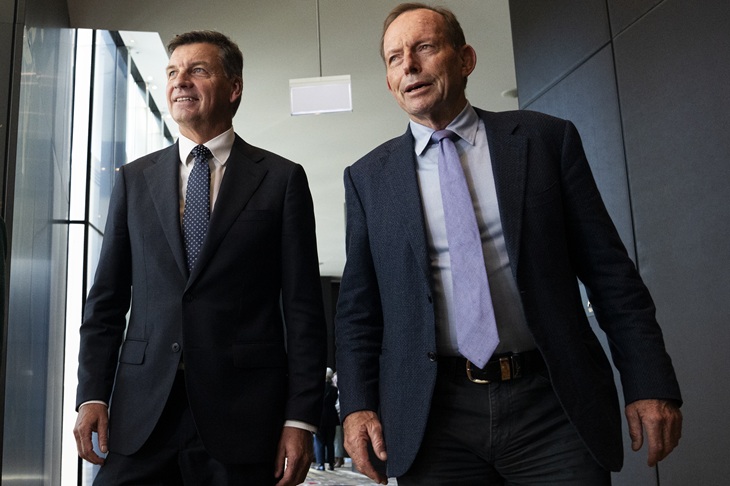
The previous Liberal Leader, Sussan Ley, failed to realise that being Labor-Lite spelt political disaster. Her replacement, Angus Taylor, and the newly elected Liberal Party President Tony Abbott understand what must be done to regain voters’ confidence.
Taylor’s Budget Reply speech, in addition to denouncing the ALP’s deceit (where they mislead voters about negative gearing and capital gains tax), promised to stop unrestricted mass immigration and scrap the Albanese government’s destructive and senseless drive to Net Zero.
In his speech at the Liberal Party’s Federal Conference Tony Abbott, in opposition to cultural-left activists condemning the nation’s institutions and history, proclaimed, ‘We are the freedom party, the tradition party, but above all else we are the patriot party, which is why, at our best, we should be absolutely unbeatable.’
After years of the Liberal Party being dominated by moderates, such as the former Prime Minister Malcolm Turnbull, it’s clear the party is now being led by those committed to centre-right political beliefs and values.
Taylor and Abbott embracing conservative policies should not surprise. Whether the United Kingdom’s decision to leave the European Union, President Trump’s return to power, the rise of centre-right parties in Europe, or the overwhelming vote against the Indigenous Voice to parliament, the political pendulum is moving to the centre-right.
As to why more and more citizens in the UK, Europe, America, and now Australia are embracing centre-right beliefs and values look no further than what the English philosopher Roger Scruton describes as the inherently conservative nature of most people.
Scruton argues ‘the conservative attitude is instinctive’ and ‘being conservative is a distinct way of being human, and in every sphere of life the conservative temperament has staked its claim’. For the majority of people their lives and aspirations centre on family, kinship, community, and a sense of place and patriotism.
In his book Where We Are, Scruton uses the Greek term oikophilia to describe this love and affection for what Robert Menzies terms in his ‘Forgotten People’ speech hearth and home. In opposition to oikophilia Scruton uses the word oikophobia to describe those embracing a ‘culture of repudiation’.
Instead of identifying with family, community, and nation those committed to oikophobia are globalist in perspective, dismissive of the traditional family and critical of those expressing patriotism and valuing what is best about the past.
Those committed to oikophobia are also committed to grandiose, utopian causes like stopping global warming and unrestricted immigration and multiculturalism. Such elites also condemn any who disagree as racist, xenophobic, ignorant, and guilty of supporting populist political parties.
While commentators dismiss One Nation as a party of opposition and explain its success by arguing voters are reacting against Australia’s Uniparty system the reality proves otherwise.
For many years Pauline Hanson has argued against multiculturalism, unrestricted immigration, and against a politically correct, Woke ideology that repudiates rationality, reason, and common sense.
Hanson is welcomed as authentic and One Nation is seen as the antidote to those undermining social cohesion and stability, bankrupting the nation, and turning Australia into what the eminent historian Geoffrey Blainey describes as a nation of tribes.
When explaining why voters are embracing what Scruton terms cultural conservatism it is also true more and more people are fed up with the school curriculum indoctrinating students with a black armband view of history and radical neo-Marxist gender ideology teaching boys can be girls and girls can be boys.
In a 2003 Sydney Institute speech Julia Gillard, then in opposition, argued Prime Minister John Howard was so successful because he was winning the battle of ideas. Gillard argued the ALP must ‘muscle up, for the hard task of winning the culture war and creating a new vision for this nation’.
There’s no doubt over the last 23 years the ALP and the cultural-left more broadly have won the culture wars. The challenge now is for those committed to cultural conservatism to join forces and ensure the unity, peace and prosperity Australians deserve.
Dr Kevin Donnelly is the author of Wake Up To Woke Why Pauline Hanson’s Party Is So Popular.