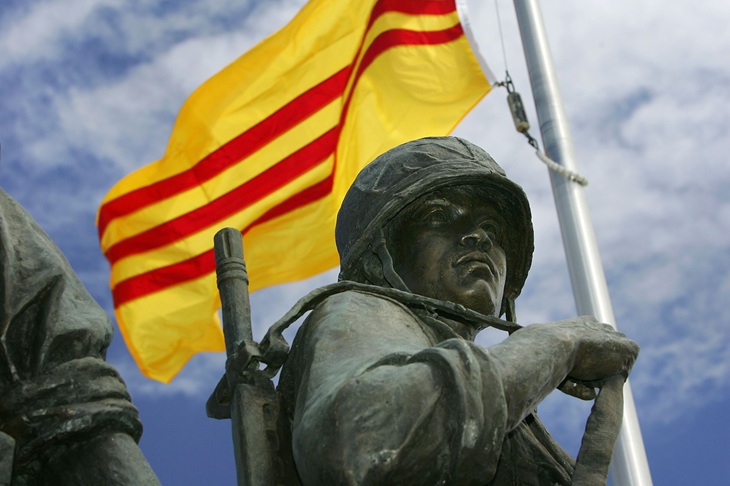
April 30 marked 51 years since the end of the Vietnam War. In Australia, on this anniversary, a group of Vietnamese people gathered outside Flinders Street Station in Melbourne to remember what they call the Fall of Saigon, when the North Vietnamese army rolled into the capital and captured the government of South Vietnam. Meanwhile, outside the State Library of Victoria on Swanston Street, international Vietnamese students gathered to celebrate what they call Liberation Day, when Vietnam was finally united as a single nation we know today.
Two flags were flown that night – the yellow and red striped Republic of Vietnam flag (also known as the ‘Vietnamese Heritage and Freedom Flag’) at Flinders Street and the official Socialist flag of Vietnam at Swanston Street. There was little public commentary about this schism by either the government or media.
While Australia’s role in the Vietnam War is not without controversy, Australia and Vietnam have since built a strong diplomatic relationship as strategic partners in the Pacific, which includes trade and economic agreements. However, the memories of the past still remain from the conflict. There is no denying there were many Vietnamese people who wanted their nation to follow in a capitalist or Western-style democracy and not that of socialism, which North Vietnam led by Ho Chi Minh championed. In fact, Western culture had a strong influence on South Vietnam with, for example, many music groups forming during the 60s and early 70s, producing a unique ‘Saigon’ genre that blended traditional Vietnamese music with American popular music. This music culture was soon lost at the arrival of North Vietnam but has seen a recent revival in new groups.
People who didn’t want to live under the new socialist system became refugees and made for closer shores of nations such as the Philippines but many, no doubt influenced by our presence during the conflict, came to Australia, in search of democracy and freedom. Many carry that loyalty with them still today with, for example, upholding a tradition of protesting out the front of Vietnamese Embassy in Canberra each year on April the 30th.
Each Anzac Day for the past few years, I have witnessed a small group of South Vietnamese ARVN (Army of the Republic of Vietnam) veterans march together in the parade. They always fly the yellow and red striped flag, which is illegal to fly in Vietnam. Family members from the diaspora also march on behalf of their relatives too. These people do this out of shared values with Australian and Western culture and the bond of fighting together in a conflict.
For those like the Vietnamese people who have come to Australia for these reasons, we seem to do a disservice to them when we allow the ideology they fled from allowed to present itself without question, with what occurred in Melbourne on the 30th April.
There seems to be a partiality in this.
For example, in recent years to clamp down on extremism and to assist in promoting what has been labelled ‘social cohesion’, Parliament enacted new laws quickly to make certain symbols, flags, and actions illegal. Most of this ban covered Nazism or extremist Islam. This was a bid to help communities feel safer. At least, in theory. However, it was a measured approach because certain, other equally harmful ideologies, were not considered to fall in the same vein, despite us having diasporas to say otherwise.
When the Vietnamese sought safety and freedom in the borders of Australia and are yet still faced with the images of the communist and socialist ideology they fought against, why is there is no word of empathy for them like there is for other groups that migrated to Australia for safety?
Is there not even a hint of controversy or irony when ‘Liberation Day’ is celebrated in the country that fought against what was once an enemy, and the ideas of the enemy?
Or is that in fact the raising of a middle finger by the pro-socialists to those who see it as a day of mourning?
These questions make one thing clear: in this nation, victims of socialist and communist regimes are not treated with the same levels of empathy as victims of other totalitarian regimes. In Australia, there are many communist and socialist parties that take part in elections and public demonstrations. Whether it’s a labour strike or Free Palestine march, one doesn’t have to go far to see a waving hammer and sickle flag. A symbol banned in many Eastern European nations but has the freedom to shine here. When people had the ability to leave their nations at the collapse of regimes in places like in the Eastern Bloc and the Soviet Union, they were able to settle in a place of freedom. But with that freedom comes a dualism. Seeing a symbol displayed and championed that for many is a sign of authoritarianism and tyranny may certainly convey a perplexing feeling. But for the nation they found solace in to then turn in an attitude of indifference would certainly feel like a slap in the face.