Whenever people cite causes of the global financial crisis, they often blame the era’s macroeconomic imbalances, the same distortions behind the Latin American debt crisis of the 1980s, the Asian Debt Crisis of the 1990s and the Eurozone debt crisis.
While these imbalances are due to a mismatch of domestic savings and investment, they show up in current accounts, the widest measure of a country’s trade in goods, services and income (as well as in capital accounts, the other side of the balance of payments that tracks investment flows.) The imbalances pre-2008 were epitomised by the US current account deficit reaching 6 per cent of GDP and China’s current account surplus hitting 8.6 per cent of output in 2006.
A similar unbalancing is evident today that poses the same risk of a halt in capital flows to deficit countries that presages exchange rate chaos and a financial crisis. Today’s unbalancing often goes by the name of ‘China Shock 2.0’ (where the first China Shock was when cheap Chinese goods abolished Western manufacturing jobs). The updated moniker describes how China’s artificially low yuan and investment-laced industrial policy are damaging trading partners at a greater scale.
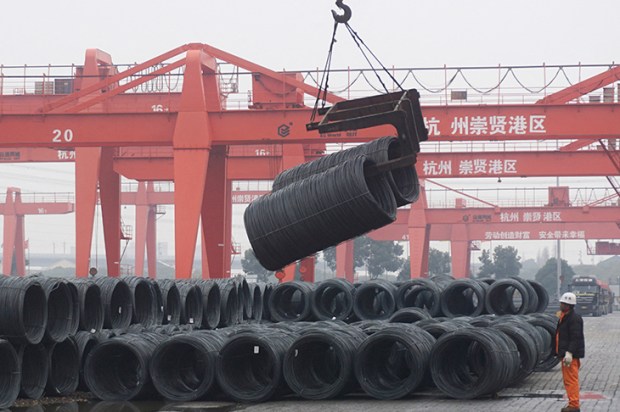
What started as the ‘Made in China 2025’ plan announced in 2015 is now an ‘industry policy of everything’ fuelled by state subsidies the IMF estimates reach close to 4 per cent of China’s GDP. China’s resultant supremacy in advanced manufacturing such as chemicals, industrial equipment and green industries like batteries, electric cars and solar panels propelled the country’s trade surplus to a record US$1.2 trillion last year and drove its current account to a surplus of 3.7 per cent of GDP.
But the blame is not all on China. The US is adding to the unbalanced world by running budget deficits at 6 per cent of GDP – around the level Canberra’s budget shortfall peaked at during the pandemic, to give some perspective of how US federal spending is out of control. Washington’s deficits largely explain why the US current account deficit is close to 4 per cent of GDP.
The IMF calculates (by summing the absolute value of current account surpluses and deficits) that current account gaps across the world’s economies reached 3.7 per cent of global GDP in 2025, which is high by historic standards outside of the mid-2000s.
Countries vulnerable to China Shock 2.0 notably include those in the EU, which recorded a current account surplus of 2.4 per cent in 2025 due to a lack of investment (though Japan and Korea are susceptible too). Many warn China could demolish much of EU’s industrial base in coming years and trigger high employment, recessions and political upheaval.
The French government’s planning agency warns Chinese alternatives that are about 40 per cent cheaper menace about 25 per cent of European exports. The Haut-commissariat à la Stratégie et au Plan says the ‘Chinese steamroller’ threatens up to 55 per cent of European manufacturing output over the medium term – including 70 per cent of Germany’s industrial base. Germany’s current account surplus has halved from its peak of 8 per cent of GDP in 2016, which shows how China Shock 2.0 is diminishing the EU surplus while adding to China’s.
The complication with today’s macro distortions is they are metastasising amid the geopolitical rivalry between the West and China. China’s search for autarky and dominance in key global industries clashes with pushes in advanced countries for secure supply chains and technological supremacy.
The prudent way to reduce these imbalances would be a cooperative approach between deficit and surplus countries as occurred in 1985 when the world’s big economies signed the Plaza Accord to lower the US dollar to re-tilt the world economy.
Under any joint approach now, China would allow the yuan to appreciate to slow the country’s export growth and help boost import growth as part of a shift towards a consumption-driven economic model. The US would reduce its budget deficits and Washington could indicate it is happy for the US dollar to slide. Europe would lift investment.
But geopolitical rivalries rule out a calm and shared adjustment. Beijing is too focused on global dominance to relax its industry policy. A higher yuan would hurt Communist party business interests. Any move to a consumption-driven model would require easing political controls on Chinese citizens who are too insecure to spend anyway. Washington has no will to curb budget deficits and US President Donald Trump boasts about a strong US dollar. European policymakers can’t easily increase private investment when the smallness of EU member countries inhibits economies of scale.
The absence of cooperation means nasty outcomes are more likely. One of these is deeper trade conflict with China. European countries are demanding protection against unfair Chinese trade practices. One of the few issues that unifies US politicians is tougher trade measures against China. Such protectionism, though, hurts Western consumers and adds to inflation. It risks a downturn in China where returns on investments are already being competed away – the ‘involution’ problem that leads to deflation.
Tariffs are a futile response anyway. They are ineffective against macro imbalances because any benefit they might have on current accounts is usually swamped by movements in exchange rates, investment and savings. Note the US last year posted a record trade deficit and the second-highest current account deficit ever despite Trump imposing the highest tariffs since the 1930s.
Another risk to prosperity from non-cooperation is Western countries might further expand state intervention at home to counter China’s. The greatest danger is foreigners, wary of the indebted and spendthrift US government, might stop sending enough savings to the US à la 2008. An unbalanced world is an unstable one.
Deficits and surpluses on current accounts are normal, to be sure, and today’s imbalances are smaller than those of the mid-2000s when collectively current account gaps exceeded 5 per cent of global GDP. But today’s imbalances are large and enduring enough to threaten.
For the record, China’s Prime Minister Li Qiang in June attributed his country’s competitiveness to technological innovation, not state aid. Ha ha.
Australia is a rare country that benefits from China Shock 2.0 to the extent that commodity prices are higher. But it would be damaged in any upheaval.
In many ways, surplus countries such as Germany whose over-reliance on exports helped trigger the Eurozone debt crisis are getting their comeuppance from China’s industry policy.
But that would be little solace if today’s imbalances extend the list of financial disasters that reverberate throughout the world.
Got something to add? Join the discussion and comment below.
You might disagree with half of it, but you’ll enjoy reading all of it. Try your first month for free, then just $2 a week for the remainder of your first year.