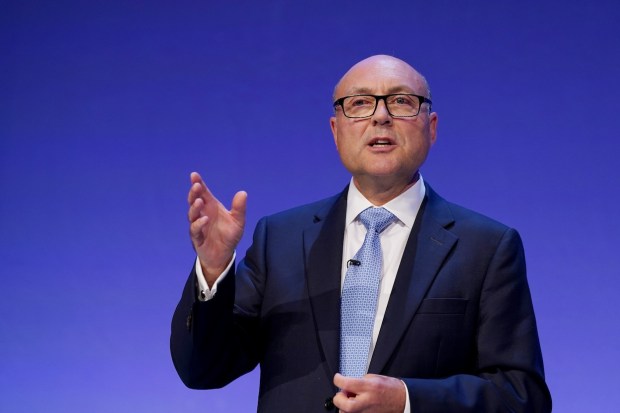
The poor old Establishment! In the 71 years since the expression was first coined in The Spectator, it’s never taken such a kicking. In his speech this week, calling for a by-election in his Clacton constituency, Nigel Farage declared: ‘This will be a people versus the Establishment by-election.’ He added: ‘The Establishment have now decided that they can’t beat us fairly – so they’ve chosen to use foul means.’
Surely Nigel Farage, a fabulously rich, Dulwich-educated MP, and Prince Harry, the Old Etonian son of the King, are the Establishment
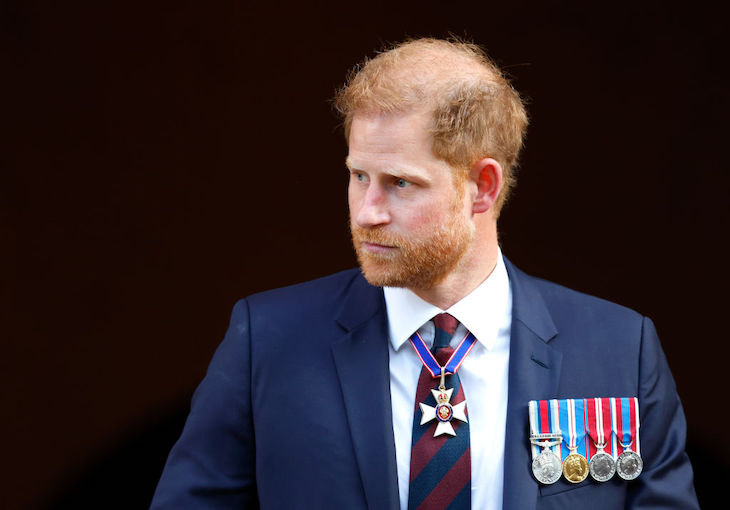
Prince Harry hates the Establishment, too. When he lost his legal challenge over getting government security in May 2025, he described his court defeat as a “good old-fashioned Establishment stitch-up”.
Surely Nigel Farage, a fabulously rich, Dulwich-educated MP, leading Britain’s most successful political party, and Prince Harry, the fabulously rich, Old Etonian son of the King and one of the most-loved princesses in history, are the Establishment writ large.
But their attacks just go to show how the meaning of the Establishment has changed since Henry Fairlie (1924-90) first popularised the term on the Political Commentary page of The Spectator in 1955.
You might say Fairlie himself was a pretty well-qualified member of the Establishment. After Highgate and Oxford, he became a journalist, writing for, inter alia, The Spectator, the Times, the New Yorker and the Washington Post.
He wrote that famous 1955 column to expose how Establishment friends of the Cambridge Spies, Guy Burgess and Donald Maclean, helped them avoid scrutiny.
Fairlie said: ‘The ‘Establishment’ in this country is today more powerful than ever before. By the ‘Establishment’, I do not mean only the centres of official power – though they are certainly part of it – but rather the whole matrix of official and social relations within which power is exercised.
‘The exercise of power in Britain (more specifically, in England) cannot be understood unless it is recognised that it is exercised socially. Anyone who has at any point been close to the exercise of power will know what I mean when I say that the ‘Establishment’ can be seen at work in the activities of, not only the Prime Minister, the Archbishop of Canterbury and the Earl Marshal, but of such lesser mortals as the chairman of the Arts Council, the Director-General of the BBC, and even the editor of The Times Literary Supplement, not to mention divinities like Lady Violet Bonham Carter [the Liberal politician and daughter of HH Asquith, Liberal Prime Minister from 1908 to 1916].’
Fairlie went on to tell the story of Maurice Edelman, a Labour MP who wrote an article about Princess Margaret’s 25th birthday for an American magazine. There was one mildly critical sentence.
When he presented the piece to the princess’s lady-in-waiting for royal approval, he was suddenly summoned to the office of Clement Attlee, the former prime minister. Attlee asked for it not to be published – and it wasn’t. As Fairlie wrote: ‘That was the Establishment at work.’
The expression ‘the Establishment’ had been used in English ever since the late 15th century, but it had different meanings over the years – from ‘income’ to ‘property’ to ‘place of business’. From 1923, it had been used to mean the ‘social matrix of ruling people and institutions’.
But it was Fairlie who first used it in the critical Farage/Prince Harry sense – meaning a powerful group of people who stitch up public affairs for their own benefit.
Peter Cook brilliantly picked up on the expression as the name for his satire and jazz nightclub, which he founded with Nicholas Luard in Greek Street, Soho, in 1961. Cook said it was “the only good title I ever came up with”. The Establishment attracted such great talents as Lenny Bruce, Barry Humphries and Dudley Moore.
For decades, though, the Establishment continued to mean the well-connected, public-school elite, stretching its tentacles though Parliament, the professions and high society.
It’s a new development when that very elite, in the shape of Nigel Farage and Prince Harry, attack an ill-defined Establishment they claim has got it in for them.
In the modern age of mass paranoia, the top dogs think other top dogs hate them. Billionaire Donald Trump, the most powerful man on the planet, is very good, too, at giving the impression there’s a wicked old deep state out there, determined to bring down a president who’s really just a Coke-drinking, McDonald’s-chomping, average Joe.
‘The Establishment’ is a useful term for these poor, misunderstood souls like Farage and Prince Harry – because they never have to define exactly what it means. And it can mean different things to different people. To Prince Harry, it means the Royal Household and the Royal Courts of Justice, which have just delivered a smashing defeat to his case against Associated Newspapers. To Farage, it means, as he said in his speech, ‘Labour, the Conservatives, and the media’.
So we can all concoct an Establishment that’s dead set against us. What’s yours?