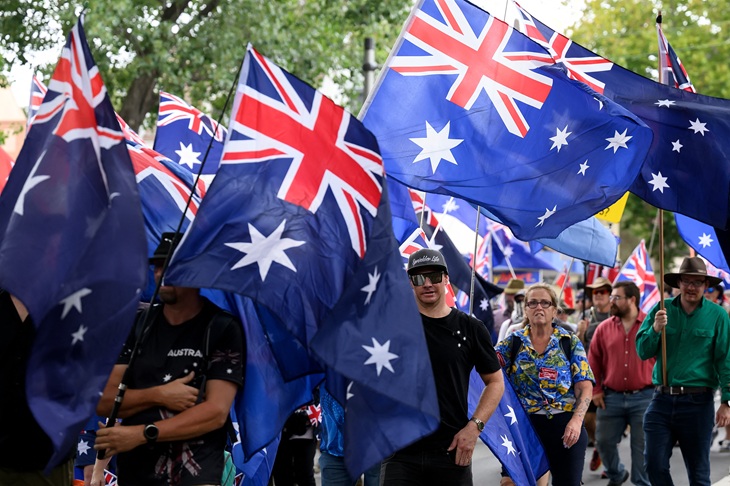
The Australian Bureau of Statistics reported in March that net overseas migration rose to 311,000 in September 2025, marking a two-year increase in migration levels since peaking at a shocking 556,000 in 2023. The present levels of mass immigration to Australia, especially from areas of the planet devoid of a culture of legality and respect for individual rights, lead us to assume that our country may soon witness the same levels of violence and social fragmentation currently taking place in many European countries.
We were recently reminded of this disturbing reality by Liberal leader Angus Taylor.
In his courageous speech at the Menzies Research Centre this Tuesday morning, he flagged an end to a non-discriminatory Australian migration policy, arguing that we must dispense with the ‘naïve thinking’ that holds that all immigrants, regardless of where they are from, will embrace our way of life. As he correctly stated, ‘our nation has paid the price for believing that anyone, from anywhere, will embrace our way of life’. Most importantly, Taylor fully acknowledged:
‘Looking to parts of the UK and Europe, Australians see the erosion of national culture and Balkanisation of communities that has come from immigration policies which haven’t prioritised values. Indeed, Australians are worried we’re on the same disastrous road.’
He went further and boldly expressed this important truth:
‘Not everyone wanting to migrate to Australia has a noble intent. Not everyone waiting to migrate to Australia will be a net benefit to Australia; indeed, many will be a net drain … not everyone wanting to immigrate to Australia will integrate or assimilate … immigration policy under Labor is dominated by the ideology of cultural relativism.’
Of course, the ideology of cultural relativism more commonly goes by the name multiculturalism. And, as this short paper seeks to demonstrate, a determinant factor causing entire countries to fragment into enclaves of ethnicity (and religion) is, undoubtedly, the disastrous ideology of multiculturalism and its socially divisive policies.
The Whitlam government (1972-75) propagated this policy and its then Immigration Minister, Al Grassby, released a policy paper in 1973, A Multi-Cultural Society for the Future. The policy which promotes the existence of multiple cultures in Australia was later sanctified by successive governments of both persuasions.
More recently, the Prime Minister, Anthony Albanese, stated on his official website: ‘Diversity is strength; tolerance is natural.’ The Prime Minister even claimed that multiculturalism promotes diversity and that diversity is a strength. He said:
‘We need to be vigilant. There are some, including some in political life [who] want to turn back the clock to an Australia that is no longer who we are, and we need to call out those people, and we need to continue to cherish our diversity as a strength for our nation, which it is.’
This may be a nice message, but the question is: Is this statement supported by the best historical evidence?
Unfortunately, not. To the contrary, too much ‘diversity’ may become a determining factor of national fragmentation and eventual civil conflict. It naturally leads to the gradual loss of any sense of national identity that causes entire nations to fragment into enclaves of ethnicity and/or religion.
In his seminal book, On Democracy (Yale University Press, 1998), Robert Dahl the emeritus professor of political science at Yale University, identified the underlying conditions favouring the stability of democratic institutions. According to Dahl, among conditions leading to democratic instability are ‘cultural pluralism’ and the lack of commonly shared beliefs. ‘Democratic political institutions are more likely to develop and endure in a country that is culturally fairly homogeneous and less likely in a country with sharply differentiated and conflicting subcultures,’ he writes.
John Gray, a retired professor of politics at Oxford University, contends that democratic societies ‘cannot be radically multicultural but depend for its successful renewal across the generations on an undergirding culture that is held in common’. This common culture, Gray continues, ‘Does demand widespread acceptance of certain norms and conventions of behaviour and, in our times, it typically expresses a shared sense of nationality.’
In truth, of course, multiculturalism has never been simply a fair and impartial understanding of different cultures. The late political scientist, Samuel Huntington, defined multiculturalism essentially in terms of an ‘ideology opposed to Eurocentric concepts of democratic principles, culture, and identity’. Huntington went even further, describing multiculturalism as a socially deconstructionist ideology that is, above all, ‘anti-Western and anti-Christian’.
Due to multicultural policies, for example, Muslims who migrate to Australia have little or no incentive to assimilate into the host society, especially if they come to this country professing an all-encompassing way of life in which the whole of reality falls under the sovereignty of Allah. There will be no desire or incentive for these new migrants to assimilate into the mainstream society, but instead an incentive for them to constantly demand that ‘the host society must change in line with their beliefs, or grant them separate rights and privileges’.
Naturally, most of the Australian Muslims are not radical Islamists. They are not trying to impose a fundamentalist version of their religion. It is deeply regrettable, however, that these individuals, perhaps out of fear of retaliation, comprise a silent majority within the Muslim community. Christopher Caldwell notes that, in Western societies, public condemnation of terrorism by the Muslim community ‘has never been frequent or full-throated enough to assure their fellow citizens’. In their book Shari’a in the West (Oxford University Press, 2010), law professors Rex Ahdar and Nicholas Aroney comment:
‘Since September 11, 2001, governments eagerly awaiting firm denunciations by Muslim community spokesmen of Al-Qaeda terrorist attacks have been consistently disappointed […] the extent to which this silence represents tacit acquiescence and support for the radicals remains a moot point.’
The ignorance displayed by policy makers and politicians when developing the policy is truly astounding because they only consider short-term, transient, and illusory benefits, not the long-term interests of the country. Indeed, a multicultural policy may be attractive, even electorally appealing, destined to promote tolerance of, and respect for, all peoples. But the ignorance of its proponents is seen in their inability or unwillingness to consider the long-term consequences of such a policy. Why?
The proponents of multiculturalism lack an ability or willingness to acknowledge where ‘culture’ comes from. ‘Culture’ is a concept inextricably linked to ‘religion’ because a country’s culture is rooted in and determined by its religion. As properly noted by Rex M Rogers, an American theologian and former president of Cornerstone University (1991-2008),
‘Each culture is a product of its philosophy, and its philosophy is an expression of its religious presuppositions […] religious views are the source of culture. Or put another way, culture is religion externalised. In other words, cultures, like people, are inescapably religious. What worldview(s) a culture embraces influences the inescapably religious enterprises of education, the law, business and economics, government, health care, the arts, and entertainment, and much more.’
Analogously, Essayist T.S. Eliot correctly reminded his readers that ‘no culture can appear or develop except in relation to a religion’. Hence, as the late Professor Philip Ayres once pointed out, ‘Multiculturalism militates against a cohesive nation and encourages ethnic tensions and Islamic extremism in this peaceful country.’
Sir William Holdswoth, commenting on the English legal system, wrote in his seminal History of English Law (1932): ‘Christianity is part and parcel of the common law of England, and therefore is to be protected by it; now whatever strikes at the very root of Christianity tends manifestly to dissolution of civil government.’ And the great expositor of English law in the 18th Century, Sir William Blackstone, proclaimed that, indeed, ‘The Christian religion is a part of the law of the land.’
Equally, the founders of Australia described the new federated country to be a Christian country and understood religious influences shape Australian values and culture, from the most mundane to the most spiritual. For example, at the mundane level, Australia’s Easter celebrations have introduced into our culture a delightful tradition of hunting for chocolate eggs, and people celebrate the Christian feast of Christmas with a colourful display of decorations; it also spawned the ubiquitous tradition of Christmas carols. At the more spiritual or numinous level, Christianity nurtured respect for the rule of law, the adoption of the principle of being guilty only when convicted, respect for life, sexual equality, and compassionate treatment of all people.
Perhaps the Christian value with the greatest implication for democracy in the West is the belief that all human beings, men and women, are created in God’s image and, therefore, must be granted equal rights to life, liberty, and property. Since this ‘rights-based’ tradition was exemplified, formulated, and wrought into the texture of the Western world by Christianity, it is reasonable to assume that these basic rights of the individual might not persist while the religion that gave birth to them has been deliberately undermined. This is so, because, as law professor Jeffrie G. Murphie correctly explains:
‘Values come to us trailing their historical past; and when we attempt to cut all links to that past we risk cutting the lifelines on which those values essentially depend… Thus ‘All men are created equal and are endowed by their Creator with certain unalienable rights’ may be a sentence we must accept in an all or nothing fashion – not one where we can simply carve out what we like and junk the rest.’
But when other religions are introduced in the country, they bring with them different cultural traditions, ‘distinct worldviews with their own unique sets of rights and wrongs, often rooted in a religion or philosophy’, for example, the Hindu practice of sati, the burning of a widow on her husband’s funeral pyre – outlawed by the British in India in 1829 – or the rampant denigration of women.
In Australia, Professor Lauchlan Chipman authored an impressive and influential essay on multiculturalism, The Menace of Multi-Culturalism in 1980. He made a useful distinction between ‘soft’ multiculturalism – the food, dances, and cultural festivals of an ethnic group – and ‘hard’ multiculturalism, which prescriptively seeks to impose rules of behaviour on people. He argued that ‘hard’ multiculturalism:
‘… is not about folk dancing, interesting food, and free-flowing wine. Nor is it about experiments in living and the open-minded, and sensitive quest for improved or alternative lifestyles. It is not just about reinforcing the ‘nice’ or the ‘cute’ or the ‘exotic’ aspects of these cultures as perceived by widely read, widely travelled middle-class Australians. Rather, it is about the preservation of ‘ethnic integrity’, the reinforcement and imposition on the new-born of sets of traditions, beliefs, and values which include, as well as those which are noble and enlightened, some of which are at least as inhuman, as grotesquely ignorant, and as racist, as sexist, and as bigoted as any that can be squeezed from even the most appalling of ockers.’
Professor Chipman’s views on multiculturalism echoed the sentiments of the late British historian Paul Johnson, who said, ‘Multiculturalism has been, and will be, exploited by a few social engineers to dismember the elements of existing societies, especially those of the West with their deep Christian underpinnings and reconstruct them according to new blueprints.’ As such, multiculturalism is an ideological movement opposed to the Western principles of culture and identity.
There are four conclusions that we can draw from the above ruminations. First, culture is linked to and comes from religion. Thus, in attracting immigrants from countries with religions that are antithetical to Christianity, a recipient country will not promote tolerance of different cultures but, instead, will inadvertently promote division.
Furthermore, this also explains why people who do not believe even in a core concept of a religion, may still want to fervently support it. This is because a religion is the repository of the culture in which people operate and live. For example, a Catholic who does not profess to believe in the resurrection – surely a core concept of the religion – may still favour Catholicism/Christianity because it is the embodiment of the cultural traditions of his country. Another example is Richard Dawkins, an atheist, who nonetheless has supported Christianity for its social benefits and admitted to being a cultural Christian.
Above all, the idea that all cultures are equal is manifestly wrong. Indeed, whilst it is not feasible to judge the beliefs and practices of any religion, we can objectively compare the cultural expressions of these religions and draw appropriate conclusions. Hence, the ill-conceived and often quoted remark of the late Pope Francis that, ‘never again can the Christian community allow itself to be infected by the idea that one culture is superior to others’ is as uninformed as it is untrue. Commenting on this issue, Raymond Ibrahim, in an incisive article, was able to write that:
‘All values traditionally prized by the modern West – religious freedom, tolerance, humanism, sexual equality – did not develop in a vacuum but rather are inextricably rooted to Christian principles which, over the course of some two thousand years, have had a profound influence on Western epistemology, society and, of course culture.’
Finally, it is important to consider that the belief that all cultures are equal inevitably favours the adoption of the philosophy of relativism. It also facilitates secularism because it severs the relationship between culture and religion.
We have always felt that multiculturalism was about gaining privileges for ‘ethnic’ groups in Australian society, which would inevitably lead to the creation of Australian tribalism – in effect balkanisation. Put differently, we regard multiculturalism as an ideology that seeks to confer special privileges on designated groups, and the privileges are distributed based on a person’s ethnic allegiances. Indeed, as sociology professor Alvin J. Schmidt correctly points out:
‘Political, economic, and religious freedom can only exist where there is liberty and freedom of the individual. Group rights that determine a person’s rights on the basis of belonging to a given ethnic or racial group, as … advocated by multiculturalists and by affirmative action laws, nullify the rights of the individual. Group rights greatly reduce the freedom of individuals in that their rights stem only from the group; if they do not belong to the group, their rights are greatly curtailed.’
Apart from a few privileged individuals who are recipients of these group rights (legal privileges), the remainder of the community gain very little from the amorphous atmosphere of multiculturalism, save bewilderment and the loss of any sense of national identity. Accordingly, as noted by the late political philosopher, Roger Scruton, ‘If people come from immigrant backgrounds that preserve the memory of a religious law, they will often revert to a religious experience of membership, and define themselves in opposition to the territorial jurisdiction by which they are ostensibly governed.’ What is more, taking into account the contempt for the individual as the primary recipient of rights and obligations, French philosopher Pascal Bruchner comments:
‘The ambiguity of multiculturalism proceeds from the fact that it imprisons men, women, and children in way of life and in traditions from which they often aspire to free themselves. The politics of identity in fact reaffirm difference at the very moment when we are trying to establish equality, and lead, in the name of antiracism, back to the old commitments connected with race or ethnicity.’
Here in Australia this trend towards the protection of group rights (as opposed to individual rights), of course, accelerated in the 21st Century and reached its lowest point in 2023 when the Labor government sought to entrench group rights in the Constitution, based on a person’s race – a characteristic over which people have no control. Now, using the language of Kerry Wakefield, we have entered a world where ‘culture itself is becoming more important than ever, with race, religion, skin colour, and “diversity” new markers of social status’.
But is it a right to seek the unequal distribution of burdens and benefits, thereby emasculating the concept of political equality? Is multiculturalism a viable substitute for ‘integration’? Or, as argued by Ibrahim, is it just ‘another euphemistic way of undermining and replacing the truths of a religion and its culture – namely Christianity – with relativism’?
In answering these questions, one hopes that Australian politicians, when designing its immigration policy, will consider the assumed benefits of multicultural policies and will redefine immigration in terms of cultural stability and cohesion. However, for that to happen, it will also be necessary to rediscover the undisputable roots of Christianity in Australia.
At the National Press Club Address, the Prime Minister spoke passionately about ‘celebrating diversity’ and ‘the multicultural miracle of modern Australia’. Of course, in a certain way he is quite right. It will certainly require a miracle for Australia to survive a radical ideology that is invariably accompanied not only by the undermining of individual rights, but also by moral confusion and then social fragmentation into enclaves of ethnicity.
Augusto Zimmermann is foundation dean and professor of law at Alphacrucis University College. He served as associate dean at Murdoch University. He is also a former commissioner with the Law Reform Commission of Western Australia.
Gabriël A. Moens AM is an emeritus professor of law at the University of Queensland and served as pro vice-chancellor and dean at Murdoch University.