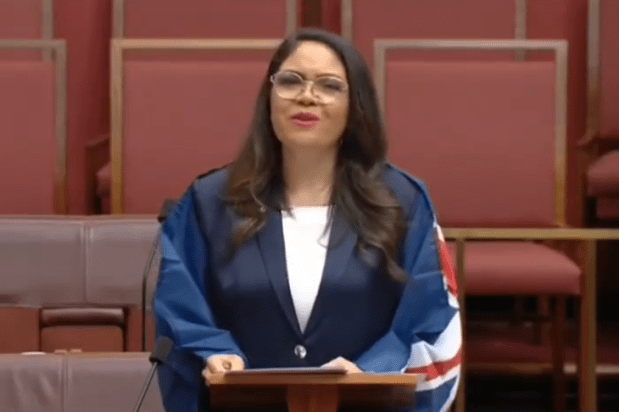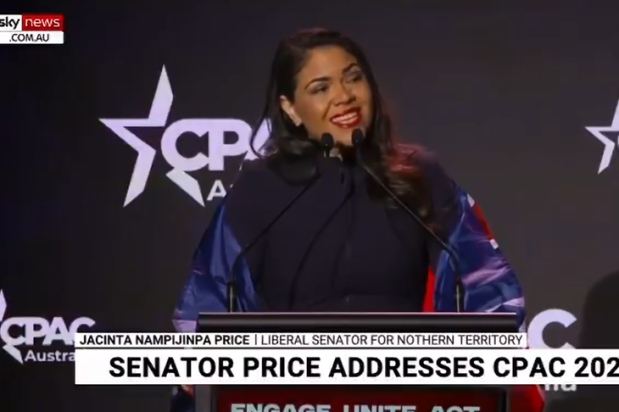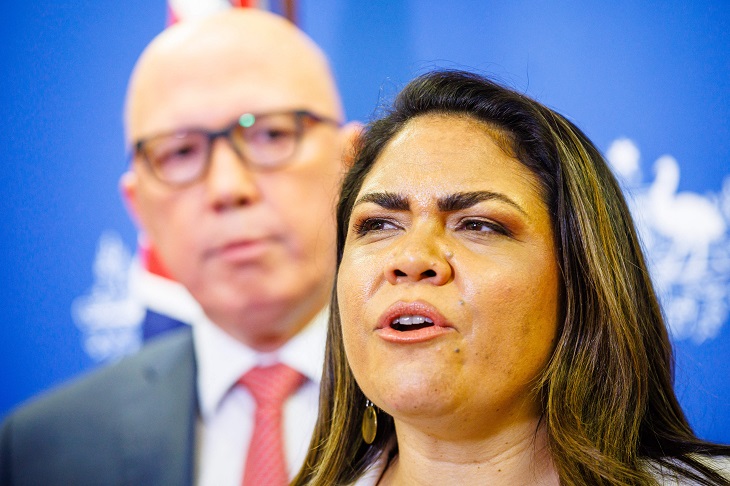
Two years on from the Voice to Parliament referendum, one of the leading figures of the successful ‘No’ campaign, Senator Jacinta Nampijinpa Price, has made the following statement.
When millions of Australians resoundingly rejected the Voice referendum two years ago, their decision preserved our values and democracy.
A constitutionally enshrined Voice was far from a ‘modest request’. It would have been a radical and permanent change to our democratic system.
The Voice would have been a new institution: a fourth arm of national power sitting alongside the Parliament (which makes and changes laws), the Government and public service (which put laws into action), and the courts (which interpret the laws).
The Voice would have had the power to have a say on any area of policy.
Nothing would have been off limits.
And more Canberra-based bureaucracy would have been created to support the Voice, costing taxpayers millions of dollars.
The Voice would have also given one set of Australians a privilege based on their ancestry. It would have divided us by race. It would have undermined the fundamental democratic principle that all Australians are treated equally under the law.
The Voice was far from a ‘gracious request’ too. Activists who championed the Voice called it ‘a black political force to be reckoned with’ and ‘the first step in redistributing power’.
The longer version of the Uluru Statement mentions the goals of ‘self-government’, ‘self-determination’, ‘reparations’ and ‘a financial settlement’.
The worthy goals of reconciliation and rectifying Indigenous disadvantage were not front and centre of the activists’ minds.
They pushed so hard for a constitutional Voice because they wanted power to carry forward an agenda driven by retribution and resentment.
These activists found a useful ally in Anthony Albanese. From the moment he became Prime Minister, Mr Albanese refused to be upfront with Australians about the Voice. And he was incapable of moderation during the referendum process.
He rejected holding a constitutional convention to thrash out his proposal.
He provided no details about how the Voice would function in practice.
He ruled out having separate referendum questions on constitutional recognition and a constitutionally enshrined Voice (the former would have likely passed on its own).
He dismissed calls to road-test the Voice by establishing it through legislation.
When Australians raised reasonable questions about his proposal, the Prime Minister resorted to insults, calling them ‘chicken littles’ and ‘doomsayers’.
When Australians raised legitimate criticisms about the Voice, the Albanese Government accused them of peddling misinformation and disinformation.
And that’s food for thought given the Albanese Government is still seeking to be the arbiter of the truth through its illiberal and censorious misinformation and disinformation agenda.
For the first 16 months of his first term, the Prime Minister was fixated on the Voice referendum. He wasted $450 million of taxpayers’ money as he yearned for his own Paul Keating Redfern moment and to ink his name in the history books.
Mr Albanese should have been focused on Australians’ number-one concern: the cost-of-living crisis. But because he wasn’t, Australians have paid the price for the Albanese Government’s inattention.
Today, power bills continue to soar; so many Australians cannot afford to buy a home, or find one to rent; crime is up in many communities; too many businesses are struggling or closing; and industries continue to move offshore.
Our 45th referendum didn’t simply cause unnecessary division. It also cost the nation and the Australian people.
And Mr Albanese was the author of this dark and divisive chapter in our country’s history. On this 2nd anniversary of the Voice referendum, we remember what the Prime Minister put to the people.
On multiple occasions, Mr Albanese said that he was committed to implementing the Uluru Statement ‘in full’ which included three components. The Uluru Statement states, ‘We call for the establishment of a First Nations Voice enshrined in the Constitution… We seek a Makarrata Commission to supervise a process of agreement-making between governments and First Nations and truth-telling about our history.’
The Prime Minister’s commitment to all three components was evident in the t-shirt he wore emblazoned with the words, ‘Voice Treaty Truth.’
The ‘No’ referendum result wasn’t just a rejection of the divisive Voice. It was also a rejection of divisive treaty-making. It was also a rejection of those activists who have no interest in telling history in the round, but instead, seek to rewrite our past in the most hostile, unforgiving and unbalanced manner imaginable.
The activists have a political goal: to demonise British settlement in its entirety. By falsely claiming our nation was founded on original sin, the activists seek to delegitimise the achievement of modern Australia.
Despite Australians voting ‘No’ to Voice, Treaty and Truth-telling, certain Labor governments and leaders still won’t take ‘No’ for an answer and are pressing ahead with such goals.
Of course, all fair-minded and decent Australians want to see practical improvements to address Indigenous disadvantage. But those improvements will not be achieved by more bureaucracy; by symbolic gestures like the performative Acknowledgement of Country or continuing to use the Canadian-appropriated term ‘First Nations’ in an Australian context; or by acquiescing to activists whose objectives remain reparations and segregation under the guise of ‘treaty’ and ‘truth-telling’.
Real outcomes can only be achieved by getting the basics right. Crime free streets lead to safer communities. Safer communities lead to children going to school. Educated children lead to employable adults. Working adults lead to resources for one’s health and home ownership. And stable homes lead to better lives and better families.
We will also not improve the lives of disadvantaged Indigenous Australians until our country stops romanticising traditional culture.
Within that culture still exists outdated patriarchal beliefs that are still prevalent in many Indigenous communities.
Today, there are Indigenous men who still see women as inferior, who treat women as possessions, and who believe that beating a woman is acceptable behaviour.
The 2nd anniversary of the Voice referendum is a time to speak up with courage and conviction if we are to address Indigenous disadvantage. It’s also a time to reinforce our rejection of division based on race.
The path ahead must be one of unity where we celebrate the achievement of modern Australia which exists thanks to our Indigenous heritage, British inheritance and migrant contributions.
And may we always live by Prime Minister Bob Hawke’s words, ‘In Australia, there is no hierarchy of descent; there must be no privilege of origin.’