The International Health Regulations (IHR) 2005, which finds its roots in the International Sanitary Conference 1851, is a legal instrument ratified by 196 member countries of the World Health Organisation (WHO), endeavours to: ‘Prevent, protect against, control, and provide a public health response to the international spread of disease.’ While its main objective is laudable – concerns arise about the potential erosion of human rights, dignity, and freedoms in its execution – this article provides a critique of these concerns, focusing on its ability to potentially censor information, which can negatively impact the fundamental principles of transparency, accountability, and inclusivity. By no means does this critique purport to be a conclusive and/or exhaustive discourse on the ideological underpinning socially constructing a perpetual state of global emergency, but it does represent the threat to human rights, dignity, and access to timely healthcare without the intervention of non-elected international bureaucrats with little to no accountability of the host nations.
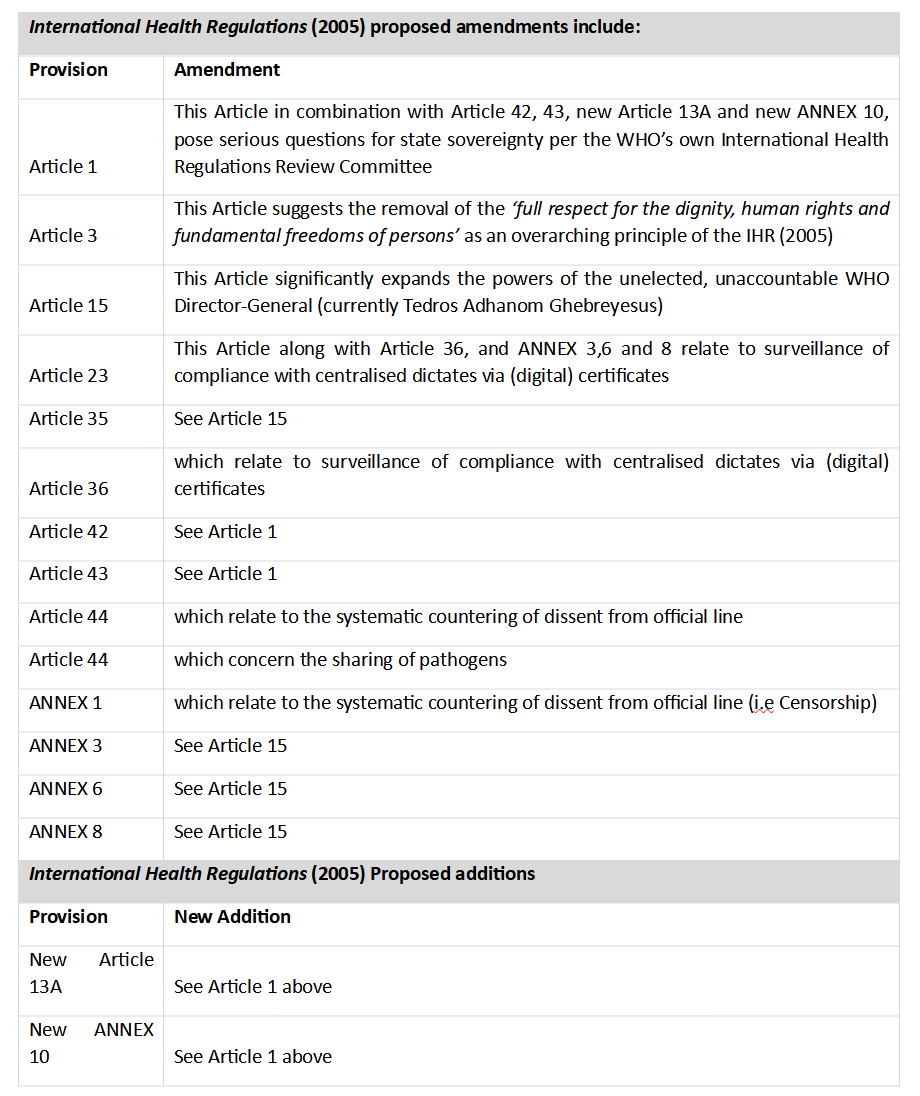
IHR 2005 proposes to grant significant powers to WHO, that could, depending on which version is implemented, allow the institution to take drastic measures to control public health emergencies of international concern (PHEIC). It would have to be ratified by government. If it proceeds, these measures may include restrictions on travel and trade, monitoring individuals, or enforcing quarantines. Such actions, though intended for public health protection, may inadvertently impinge on the human rights of individuals and communities. At first blush, one may indeed be captivated by the emotional spell of idealistic government/state-controlled healthcare, as we had seen during Covid. But more striking was the lack of protections afforded to citizens by those institutions such as the human/civil rights lobbies, selecting instead to follow the Government line. It is not our intention here to reflect on anything more than the failure of institutions to protect the fundamental rights of citizens all over the world.
Mistakes that permitted unelected health bureaucrats to wave their emergency powers infringing fundamental human rights such as:
 Further, the IHR must be viewed in conjunction with the WHO pandemic treaty.
The WHO Pandemic Treaty/Accord Zero Draft is a separate and complementary legally binding treaty which, if adopted, would:
Further, the IHR must be viewed in conjunction with the WHO pandemic treaty.
The WHO Pandemic Treaty/Accord Zero Draft is a separate and complementary legally binding treaty which, if adopted, would:
- freedom to earn a living;
- freedom of movement;
- freedom of association;
- freedom to participate in society;
- freedom to get married;
- freedom of religion;
- freedom of education, and so on.
Further, the IHR must be viewed in conjunction with the WHO pandemic treaty.
The WHO Pandemic Treaty/Accord Zero Draft is a separate and complementary legally binding treaty which, if adopted, would:
- Cede undue authority over global public health to the WHO;
- Create a new cost-intensive, undemocratic supranational bureaucracy;
- Impose an ideological framework called ‘One Health’ for matters of global health, including support for gain-of-function research with pandemic potential pathogens (Article 9.8) and also encouraging a globally coordinated effort to counter public dissent (Article 17);
- Create ‘platforms that promote findable, accessible, interoperable and reusable data [on hazardous pathogens] available to all Parties’ – which would include dictatorships and state sponsors of terrorism, raising security concerns.