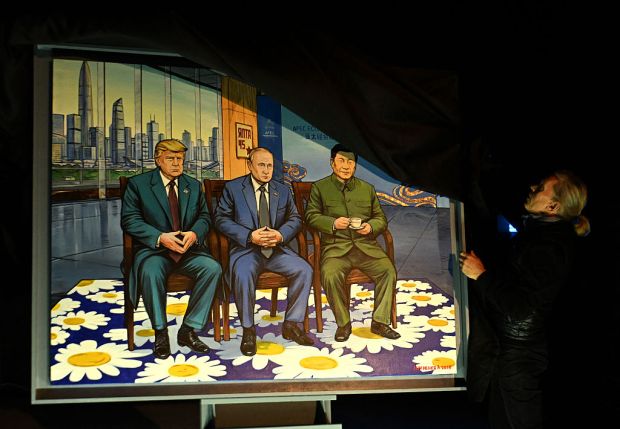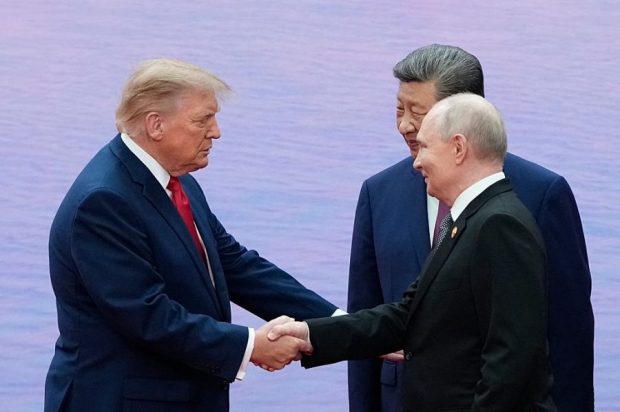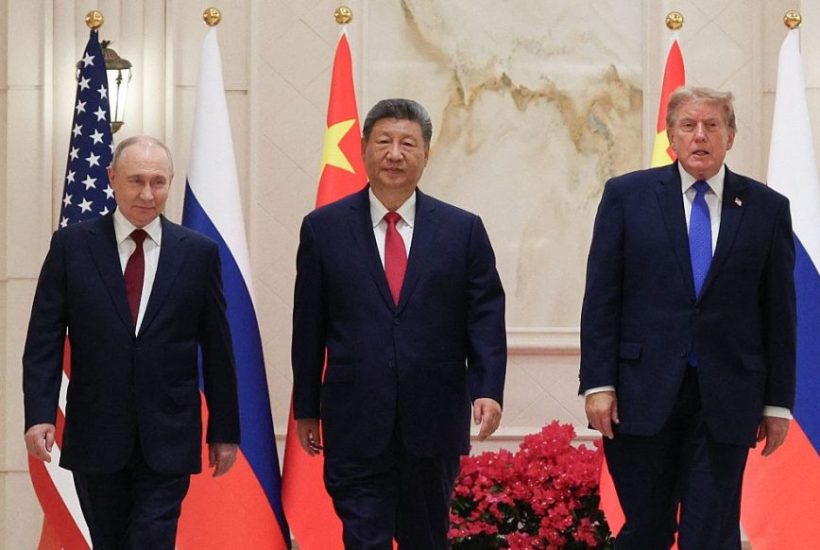
History has been made. In the Chinese city of Shenzhen, on the sidelines of the Asia-Pacific Economic Cooperation (APEC) summit which ended earlier today, Xi Jinping, Vladimir Putin and Donald Trump met as a triumvirate for the first time. The meeting had been dubbed as a second Yalta summit – an attempt by the ‘big three’ to carve up the world akin to how the Soviet Union, US and United Kingdom did in 1945.
Today there were declarations from Putin about the need for ‘constructive cooperation’ to strengthen global stability and resolve global conflicts; calls from Xi to ‘set an example’ to the world, ‘avoid Cold War thinking’ and respect sovereignty; and words from Trump about how Iran should never acquire nuclear weapons, whilst also calling Putin his ‘friend’. Symbolism prevailed over substance, but this worked in Beijing’s favour.
Going into the trilateral meeting, nuclear arms reduction and the Iran war were speculated to be on the agenda. Yet, the shadows of Taiwan, the Nvidia scandal, Sino-US economic tensions, and a nuclear North Korea also loomed. For all the White House’s desires for nuclear arms reduction to take centre stage, Beijing – as the host and writer of the meeting’s agenda – quickly dismissed the prospect. In Beijing’s eyes, trilateral arms control talks are unfair, unreasonable, and unrealistic.
The Shenzhen trilateral united three powers with ongoing mutual suspicion
On the third point, China is correct – and it should know. Beijing has a notorious history of disliking multilateralism, instead opting to practise it à la carte, picking the forums in which it participates to avoid jeopardising its economic and political interests. China may bleat about its self-proclaimed status as a ‘responsible’ nuclear state, and at the summit, Xi himself described nuclear weapons as a ‘sword of Damocles hanging over humanity’. But Beijing has been adding about 100 warheads annually to its stockpile (which stands at approximately 620, far fewer than those of Russia and the US). Ultimately, Beijing has little intention of curtailing its nuclear development and will do so only if Washington goes first. Not only do nuclear weapons bring China status, but the middle kingdom wants to maintain leverage over its most important priority: Taiwan.
Nevertheless, by meeting his ‘old friend’ Putin together with Trump, Xi has signalled to his fellow interlocutors, the Chinese people, and the world, that Beijing’s convening power is real, whether between friends or rivals. The fact that Xi greeted President Trump as Air Force One landed at Shenzhen’s airport epitomised how the Chinese leader wanted to ensure that any talks had China’s interests front and centre. It was a telltale sign of who was in charge of proceedings.
China and Russia’s relationship is frosty, despite Xi’s claims that relations are as ‘steady as a mountain’. Yet, the fact that Xi met Putin for the fiftieth leader-to-leader meeting (prior to Trump’s arrival) demonstrates that their mutual dislike of the West is far greater. The trilateral meeting made only passing reference to the Ukraine war, for which a victory remains essential for Putin’s plan for a new world order. Once again, Beijing was distancing itself from a conflict in which it is a core enabler.
Accompanying the trilateral meeting was proliferation of another kind: speculation as to whether Donald Trump would meet with another ‘friend’, Kim Jong-un. No such meeting materialised between Little Rocket Man and the ‘dotard’ (an insult which Kim first called Trump in 2017). Nevertheless, the US president’s weakened position, following the disastrous mid-term election results, has indeed raised the likelihood for another tête-à-tête.
Not only might Trump now devote greater energy towards consolidating his legacy, of which meeting Kim has formed one key component. What is more, the fact that Russia is providing North Korea with everything it wants, including humanitarian assistance, oil, and much-coveted missile and military technology, might, paradoxically, convince Kim to go all in and respond to Washington’s olive branch. For the North Korean leader: what is to lose?
The North Korean leader, whilst devoting most of his attention to ensuring that Pyongyang benefits from ties with its two allies of Moscow and Beijing, has not completely locked the door on talks with Trump. Kim has repeatedly alluded to his ‘fond memories’ of previous occasions. We must also remember Trump’s desire for a Nobel peace prize. If Kim does meet Trump before he leaves the White House and, in so doing, offers no nuclear concessions, thereby gaining tacit approval of North Korea’s self-declared status as a nuclear weapons state, then he will have emerged victorious. And even though Beijing dislikes being dragged into global disputes, any opportunity to be seen as a diplomatic broker, such as by facilitating Trump-Kim talks, would only further China’s image as a global power, even if in reality, it is anything but a benign one.
Whilst it was unsurprising that the three nuclear powers expounded few details about an arms control treaty, even less so was the omission of Pyongyang. Trump and Xi may have ‘confirmed their shared goal to denuclearise North Korea’ when Trump visited Beijing in May, but Russia and China’s tolerance of its nuclear ambitions remains in contrast to the US’s policy of denuclearisation.
The Yalta summit divided the world between then allies, all of whom shared a common enemy. Today’s Shenzhen trilateral, however, united three powers with ongoing mutual suspicion, for all the rhetoric suggesting otherwise. Xi was correct when he asserted, as the talks began, that ‘We should learn from history’. Indeed, we should not forget the dire consequences of appeasing our adversaries.