Are you getting sick and tired of the limp nonsense coming out of the left? I am.
One leftist article in a leftist rag went on and on about the ‘militarisation’ of Remembrance Day and Anzac Day and the absence of the ‘frontier wars’ in the ‘narrative’.
What really bothers me is that the fearless sons and daughters of Anzacs have a reputation to protect. Meanwhile, the leftists are actively trying to undermine that fearsome reputation among our younger generation.
The Desert Fox, Erwin Rommel, arguably one of the greatest generals in history, wrote of the Australians he encountered, coincidentally on Anzac Day 1941:
‘…some 50 or 60 Australian prisoners were marched off close beside us – immensely big and powerful men, who without question represented an élite formation of the British Empire, a fact that was also evident in battle. Enemy resistance was as stubborn as ever…’
Rommel also described the Australians at Tobruk in 1941 as fighting with outstanding tenacity, with even wounded men continuing to fire.
He reportedly noted in a letter to his wife:
‘The Australian troops are fighting magnificently and their training is far superior to ours.’
My great-grandfather faced him at Alamein in 1942. Rommel wrote:
‘Fierce fighting followed with the Australians, whom we knew only too well from the time of the Tobruk siege, and lasted well into the night.’
Rommel also reportedly ranked Australians highly as individual soldiers while noting they could be rough (especially toward Italians) and potentially difficult to command in very large numbers. (This is something that Anthony Albanese is discovering.)
In the Great War, the Anzacs established a reputation as disciplined and brutal trench raiders. Aggressive patrolling remains an Australian tactic that differs most notably from the approaches of American soldiers.
A ‘clearing patrol’ by US soldiers in the Vietnam War consisted of a platoon letting loose a hail of lead into the platoon’s vicinity. Australians would instead walk the ground, silently, spaced out to avoid casualties from being too bunched together. Much more dangerous, to be sure, but much cheaper for a nation that lacks the logistics capacity of the greatest military force in history. But that’s not what I wanted to discuss.
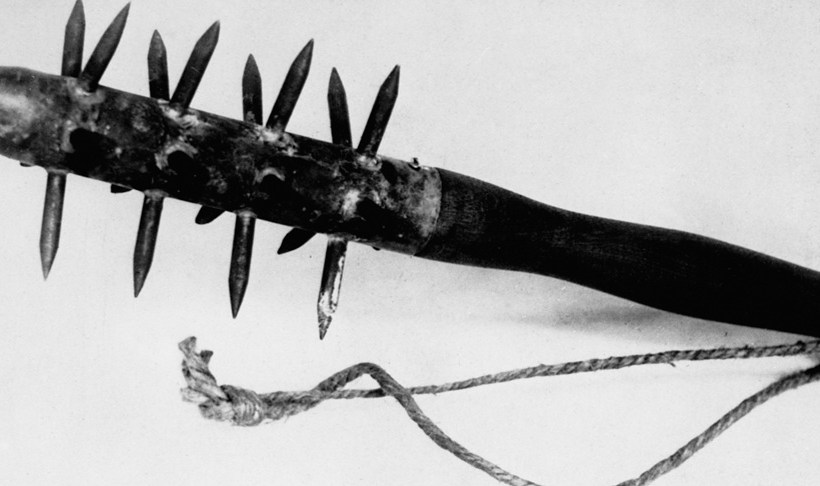
During the Great War, Australian troops conducted trench raids. These were typically small-scale and consisted of 6 to 12 soldiers armed with hand-to-hand melee weapons like nail-studded clubs (known as knobkerries), brass knuckledusters, trench knives, hatchets, and Mills bombs. The idea was to infiltrate the enemy’s trenches, gather intelligence and prisoners, and no doubt to scare the living hell out of the Germans.
The Anzacs would slip out silently under the cover of darkness, creep past barbed wire and forward posts, and breach the enemy lines.
The goal was to disrupt enemy morale, destroy dugouts, sabotage machine-gun nests, gather intelligence documents, and capture prisoners for interrogation before retreating back to friendly lines.
It worked.
Now imagine some modern Australian doing the dirty work of freedom?
Instead, we have leftists wanting to be peaceful while our enemies are taking advantage of our cowardice. Or suggesting that we could have pretended we were not part of the British Empire or now the Free World. Talk about being a free rider!
Sometimes the raiding parties were supported by fighting patrols. I commanded a couple of fighting patrols in training. It was basically a two-section platoon with two MAG58 section machine guns and riflemen. Apparently, the half-platoon fighting patrol concept developed during the first world war with Lewis guns.
(The MAG58 was my favourite machine gun. It is a tool like a crowbar. Hard on the hands and hard to work, yet extremely effective. The infantry battalions I later worked with had them modified with the M60’s bipod. Much more robust than the standard pressed aluminium bipod. But I digress.)
For what it is worth, the fighting patrol has less firepower than a platoon, but it is far more manoeuvrable. Combat power typically consists of firepower, manoeuvrability, and morale. Now imagine you are facing a bunch of enormous Anzacs with nailed clubs, supported by a fighting patrol, and with the moral backing of their families and nation…
When facing these Anzacs, the Germans were in a state of constant anxiety. This night-raiding discipline and brutality continued for decades after. Any wonder Rommel was impressed!
Which brings me to today. I have Facebook ‘friends’ who have made a sport out of being two-tier Facebook police. They defend the recent comments by the UN’s Special Rapporteur on the Rights of Indigenous Peoples. He comes from the Democratic Republic of the Congo and is currently lecturing Australia on ‘embarrassing’ Indigenous incarceration standards.
His own country’s record on violence against women, children, and civilians is exponentially worse than Australia’s, with a far weaker state that is unwilling to address its own problems. Please don’t let me confuse you with my facts!
The Australian left’s critique of the so-called ‘militarisation’ of Remembrance Day and Anzac Day neglects the fact that they can say the things they can because the Anzacs put themselves on the line, and even behind the lines, to preserve their freedom, even to be idiots.
But these two-tier tentacles need to be removed from the story of our Anzacs. And to charges that these commemorative days are supported by ‘unquestionable sacred/religious grandeur (and marked with Christian prayer)’? They’re right.
I doubt there were many atheists in the trenches on the Western Front. Those who didn’t pay with their lives paid with their sanity. War is hell, after all.
Freedom is not retained by people who flinch at the memory of what it once required. If modern Australians cannot stomach the reputation its Anzacs earned, it should at least stop pretending it earned the peace they left behind.
Dr Michael de Percy @FlaneurPolitiq is the Spectator Australia’s Canberra Press Gallery Correspondent. If you’d like to support his writing, please shout him a drink over at Donorbox.