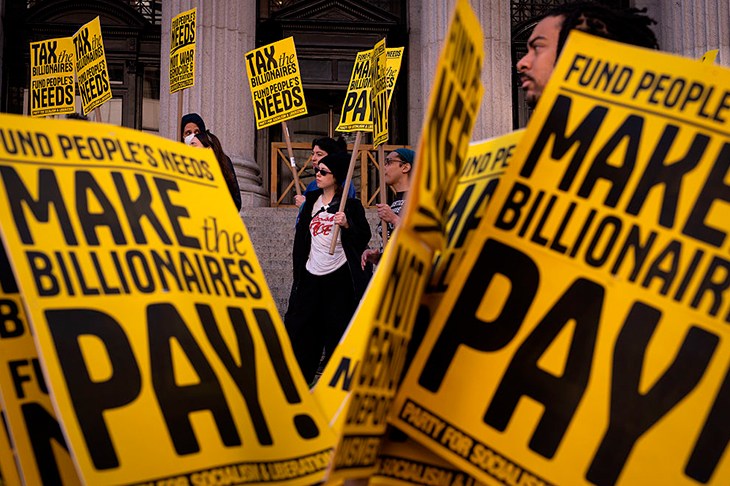
Californians were at least asked. This month they voted on Proposition 40, the Billionaire Tax, and on the Associated Press count they rejected it by 52.3 per cent to 47.7 per cent. Stanford’s Hoover Institution reckons 30 per cent of the tax base had already left the state. Whatever one thinks of the outcome, the voters decided.
Australians are never asked. The biggest tax increase of the Albanese years has never been put to parliament, let alone to the people. It is levied by inflation. Milton Friedman called inflation ‘taxation without legislation’. Canberra has turned his warning into a business model.
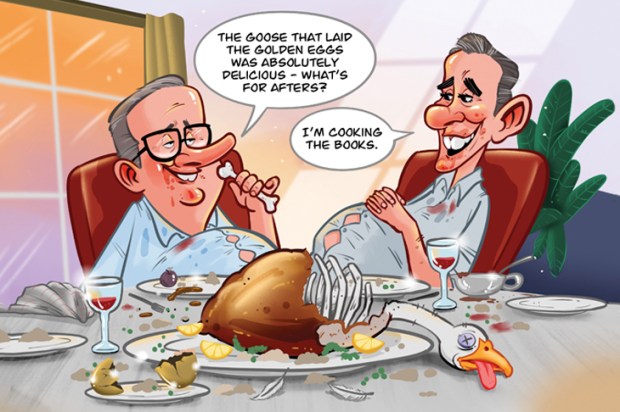
The trick has two halves. The government first helps create the inflation. It then collects the proceeds through a tax system built to capture every price rise and return none of it.
Start with the first half. Public spending has reached a record 28 per cent of GDP. The non-market sector of health, education and public administration produced 93 per cent of jobs growth in the year to late-2025. Westpac estimates that public spending now underpins 40 per cent of all employment. In February the Reserve Bank governor told a Senate hearing that public spending was adding to inflation. Every extra dollar the government spends competes with private firms for the same workers and materials. Prices rise.
They have risen faster here than anywhere comparable. Consumer prices climbed 4.3 per cent in the year to September. That compares with 3.7 per cent in the United States and New Zealand, 3.5 per cent in Britain and 3.1 per cent in France. The government blames world oil prices. Yet the rest of the world pays the same for oil, and has lower inflation.
Now the second half. Inflation lifts wages, prices, interest and asset values alike, without making anyone richer. The tax system treats it all as gain.
The main collector is bracket creep. Our income tax thresholds are fixed in dollars and never adjusted for prices. A worker whose pay merely keeps up with inflation is pushed into a higher bracket. He pays a larger share of an income that has not grown in real terms. America ended this racket in the 1980s by indexing its federal brackets every year. Malcolm Fraser indexed ours in 1976, then dropped it within a few years once he wanted the revenue without a vote.
The result is a tax rise that no Member of Parliament ever voted for. Since Labor took office in 2022, income tax has risen from 14.3 per cent to 15.9 per cent of household income. On the opposition’s figures, the average earner has lost about $2,000 a year of purchasing power to bracket creep. The Parliamentary Budget Office says the average income tax rate is heading to the highest level ever recorded. Each so-called tax cut hands back a slice of this haul. The Treasurer then takes a bow for generosity with our own money.
The GST does the same work quietly. It is a fixed percentage of prices, so every price rise lifts the take automatically. Fuel excise goes further. It is indexed to inflation twice a year. The only tax our government bothers to index is one that rises for its benefit.
Savers are hit hardest. Interest is taxed in full, including the part that merely compensates for inflation. Take a term deposit paying 4.5 per cent, held by someone on the top marginal rate of 47 per cent. After tax the saver keeps about 2.4 per cent. With inflation at 4.3 per cent, the real value of his savings falls every year. He pays tax on a loss. That is not an income tax. It is a levy on his capital.
Capital gains will soon fare worse. This year’s budget scrapped the 50-per-cent discount from July 2027 and restored the indexation abandoned in 1999. That sounds fair, since only real gains are taxed. But those real gains will be taxed in full at up to 47 per cent, with a new minimum rate of 30 per cent and no averaging. That is among the highest capital gains tax rates in the world. A gain built up over a decade is taxed in a single year, so unindexed brackets push it straight into the top rate. Then there is the government’s own debt. Inflation erodes the real value of every bond Canberra has sold. The holders are repaid in debased dollars. That too is a transfer from citizens to the state that no parliament approved.
This is why the clamour for wealth taxes is so revealing. The Greens want an annual 10-per-cent levy on billionaires. The Australia Institute wants 2 per cent a year on anyone worth more than $5 million. Labor tried to tax unrealised gains on superannuation balances above $3 million and retreated only after an outcry. Yet inflation already imposes a wealth tax on every saver in the country. It just does so without the inconvenience of a vote.
All this extraction comes as living standards fall. Real GDP per head is lower than it was in June 2022. The OECD ranked Australia’s fall in real household income per head in 2024 as the worst of any member country. The public sector grows, the private sector shrinks, and households pay the bill twice. They pay higher mortgage rates as the Reserve Bank fights the inflation. They pay higher taxes as the Treasury pockets it.
Consider the incentives. A government that profits from inflation has little reason to fight it. Every point of inflation raises revenue without a hostile headline or a contested Senate vote. The Treasurer can boast of budget repair built on bracket creep while blaming the Reserve Bank for the pain of higher rates.
The fix is simple to explain. Index the income tax brackets to prices every year, as the Americans do. Tax only real interest, and tax real capital gains at a moderate rate. Require parliament to vote on any rise in the real tax burden, in daylight, where voters can see who voted for it.
Californians were given a ballot and said no. Australians deserve the same courtesy. A tax rise worth having should be worth defending in parliament. One that has to be smuggled in through inflation is not worth having at all.
Got something to add? Join the discussion and comment below.
Peter Swan AO is Emeritus Professor of Finance at the UNSW-Sydney Business School
You might disagree with half of it, but you’ll enjoy reading all of it. Try your first month for free, then just $2 a week for the remainder of your first year.