‘My Dear Friend,
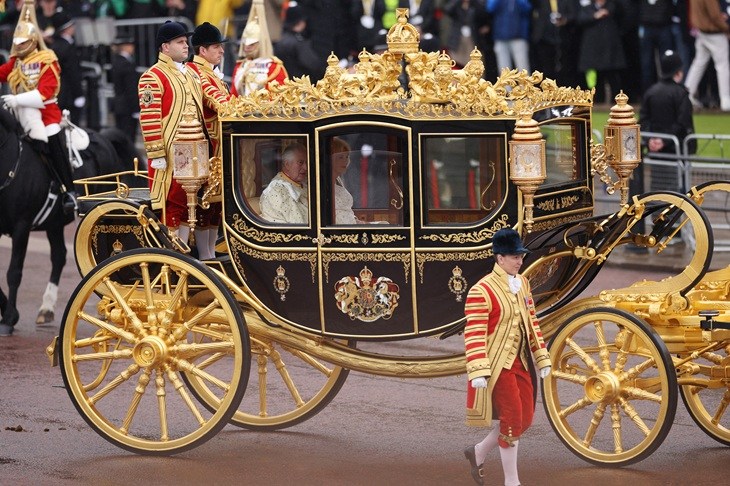
I thought you may like to see the freshly painted coat of arms that is on the front panel of the new coach. I will have two on the doors and one on the front and rear panel.
Will speak soon.
My kind regards,
Jim’
In September of this year, one of the few remaining coachbuilders in the world passed away: the Australian William James Frecklington.
We shall all end up there…
The words were inscribed in immaculate Cyrillic cursive on the wooden casing of a lighter my uncle had given my grandfather for his birthday. Apparently, a flair for originality in the form of devastating existential irony runs in the family. To say I was utterly bewildered as a child would be an understatement. Especially since the two men had a perfectly warm and respectful relationship.
The death of my beloved grandfather – a pilot who taught higher mathematics at an aviation academy – was the first great loss of my life. A part of my world vanished. Later, my uncle arranged for another inscription to appear on the stone coverlet of his mother’s grave – my grandmother, also a mathematician, who taught strength of materials to architecture students. In his characteristic fashion, my uncle had these words engraved on the grave of his mother, my grandmother, whom we all love dearly:
Do not try to live forever. You will not succeed.
George Bernard Shaw
Jim Frecklington is gone. An Australian who built coaches for British monarchs. Jim, my friend, almost the last of his kind – I published an interview with him a few years ago, on coronation day. We had known each other long before that. He usually ended his messages to me with the words: ‘Thank you for being my beautiful friend in Russia.’ Reading those lines now makes me want to cry. He never answered my last message because he no longer could. At some point I sensed that no answer would come, that I would never hear those words again. We will not speak soon. We will not speak even later. Not ever…
It can hardly be the first time you realise – when your mind realises – ‘we will speak soon’ will one day, inevitably, turn into ‘no, we will not’.
And my thoughts kept returning to that absurd inscription on the lighter, so mercilessly right. To the stone coverlet bearing Bernard Shaw’s words. To the student representative of the group of architects my grandmother taught strength of materials, and to the thought that if the teaching assignments had been distributed differently, if she had been given another group, neither I nor these lines would exist. Memory would not relent. It went on, mercilessly:
‘Jim! How could this happen? You were so nearly there! Your finest creation was still ahead of you. And now it always will be. And it will last for centuries! But none of us will!’
Then I hear three shots fired by the honour guard over the grave of an aviation colonel. For the first time since that day, I heard that sound again, more vividly than if it had been real.
The guard is led by my future husband, who happened to be among those firing into the air that very day, paying their respects to the airman. Good Lord! How does any of this work? For some reason memory went on to Bulgakov and his prophetic cry, ‘Master, shelter me beneath your cast-iron overcoat!’ and to the story of how, according to legend, a stone from Gogol’s grave, Gogol whom Bulgakov regarded as his teacher, came years later to rest upon Bulgakov’s own grave.
The memories kept coming. Half an aircraft fuselage stood at our dacha, filled with water, and I used to swim in it in summer. From this improvised swimming pool I watched parachutists floating gracefully beneath their white canopies, presumably enjoying from above the beautiful views of a lake of fresh, drinkable water. The entrance examinations for the aviation academy took place very near our dacha. Grandfather would return from the exams to our country retreat, and I would beg him to let me jump with the parachutists. He would make excuses, citing my insufficient weight. I suggested tying a brick to me so that I would meet the minimum weight requirement. In truth, he was worried about me. He was protecting me.
Only the young believe in immortality. I remembered the taste of new potatoes fried in butter in a cast-iron pan on the outdoor stove my grandfather had built. That smell. That feeling of a carefree childhood, tasting of apples.
Jim and I met in Moscow a very long time ago, seemingly quite by chance. Light-hearted, buoyant, in high spirits, and wearing, I think, a silk dress I had made myself, I was walking through Alexander Garden. My grandmother was not only a mathematician but also a gifted couturière, and she passed on to me some of her skill and her eye for beauty. But that was not quite what caught the attention of the tall, silver-haired foreign gentleman. I was wearing beautiful, open high-heeled shoes. Azzedine Alaïa, I think – no, they were Jimmy Choo after all. The tall, grey-haired stranger approached and complimented my shoes in impeccable English, immediately revealing himself to be a native speaker. Apparently, those extraordinary shoes reminded him of horse tack. The shoes, which I still keep, really do have something of equestrian harness about them: beige leather softly embracing a slender ankle, with metal fittings. They are truly magnificent.
It turned out that my new acquaintance loved horses and beautiful old things, sometimes rather peculiar ones, just as I did. We must have talked for hours while Jim was in Moscow. About horses, creativity, meaning, him, me. About worlds so different and yet so alike. We both adored horses. I recalled learning to ride, and one difficult winter when the horses were left half-starved because the hay delivered in what were called round bales had gone mouldy, and we had to pick through it by hand for the little that was still fit to feed them. As we entered the stables, we heard impatient, insistent hooves striking the iron doors of the stalls. I told him how we steamed oats in an enamel bathtub. How a horse once threw me forward over its lowered neck because I was an uncertain rider, then walked a few steps, came over to where I lay in the sand, carefully placed a hoof on my breastbone and looked me in the eye as though to say: ‘Well, what are you lying there for? Get up! Get back on!’ A stablehand, jealous of a horse I was treating to one of my grandmother’s delicious pastries, remarked something like, ‘Lucky horse. She gets one and I don’t.’
Needless to say, from then on the stablehand received a pastry along with the horse.
Memory brought back a towering, beautifully formed bay stallion called Moryak – whom only one of the male trainers dared to ride. My thoughts returned to the sandy riding arena, with stalls stretching along either side, and a newly arrived mare standing in the middle of that sandy circle. Delicate and refined, with an extraordinarily long, wavy mane and the most beautiful flowing tail, so long it almost brushed the sand.
Jim told me about his childhood on a farm, his workshop, his passion for coaches. About his first carriage and his beloved pony. About how his passion was not the museum restoration of old coaches but building new ones! For the British royal household. Well, naturally. Nothing unusual about that. You stroll through Alexander Garden in beautiful high heels that look rather like horse tack, with a PhD, working in English philology and cognitive science and product design, and loving horses – and you meet an enormous Australian with exquisite English who loves horses too, makes coaches for Her Majesty Queen Elizabeth II, and also adores Fabergé eggs, a book about which happens to sit on your own bookshelf.
We remained friends for many years, never losing touch. I even considered accepting his invitation to visit Australia and the coachbuilder’s workshop. I genuinely admired the work and talent of this great craftsman, and treasured the moments when he would call me on his way home from his ‘workshop’ – his own word for it – and tell me how his day had gone and what interesting thing he had made that day.
Once, two students had the good fortune to overhear one of these accounts, to their undisguised delight.
Jim loved the coaches of the Russian tsars and emperors. He said they were cared for to an exemplary standard and that he would gladly have joined in their restoration. He was studying the workings of a particular component of an old Russian coach in the Kremlin Armoury. I think it was a spring. He explained its name at great length in English – a term I had naturally never heard before – but I understood perfectly well from his explanation what he meant, even though to this day I still struggle to name in Russian the part he wanted to see.
The next time I visited the Armoury, I went in search of the masterpiece and its springs. The small and genuinely elegant coach was indeed graceful and beautiful. It is well known and once belonged to one of the Russian tsars. The museum catalogue photographs, familiar throughout the world, did not show the angle he needed. I approached the coach. Photography was forbidden. I spent a long time studying its underside, which apparently attracted the attention of a guard. We had a pleasant chat. He looked at me, then at the coach, and agreed that it was beautiful.
I still love imagining the Australian coachbuilder in his workshop, drawing inspiration from a masterpiece by Russian craftsmen who had worked for the tsar’s court centuries earlier – and who might conceivably have known someone working for the English court. How fascinating to imagine how coachbuilders exchanged knowledge in those days… I bent over the masterpiece in the Armoury, while at that very moment an Australian craftsman, in his distant workshop, was examining its spring to understand how his predecessors had worked. What a wonderful picture. O brave new world.
Part of a later conversation found its way into our long interview with Jim Frecklington, Her Majesty’s coachbuilder, entitled My Finest Creation Is Still Ahead of Me. We talked for a long time. About life, art, love, coaches, and fate. I remember that conversation, only part of which appeared in print. Naturally we talked a great deal about his coaches, and I suddenly realised how mistaken I had been to place them mentally in the 19th Century. Inside were air conditioning, electric windows, I think, and all sorts of other modern features. A coach drawn by six horses, with inlay, historical artefacts and Rolls-Royce technology. I had expected nothing of the kind. It had never occurred to me to think of them that way! Nor that this encounter would turn into a friendship.
In the interview, Jim explained why such things cannot be made by one person alone: they require the finest craftspeople in their respective fields. His was the finest team. One made the glass, another the interior, a third the frame. Can you imagine a coach with air conditioning and electric windows from Rolls-Royce? And all of it comes together in a single work of art that will last for centuries. The work will endure; its maker will not. But what struck me most was his account of the coach itself being assembled from fragments of historic artefacts – buildings, ships, sometimes even aircraft. Wood from places that had long since passed into history arrived by post in Australia, accompanied by certificates guaranteeing its provenance. Imagine: a man opens a parcel containing a tiny piece of wood perhaps a thousand years old, checks the documents, and finds a place for it in a royal coach. Frecklington called it a time capsule. Except that a time capsule is usually buried, whereas this one can be harnessed to horses and driven down the street.
At eight, he built a little cart for a pony called Black Beauty, who had the infuriating habit of stopping at every obstacle. Then came travels, work in Canada, the royal stables in England. And finally the coaches in which monarchs ride. He was an extraordinarily delightful companion: genuinely sincere, never artificially or ostentatiously polite, and noble in spirit. In all our years of friendship he never once made me feel uncomfortable. My memories of that interview come back in fragments, but I remember an extraordinary sense of wisdom, devotion to his craft and something deeply moving. He may have been the least foreign foreigner fate has ever brought into my life.
At the end of the interview I asked him about a new project whose details we had agreed not to disclose just yet, and which of his completed works he considered his finest.
‘I hope my finest creation is still ahead of me,’ Jim replied.
That became the title of the interview I published on May 6, 2023, coronation day. Now I reread his words. He spoke of working with younger craftspeople who could carry on the work if they wished. He spoke of objects designed, in his mind, to endure for centuries. A man who as a child had built a little cart for a stubborn pony was seriously thinking about what his work would look like several hundred years from now.
He continued building a new coach for the British monarchy. And did not finish it. He came so close.
Meanwhile, in the Armoury stands that very coach whose springs fascinated him so much. Somewhere in Australia remains his first little cart for Black Beauty – he said he kept it in his workshop. There are photographs of the very spring Jim studied to understand how his predecessors worked. But perhaps there is still no collected volume of his work. I urged him so often to bring it all together in a book.
And there is a new coach. The one Jim did not live to finish. The one somebody else will finish without him.
Ostrovskaya, I. My Finest Creation Is Still Ahead of Me. Kompaniya, 6 May 6, 2023.