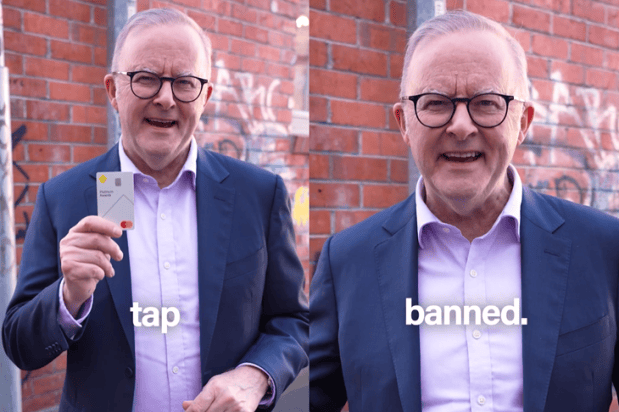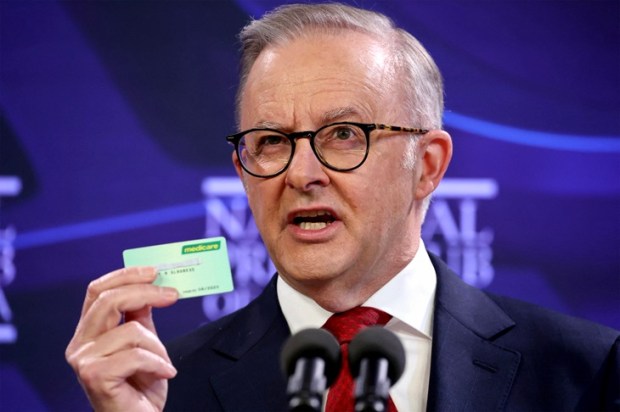
In a classic case of not having a clue, Anthony Albanese has made himself out to be the goose we always knew him to be. Not only did he think that hiding the merchant fee applied to card transactions at the point of sale would reduce the price of a cup of coffee, but his own revenue collection department refused to foot the bill. In my opinion, this is what happens when people who have never been in business or worked a day in their lives get to be in government.
The ban on card surcharges came into effect on October 1. Albanese posted that the surcharge ban would save money ‘every time you tap’ and that ‘from tomorrow, your morning coffee could be cheaper’.
Angus Taylor called it a lie. (More of this, please, Mr Taylor.)
One Sydney roaster said about 98 per cent of her customers paid by card at a 1.3 per cent surcharge and that she would have to raise prices. A café in Perth increased the price of a coffee from $6 to $6.50. Including the old 1.8 per cent surcharge, a card customer had previously been paying about $6.11.
The banks still charge the café a fee every time someone taps. The ban only stops the café adding that fee as a separate line on the docket.
A Melbourne café is reportedly preparing a 50-cent rise on coffee and a $1 rise on a panini, with card fees already over $1,000 a week. Other shops were putting prices up on the first day of the ban.
The Reserve Bank never said the coffee would get cheaper. In its March paper it said that if cafes simply move the old surcharge into the price on the menu, the official inflation rate, the Consumer Price Index, would edge up by about 0.1 per cent. That is because the surcharge never counted in the CPI.
The menu price does. It’s the same money out of the customer’s pocket.
And it shows up in the inflation figures Albanese claims to be fighting. The RBA called it a small, one-off blip, and said customers at those shops would pay much the same as before, only hidden in the menu price instead of printed on the receipt.
Well, no they didn’t. The menus read otherwise. Consumers are paying more.
On a menu, the rounding up on the price is where the surcharge savings go to die.
No café is going to increase a coffee from $6 to $6.11. They will increase to $6.50. So card customers pay 39 cents more, while cash customers pay 50 cents more.
Only a numpty would have thought the ban would work out differently.
Nobody loved card surcharges, but at least you had a choice in how you paid. The trouble is now, if you pay cash, not only are you paying more, but you are cross-subsidising card payers.
In my opinion, there appears to be a disconnect between the Treasurer and his revenue collection agency, the ATO. Either that or the ATO knows a thing or two about economics that Labor fails to comprehend.
On the day of the ban, the ATO announced it will stop accepting credit card payments after November 30. Its reason was that, as a government agency, it would not be appropriate for the cost of credit card merchant fees to be transferred to the community.
So the government tells the café to absorb a fee the Tax Office refuses to absorb, then suggests a coffee might get cheaper. You really can’t make this stuff up!
The coffee is the small version of the same habit. A cost is treated as abolished once it can no longer be seen on the docket. The budget is the same trick, only with a bigger till.
The Coalition’s old rule of thumb was that tax receipts should not sit above 23.9 per cent of GDP. It was never a law. The final outcome for 2025-26 put tax receipts at 24.1 per cent anyway. Spending is a separate measure. Payments are forecast at 26.8 per cent of GDP in 2026-27, against a long-run average near 24.5 per cent since 1970. The Intergenerational Report has that share drifting toward 27.7 per cent, with deficits out for decades.
A government that thinks banning a line on a receipt is cost-of-living relief will also think that taking more than 24 per cent of the economy in tax is a rounding error.
You do not need a theory. You need to have stood on the other side of one. The fee is real. The Tax Office knows it. The café knows it.
The only person who thought coffee would get cheaper was the Prime Minister.
Fewer people would have noticed an increase in the price of brioche. Albo would have been better off saying, ‘Let them eat cake!’
Dr Michael de Percy @FlaneurPolitiq is the Spectator Australia’s Canberra Press Gallery Correspondent. If you’d like to support his writing, please shout him a drink over at Donorbox.