Germany wants to help pay for Britain’s nuclear weapons. Pause on that for a moment.
The country that the non-proliferation regime was partly designed to contain, the country bound by the Two Plus Four Treaty never to manufacture or control atomic weapons, now proposes to invest in the British and French arsenals so that Europe can deter Russia without relying on a United States that may or may not show up.
Friedrich Merz’s government has been in trilateral talks with London and Paris for months. The Daily Telegraph broke the story. The diplomatic logic is coherent enough. The industrial logic, from Canberra’s perspective, is a disaster.
Every nuclear submarine Britain builds, whether it carries ballistic missiles or torpedoes, passes through a single yard: BAE Systems at Barrow-in-Furness. Readers of these pages will recognise the arithmetic.
There is one submarine builder in Britain. One yard. One workforce.
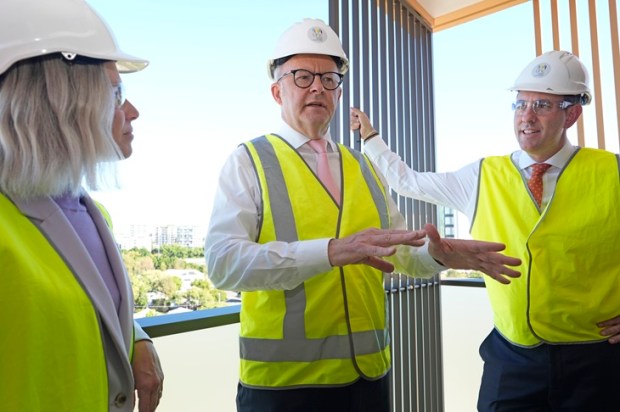
In any other sector a monopoly this complete would trigger a competition inquiry. In Barrow it triggers a royal visit and a hard-hat photograph.
There is no second supplier. There is no slack.
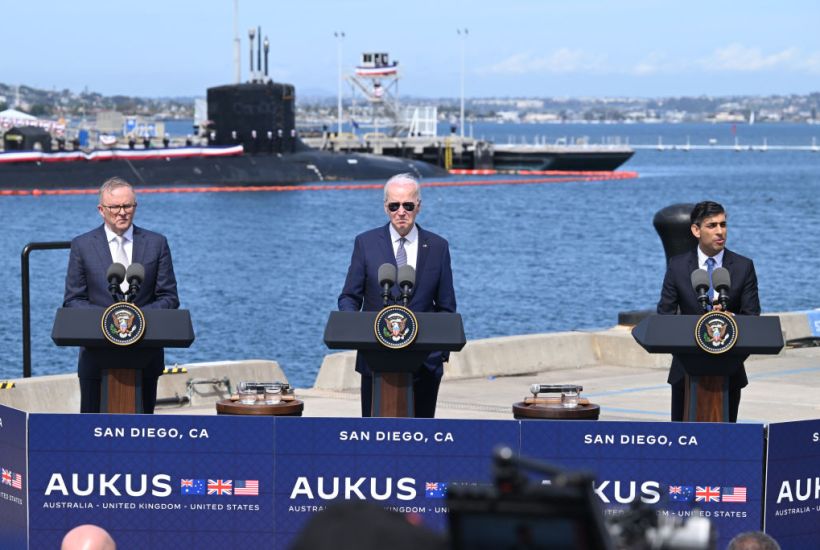
And there are now two concurrent programs competing for the same welders, the same dry dock space, and the same nuclear-qualified engineers: the Dreadnought-class ballistic missile submarines that will carry Trident, and the SSN-Aukus attack boats that Australia is counting on as the backbone of its future undersea capability.
German money does not build a second Barrow. What it does is introduce a competing buyer for the output of the only Barrow that exists.
Australia’s commitment to SSN-Aukus, now running at AUD 8.5 billion for the Osborne shipyard alone, is a bet on the UK’s ability to deliver. The bet pays off only if the British design and propulsion pipeline stays on schedule. Germany’s Trident bid means Canberra is no longer the only country banking on Barrow. Berlin is now placing its own bet on the same constrained facility, for a different purpose. When two customers depend on the same production line and that line has no spare capacity, both get less than they were promised. This is not speculation. It is how monopoly supply works.
The pressure on the system is growing from one direction. European demand for British nuclear capacity is increasing, driven by Russian aggression, by doubts about the American umbrella, and now by German willingness to write cheques. Something has to give. Workforce projections already call for 65,000 defence nuclear workers by 2030, up from 47,600 today. Either the UK expands its industrial base fast enough to absorb the additional demand, which would be historically unprecedented for a country that struggles to crew the fleet it already has, prevent rubber dinghies crossing from Calais or something in the system gives. The most likely candidate, from Canberra’s vantage point, is the SSN-Aukus delivery timeline.
As these pages reported last month, Malcolm Turnbull told a public inquiry that expecting the submarines to be delivered is ‘stark staring bonkers’. The House of Commons Defence Committee warned in April that Britain could not meet its Aukus obligations and maintain its Euro-Atlantic deterrent simultaneously without urgent investment. As of late 2025, not a single Royal Navy SSN was at sea, and four of six boats were in low readiness. HMS Anson was sent to Western Australia in February 2026 for a ceremonial maintenance visit, then abruptly recalled as the United States and Israel struck Iranian targets in late February. The Submarine Rotational Force-West is now pencilled in for 2027, though pencils have erasers.
There is a counterargument worth engaging with. German capital could, in principle, relieve pressure on the UK Ministry of Defence budget, freeing resources for SSN-Aukus. The fiscal arithmetic is plausible. But fiscal arithmetic does not govern submarine production; physical capacity does. Money cannot be substituted for welders. And the political economy cuts the other way: a Germany that is co-investing in Trident will expect a say, formally or otherwise, in how Britain allocates its submarine-building bandwidth. That leverage is unlikely to be exercised in favour of the Indo-Pacific.
There is also the question of France. Berlin’s proposal involves investing in both the British and French arsenals, and how the money divides between the two will matter. If most flows to the Force de Frappe rather than to Trident, the capacity pressure on Barrow is lighter than the analysis above implies. But France’s deterrent is entirely sovereign, built by Naval Group on French soil, meaning German investment there does not compete with SSN-Aukus for Barrow’s finite capacity. It is only the British tranche that loads additional weight onto the production system that Australia depends on. And given that Britain, unlike France, is an Aukus partner with a treaty obligation to deliver, Berlin’s negotiating position is stronger on the British side. That is where the money will do its work.
The revised Aukus pathway announced at the Shangri-La Dialogue in May already reflected adjacent pressure. Australia will now receive all three Virginia-class boats from the existing US Navy inventory rather than getting one from new production, a concession to the reality that American shipyards cannot build Virginia boats fast enough to satisfy both the USN and Aukus. The remaining reactor life in those transferred boats directly determines how forgiving the SSN-Aukus timetable can be. If the British design pipeline slows, whether because Barrow is consumed by Dreadnought, because the workforce is stretched, or because German investment brings political expectations about European prioritisation, the margin for error on the Australian side narrows to the point where the worst case is no longer a stress test but the most likely outcome.
None of this is an argument against Aukus in principle. China is real, geography is real, the Collins class is old. But the gap between brochure and delivery, as this magazine has observed before, is widening.
Australia is now the junior customer in a production system where the seller has acquired a second, better-capitalised buyer with a shorter supply chain and a more urgent strategic rationale. The UK’s ability to walk and chew gum, to sustain a European nuclear deterrent and deliver an Indo-Pacific attack submarine fleet from the same yard, the same workforce, and the same political bandwidth, was already the most consequential assumption in Australian defence planning.
Germany’s chequebook has just made it the most contestable one.