There is a decisive shift occurring in European politics. It’s happening across nations – and parties. It lies behind the far-right Alternative für Deutschland’s victory in the Saxony-Anhalt state election last weekend. And it is the under-reported factor in the close general election being fought in Sweden this weekend. In almost every part of the continent, the politics of crime, security, migration and citizenship is driving governments to harden their borders and toughen their approach towards integration, especially when it comes to Islamism.
On the centre-right, the Austrian Chancellor Christian Stocker has outlined this week that he plans to bring in a ban on what he calls political Islam. The Danish social democrat Prime Minister Mette Frederiksen has been equally robust from the centre-left, saying: ‘The problem is that a major enemy has started to grow from within and it is foreigners who have come to Europe. It is Hamas supporters. It is people who commit terror against European societies. It is people who do not recognise fundamental European values. It is people who sympathise with some of the darkest forces in the world.’
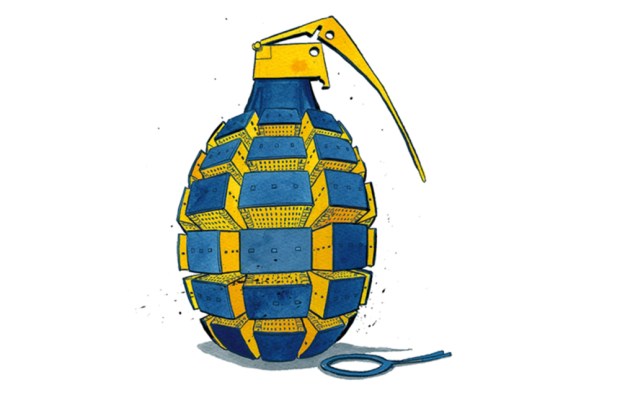
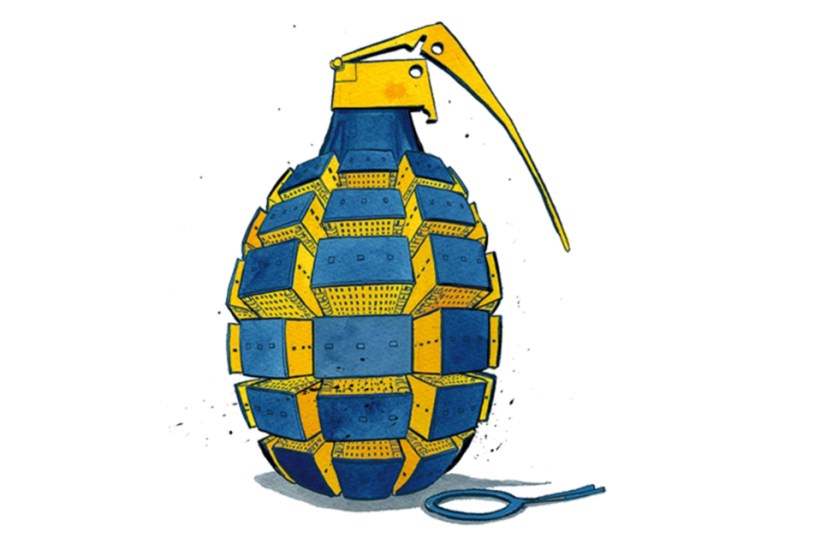
Sweden, once one of the most pro-migration nations in Europe, is now a proving ground for policies to deal with the security questions posed by migration and, in particular, the danger of Islamism. This is because the rise in crime, disorder and social fragmentation had become one of the central questions of Swedish life and politics.
The rise in crime, disorder and social fragmentation had become one of the central questions of Swedish life
Things had become so bad that the Danes used the term Svenske tilstander – ‘Swedish conditions’ – to refer to out-of-control crime in their northern neighbour. In 2021, the German tabloid Bild highlighted statistics that proved Sweden was ‘the most dangerous country in Europe’.
Sweden has gone from being one of the most homogenous societies in the world to a fragmenting polity. In 1960, only 0.1 per cent of the population had one non-European parent. That rose to 4 per cent in 1990 and then leapt to 19 per cent in 2022. In 2015, Sweden took in 162,877 asylum seekers – roughly one asylum seeker for every 60 inhabitants.
Those figures understate the transformation within specific communities. There is profound concern among the Swedish population about ‘parallel societies’ that are physically within Sweden, but not of Sweden. More than 90 per cent of the population of Rinkeby – a suburb north of Stockholm – have a foreign background, with half originating from Africa. Moreover, too many in these ‘parallel societies’ wanted the state’s money, but declined to accept its authority. In areas such as the Rosengard district of Malmo, the local fire brigade would demand a police escort before entering.
This demographic and cultural change brought other problems in its wake. Sweden’s Salafi-jihadist milieu grew from an estimated 200 people in 2010 to 2,000 by 2017, according to the country’s security service. Around 300 people travelled from Sweden to Syria and Iraq to join jihadist groups between 2012 and 2016 – one of the largest contingents per capita in western Europe.
Mohamed Belkaid, an Algerian who came to Sweden around 2009, prepared the Paris attacks of November 2015 from Brussels and was involved in preparations for the Brussels bombings of March 2016; he was subsequently shot dead by Belgian police. Osama Krayem from Malmo, of Palestinian-Syrian descent, was given multiple life sentences for his part in the Paris and Brussels attacks, as well as for his earlier role in the incineration of a Jordanian pilot in Syria in 2015. The Iraqi-born Swedish citizen Taimour Abdulwahab al-Abdaly, who had graduated with a BSc in Sports Therapy from the University of Luton in 2004, carried out a suicide bombing in Stockholm in 2010. Seven years later, Rakhmat Akilov, an Uzbek migrant, drove a stolen truck into pedestrians in the centre of Stockholm, killing five. Later in 2017, the Gothenburg Synagogue was firebombed.
The current centre-right government – working with the populist right in a kind of ‘confidence and supply’ arrangement – has been determined to deal with these dangers. A new National Security Council (NSC) has focused on how to deal not just with a resurgent Russian threat but also, crucially, migration, the ‘parallel societies’ within the country, counter-extremism and foreign influence. The UK could learn from it. It addresses challenges on the home front and performs the kind of coordinating function which the UK NSC does not.
The rise in crime, disorder and social fragmentation had become one of the central questions of Swedish life
That co-ordination has meant developing policy programmes on a range of matters to counter social fragmentation. There has been a focus on addressing honour-based violence – there are three initiatives alone on that topic, with different government departments in the lead, including the criminalisation of virginity tests and virginity certificates. There has also been a strengthening of laws against child marriage and polygamy. Two inquiries have been launched on making Swedish language compulsory for newcomers, including at the pre-school age. Steps have been taken to make deportation more frequent following criminal offending. The government has also tightened requirements for acquiring citizenship.
The Swedish Police Authority – the national constabulary – is mandated to make internal immigration controls a permanent part of its day-to-day operations. Municipalities and other public bodies must notify the Swedish Migration Agency to facilitate the return of illegal migrants. Sweden’s once-generous development aid is now tied to migration policy, making aid conditional on countries cooperating over the return of their nationals. Money for Somalia was redirected to ensure cooperation over forced returns.
On welfare, newcomers’ access to benefits has been restricted, asylum seekers must contribute more towards the costs of their reception and support for migrants is conditional on participation in civic orientation.
The policies have had an effect. Asylum claims are down by 96 per cent over ten years: the lowest levels since 1985. Shootings are down from 391 in 2022 to 158 last year – the lowest in a decade (though bomb blasts have gone up from 136 in 2024 to 189 a year later). Police figures, however, suggest there remain 17,500 active gang members, including 1,700 minors, dubbed by some as ‘child soldiers’. Success in the pushback against Islamist ideology is harder to measure – the sharply reduced immigration numbers help there, too – but funding streams for faith groups that do not fully subscribe to Swedish values are being cut as never before.
Regardless of who wins this weekend, these policies have proven so successful that they are now part of the Swedish consensus. The question is: will Britain follow the Swedish model or refuse once more to learn lessons from abroad?
Got something to add? Join the discussion and comment below.
You might disagree with half of it, but you’ll enjoy reading all of it. Try your first month for free, then just $2 a week for the remainder of your first year.