This summer, the CEO of JPMorgan Chase, Jamie Dimon, bluntly told the American Council on Foreign Relations think tank that Europe was trapped in a high-tax, ultra-regulation model.
‘When [Canadian prime minister] Mark Carney said, ‘The middle powers should get together” – it’s a fantasy. They did that, it’s called Europe,’ Dimon said. ‘The GDP of Europe has gone from 90 per cent of America to 70 per cent. And in our view, it will probably continue to erode over time because of high taxes.’
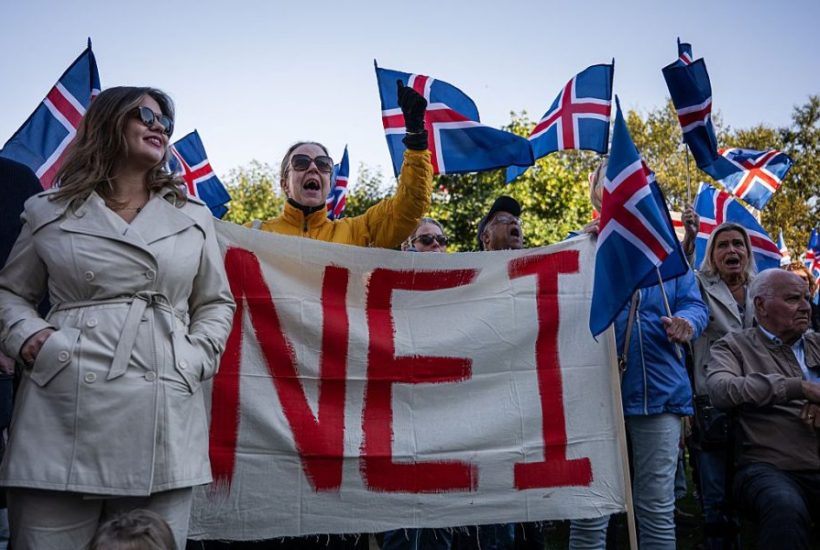
The 27-country European Union’s response to such criticism has been to double down on its bad policies and try to enlarge its membership. On Sunday, their latest attempt came crashing to earth as Iceland’s electorate voted 53 per cent to 47 per cent not to even begin talks on becoming an EU member. Elites in the capital of Reykjavik were the only part of the country to vote ‘Yes’.
In the Iceland referendum campaign, EU backers made big mistakes
Iceland may be home to only 400,000 people, but it has become one of the most prosperous nations in the world. A majority of its voters didn’t see why it should be shackled to a European superstate that could dilute its sovereignty and control over its fishing waters.
EU officials were pinning a lot of hope on Iceland moving towards joining the club. A ‘Yes’ vote would have been ‘an endorsement of Europe’s attractiveness in the world,’ an EU official told Politico. After a Gallup poll showing a three-point lead for the EU side in mid-August turned into a six-point loss on election day, the disappointment in Brussels was palpable. ‘It’s like being rejected by someone you haven’t even asked out,’ another EU official mourned.
What should also worry the EU is which groups were most opposed to the organisation. In June, 37 per cent of people aged 18 to 29 said they were likely to vote ‘No’ and 63 per cent said they were likely to vote ‘Yes’, according to a Gallup poll. By the end of August, however, 60 per cent of young people said they were leaning towards ‘No’ and 40 per cent towards ‘Yes’. If it is older generations nostalgic for an ‘ever closer Europe’ that end up being the core of the EU’s support, its long-term appeal will be limited.
That’s why some clear-eyed figures in Brussels are speaking up in the aftermath of the Iceland vote. Sandro Gozi, a member of the European parliament and secretary-general of the centrist European Democratic party, told the Financial Times that the vote was a ‘warning’ to the EU:
Europe must keep earning trust by becoming more democratic, more effective and closer to its citizens: faster decisions, simpler institutions, less bureaucracy and stronger democratic accountability.
There is, sadly, precious little evidence those lessons are being learned. In the Iceland referendum campaign, EU backers made big mistakes. They were convinced that Donald Trump’s rhetoric about annexing nearby Greenland would panic Icelanders into embracing Europe, but that argument bombed. Iceland remains a Nato member and its 75-year-old defence treaty with the US has never been questioned.
The campaign also revealed some of the EU’s cynical motives for enlargement. Icelanders were not amused when an EU official was quoted saying he hoped Iceland and Montenegro would join at the same time because the financial contributions from Iceland would cover the cost burdens of Montenegro joining. Indeed, a senior EU diplomat confessed to the Financial Times that he was worried that EU membership was being sold as ‘an economic golden ticket for poorer Eastern European states’.
The final mistake was to oversell the EU as a desirable partner. The EU has a bleak near-term future, as recent economic blueprints issued by the former Italian prime ministers Mario Draghi and Enrico Letta have pointed out. Both men say that the EU must overhaul its policies to avoid falling permanently behind the US and China. Hannes Hólmsteinn Gissurarson, a professor emeritus at the University of Iceland, told me it is inexplicable that ‘despite these challenges, the Brussels elite is trying to turn the EU into a federal state, against the wishes of most European voters’.
But the refusal for Europe enthusiasts to compromise and adopt more elements of federalism and decentralisation to steer Europe may have a simple explanation. Enrico Ciappi, a postdoctoral research fellow at LUISS Guido Carli University in Rome, is a firm supporter of the European Union and thinks the Icelandic rejection was ‘wrong and narrow-minded’. But he acknowledged that there is a wide gap between European elites and average voters that needs to be bridged. He says the explanation:
Is almost spiritual and concerns the technocratic identity of Europeanist circles. They believe the show runs better without the noise of the people. But referendums as in Iceland reveal the huge gap between elites and popular opinion.
Indeed, ever since the European Union took on its current form and abandoned its original vision as a club focused on the values of free trade and economic cooperation, that gap has grown. France and the Netherlands voted ‘No’ to an EU constitutional treaty in 2005. Irish voters rejected a more powerful EU twice before accepting the Nice Treaty in 2009 after sweeteners for Ireland were loaded onto it. Switzerland officially abandoned its membership application in 2016. That same year, Britain famously voted for Brexit, taking its 70 million people out of the bloc.
Since then, no other European nation has dared test the sentiment of its people in favour of ‘an ever closer Europe’. Now Iceland has decisively demonstrated that suspicions about the EU’s future course remain deep and ingrained.
Don’t expect another referendum anywhere else soon. Instead, you will see increasing support for ending the EU’s requirement that its major decisions require the unanimous approval of all member nations. It will be claimed the ‘show runs better’ without the noise or approval of dissident members.