In the dusty paddocks of rural Australia, the kelpie does not lead from the front. It does not bark orders or plant itself in the path of a reluctant mob of sheep and demand they reverse course.
Instead, the dog works on the edges.
It presses the flanks, darts along the rear, applies measured pressure at the heels and the shoulders until the entire flock shifts, almost of its own apparent will, in the direction the farmer requires.
The sheep move because the alternative of standing still under that insistent, low-level pressure, feels worse.
The kelpie never needs to drag the lead animal by the throat. Its genius is indirect and cumulative.
Politics has its kelpies too.
They do not always occupy formal positions of power, nor do they issue decrees. They issue statements, predictions, warnings, and half-prophecies that press the flanks of public opinion until the herd of media, investors, legislators, and voters begin to move.
The direction may be temporary, opportunistic, and even counterproductive in the long term. What matters is the short-term outcome.
The Overton Window slides a few centimetres, budgets shift, rhetoric hardens, and the appearance of inevitability does the rest of the work.
Consider a recent example.
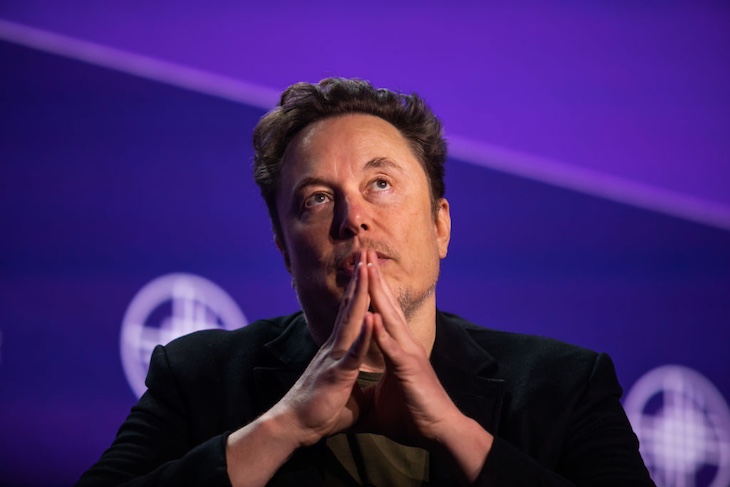
In his interview with The Economist, Elon Musk offered a characteristically blunt assessment of the AI race and China’s prospects within it. Whether he states, as many heard it, that China might come to lead the AI revolution, or merely that Chinese companies face fewer constraints and possess structural advantages in energy and scale, there was arguably an effect.
Stakeholders, such as venture capitalists, defence planners, legislators, and corporate boards heard the concern. A concern that is likely to apply pressure at the flanks of the industry. Social media certainly it up. Was there a similar level of activity in board rooms?
The herd is edging toward heavier public and private commitment to AI capacity.
The kelpie has done its job.
This is not a criticism of Musk. Political kelpies have always existed. Consider the economist whose prediction of decline becomes the justification for new spending. The intelligence official whose assessment of a foreign threat expands domestic surveillance authority. The activist whose framing of an algorithm has become the perfect force multiplier for this style of herding.
In the modern world, when an influential person makes a claim, it travels like a kelpie at full speed. It generates op eds, drives X feeds, ghost-writes emails inside companies and agencies that begin with: ‘We need to respond to this…’
The algorithm does not care if a prediction is accurate. It cares that the prediction moves the flock.
The Overton Window is the conceptual paddock in which this herding occurs. Originally a descriptive tool for mapping a range of ideas considered acceptable in public discourse, it has been weaponised as a deliberate strategy. Slide the window far enough in one direction and policies that were previously considered unthinkable become ambitious. Slide it the other way, and yesterday’s consensus becomes radical.
The political kelpie does not need to occupy the new extreme permanently. It only needs to apply pressure long enough for short-term results to lock in government legislation, regulatory guidance, and corporate strategy.
Once the herd has moved, inertia does much of the remaining work. Reversing course requires more energy than the original shift.
The technique is observed across multiple areas.
On climate, successive waves of ‘last chance’ rhetoric have justified endless renewable projects and subsidy regimes that would have been impossible to get across the line a generation ago.
On technology, the AI safety discussion has swung between utopian abundance and extinction-level risk.
In each case, the kelpie’s pressure is applied, not primarily through casual arguments, but through the feeling of necessity – ‘we need to get a move on or we’ll be left behind,’ ‘let’s act now as the alternative will be worse.’ Guiding political thought in this environment is less about persuasion in the classical sense and more about managing perceived constraints.
Classical rhetoric sought to move the audience by appealing to logos, ethos, and pathos. The kelpie method works by altering the cost-benefit calculation of standing still.
Governments and private corporations do not have to be convinced that China will dominate AI, for example, they only have to be made to fear the political and commercial consequences of remaining complacent while a figure like Musk says it might.
Social media algorithms accelerate the process by collapsing the time between a statement and reaction.
Prior to social media, a provocative claim might take days or weeks to filter through. Today, the same claim can generate measurable market and political movement within hours.
Politicians and executives learn the safest short-term posture is to treat the kelpie’s pressure as authoritative to avoid denialism or weakness. The Overton Window slides not because the majority has been reasoned to a new position, but because resisting a position could harm their reputation more than going along with it.
None of this means predictions should be banned or individuals should self-censor. Open societies require the capacity to hear uncomfortable forecasts. The difficulty arises when the forecast becomes the primary reason for policy movement and when those that should assess the forecast are themselves under pressure to treat it as a prompt.
In the AI case, the correct response to any claim about Chinese leadership is not complacency or panic, but rather discussions about energy infrastructure, manufacturing capacity, research, and the capacity to attract and retain talent.
Democracies must sometimes act under uncertainty and competitive pressures are real. The danger is the path of dependence.
Once the herd has been moved by flank pressure, the new position acquires its supporters, funding, and arguments in its defence. Rolling it back later requires fighting not only the original claim but the government and corporate interests that formed around the response.
The Overton Window does not slide back as easily as it slides open. What begins as a tactical herding move can become a structural feature of the political landscape. Musk’s remarks on China and AI may prove substantially correct, they may prove partially correct. The political effect does not wait for the verdict. The effect arrives when decision makers, hearing Musk’s statement, calculate the cost of under-reacting against over-reacting. The flock moves. The kelpie circles back, ready for the next pressure point.
The Australian kelpie is an extraordinary working dog because it can move large numbers of animals with minimal direct force. Political systems that allow themselves to be moved the same way will eventually discover that the direction of travel is no longer fully under their own control. The pressure on the flanks feels urgent, but the destination may be somewhere else entirely.